QUESTION IMAGE
Question
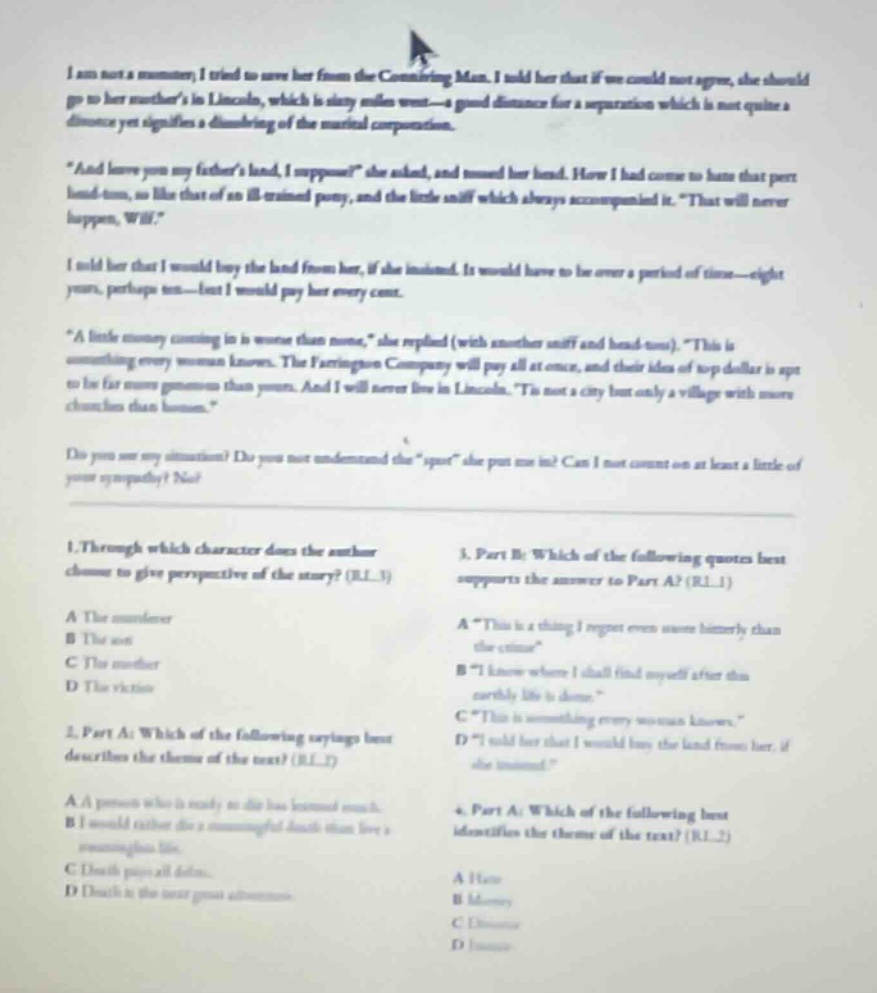
i am not a murderer, i tried to save her from the considering man. i told her that if we could not agree, she should go to her mothers in lincoln, which is sixty miles west—a good distance for a separation which is not quite a divorce yet signifies a dissolving of the marital corporation.
“and i move my fathers hand, i supposed” she asked, and tossed her head. how i had come to hate that pert head-toss, so like that of an ill-trained pony, and the little sniff which always accompanied it. “that will never happen, will.”
i told her that i would buy the land from her, if she insisted. it would have to be over a period of time—eight years, perhaps ten—but i would pay her every cent.
“a little money coming in is worse than none,” she replied (with another sniff and head-toss). “this is something every woman knows. the farrington company will pay all at once, and their idea of top dollar is apt to be far more generous than yours. and i will never live in lincoln. tis not a city but only a village with more churches than homes.”
do you see my situation? do you not understand the “spot” she put me in? can i not count on at least a little of your sympathy, nat?
- through which character does the author choose to give perspective of the story? (rl.3)
a the murderer
b the son
c the mother
d the victim
- part a: which of the following sayings best describes the theme of the text? (rl.2)
a a person who is ready to die has learned much.
b i would rather die a meaningful death than live a meaningless life.
c death pays all debts.
d death is the next great adventure.
- part b: which of the following quotes best supports the answer to part a? (rl.1)
a “this is a thing i regret even more bitterly than the crime”
b “i know where i shall find myself after this earthly life is done.”
c “this is something every woman knows.”
d “i told her that i would buy the land from her, if she insisted.”
- part a: which of the following best identifies the theme of the text? (rl.2)
a hate
b money
c divorce
d justice
- For question 1: The text is written from the first-person perspective of the son, who refers to his father and wife, so he is the narrator giving the story's perspective.
- For question 2: The text centers on a marital conflict over land and separation, with the wife prioritizing money over the marriage, matching the idea of a meaningless, unfulfilling life the narrator is trapped in.
- For question 3: To support the theme of a meaningless situation from question 2, the quote about preferring a meaningful death over a meaningless life directly aligns.
- For question 4: The core conflict revolves around money—the wife choosing the Farringdon Company's lump sum over the narrator's gradual payment, making money the central theme.

Snap & solve any problem in the app
Get step-by-step solutions on Sovi AI
Photo-based solutions with guided steps
Explore more problems and detailed explanations
- B The son
- B I would rather die a meaningful death than live a meaningless life.
- B "I know where I shall find myself after this earthly life is done."
- B Money