QUESTION IMAGE
Question
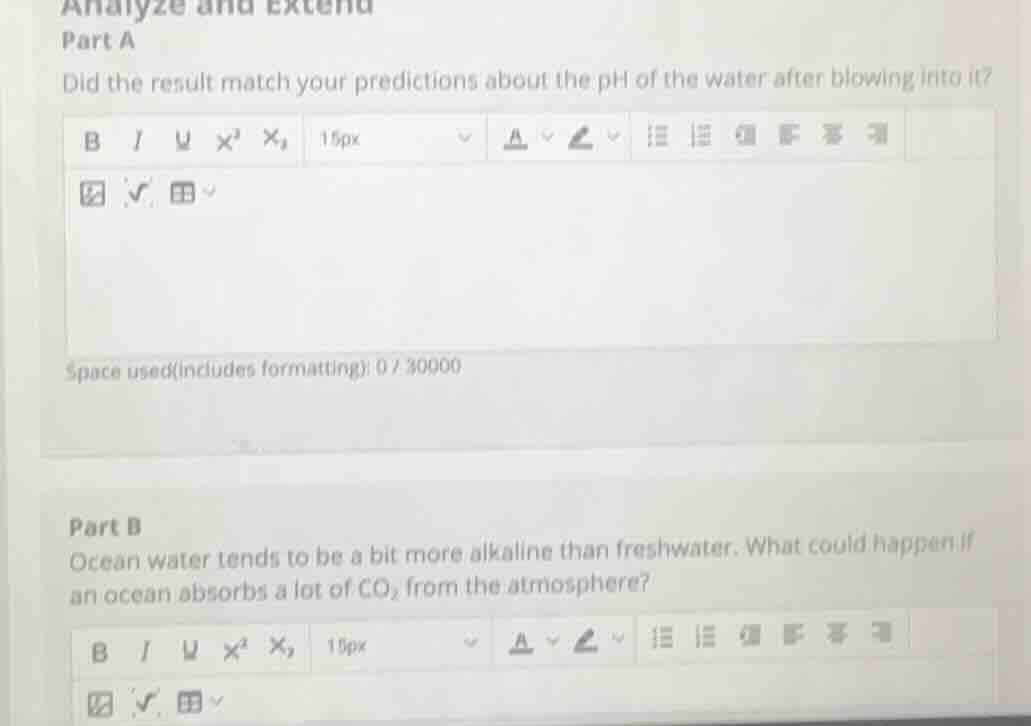
analyze and extend
part a
did the result match your predictions about the ph of the water after blowing into it?
space used(includes formatting): 0 / 30000
part b
ocean water tends to be a bit more alkaline than freshwater. what could happen if an ocean absorbs a lot of co₂ from the atmosphere?
Part A
When we blow into water, we exhale \( \text{CO}_2 \). The \( \text{CO}_2 \) dissolves in water to form carbonic acid (\( \text{H}_2\text{CO}_3 \)): \( \text{CO}_2 + \text{H}_2\text{O}
ightleftharpoons\text{H}_2\text{CO}_3 \). Carbonic acid then dissociates, increasing the concentration of \( \text{H}^+ \) ions, which lowers the pH (makes the water more acidic). If my prediction was that blowing into water would lower its pH (make it more acidic), and the result showed a decrease in pH (e.g., measured with a pH meter or indicator), then the result matched the prediction. If the prediction was different (e.g., no change or increase) and the result was a decrease, they didn't match. Typically, the expected result is a pH decrease, so if that's what was observed, it matches the prediction of increased acidity.
Ocean water is alkaline (pH > 7) due to dissolved bicarbonate, carbonate, and hydroxide ions. When the ocean absorbs \( \text{CO}_2 \) from the atmosphere, the same reaction occurs as in water: \( \text{CO}_2 + \text{H}_2\text{O}
ightleftharpoons\text{H}_2\text{CO}_3 \), and \( \text{H}_2\text{CO}_3
ightleftharpoons\text{H}^+ + \text{HCO}_3^- \). The increase in \( \text{H}^+ \) ions (from carbonic acid dissociation) will decrease the ocean's pH (a process called ocean acidification). This pH decrease (acidification) has several consequences: 1. It reduces the availability of carbonate ions (\( \text{CO}_3^{2-} \)) because \( \text{H}^+ \) reacts with \( \text{CO}_3^{2-} \) to form \( \text{HCO}_3^- \) (\( \text{H}^+ + \text{CO}_3^{2-}
ightleftharpoons\text{HCO}_3^- \)). Many marine organisms (e.g., corals, mollusks, some plankton) use carbonate ions to build their calcium carbonate (\( \text{CaCO}_3 \)) shells/skeletons. With less \( \text{CO}_3^{2-} \), it becomes harder for them to form and maintain these structures, potentially leading to reduced growth, weakened shells, and increased mortality. 2. It can disrupt the physiological processes of marine life adapted to a narrow pH range, affecting metabolism, reproduction, and behavior. 3. It can alter the ocean's chemical equilibrium, impacting nutrient cycles and the overall marine ecosystem.

Snap & solve any problem in the app
Get step-by-step solutions on Sovi AI
Photo-based solutions with guided steps
Explore more problems and detailed explanations
If the prediction was that blowing into water would lower its pH (increase acidity) because exhaled \( \text{CO}_2 \) forms carbonic acid, and the measured pH decreased, then the result matched the prediction. (The specific answer depends on the actual experimental result and prediction, but this is the typical scientific explanation for the pH change upon blowing \( \text{CO}_2 \)-rich breath into water.)