QUESTION IMAGE
Question
analyzing scenarios to calculate probabilities
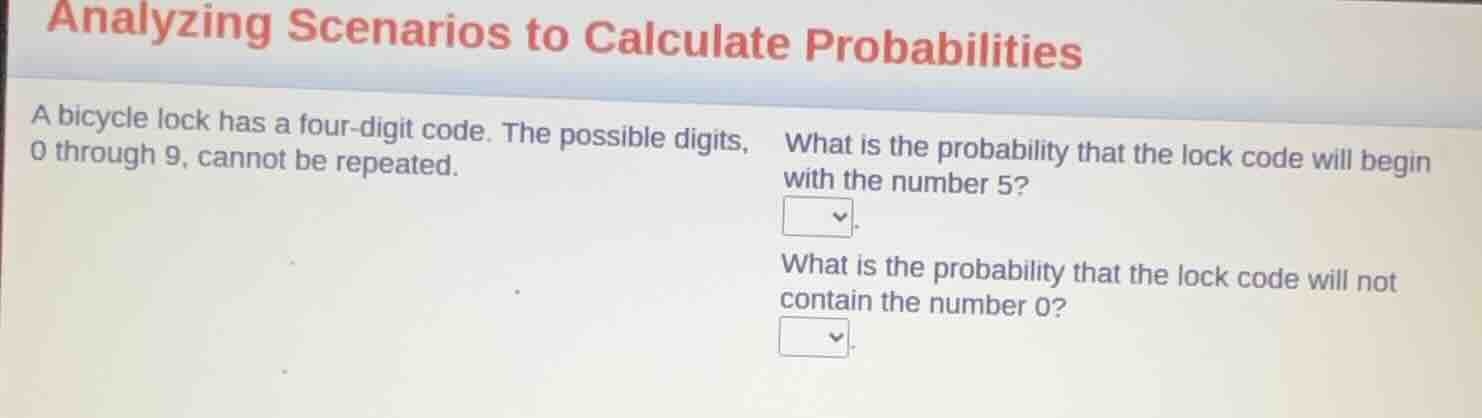
a bicycle lock has a four - digit code. the possible digits, 0 through 9, cannot be repeated.
what is the probability that the lock code will begin with the number 5?
what is the probability that the lock code will not contain the number 0?
Part 1: Probability the code begins with 5
Step1: Total permutations (no repetition)
For a 4 - digit code with digits 0 - 9 (10 digits) and no repetition, the total number of permutations is given by the permutation formula \(P(n,r)=\frac{n!}{(n - r)!}\), where \(n = 10\) and \(r=4\). So \(P(10,4)=\frac{10!}{(10 - 4)!}=\frac{10!}{6!}=10\times9\times8\times7 = 5040\).
Step2: Permutations starting with 5
If the first digit is 5 (fixed), then we need to arrange 3 digits from the remaining 9 digits. Using the permutation formula with \(n = 9\) and \(r = 3\), \(P(9,3)=\frac{9!}{(9 - 3)!}=\frac{9!}{6!}=9\times8\times7=504\).
Step3: Calculate probability
Probability \(P=\frac{\text{Number of favorable outcomes}}{\text{Total number of outcomes}}=\frac{504}{5040}=\frac{1}{10}\).
Part 2: Probability the code does not contain 0
Step1: Total permutations (no repetition)
As before, total permutations \(P(10,4)=5040\) (from part 1).
Step2: Permutations without 0
If we cannot use 0, we have 9 digits (1 - 9) to form a 4 - digit code with no repetition. Using the permutation formula with \(n = 9\) and \(r = 4\), \(P(9,4)=\frac{9!}{(9 - 4)!}=\frac{9!}{5!}=9\times8\times7\times6 = 3024\).
Step3: Calculate probability
Probability \(P=\frac{\text{Number of favorable outcomes}}{\text{Total number of outcomes}}=\frac{3024}{5040}=\frac{3}{5}\).

Snap & solve any problem in the app
Get step-by-step solutions on Sovi AI
Photo-based solutions with guided steps
Explore more problems and detailed explanations
s:
- Probability the code begins with 5: \(\frac{1}{10}\)
- Probability the code does not contain 0: \(\frac{3}{5}\)