QUESTION IMAGE
Question
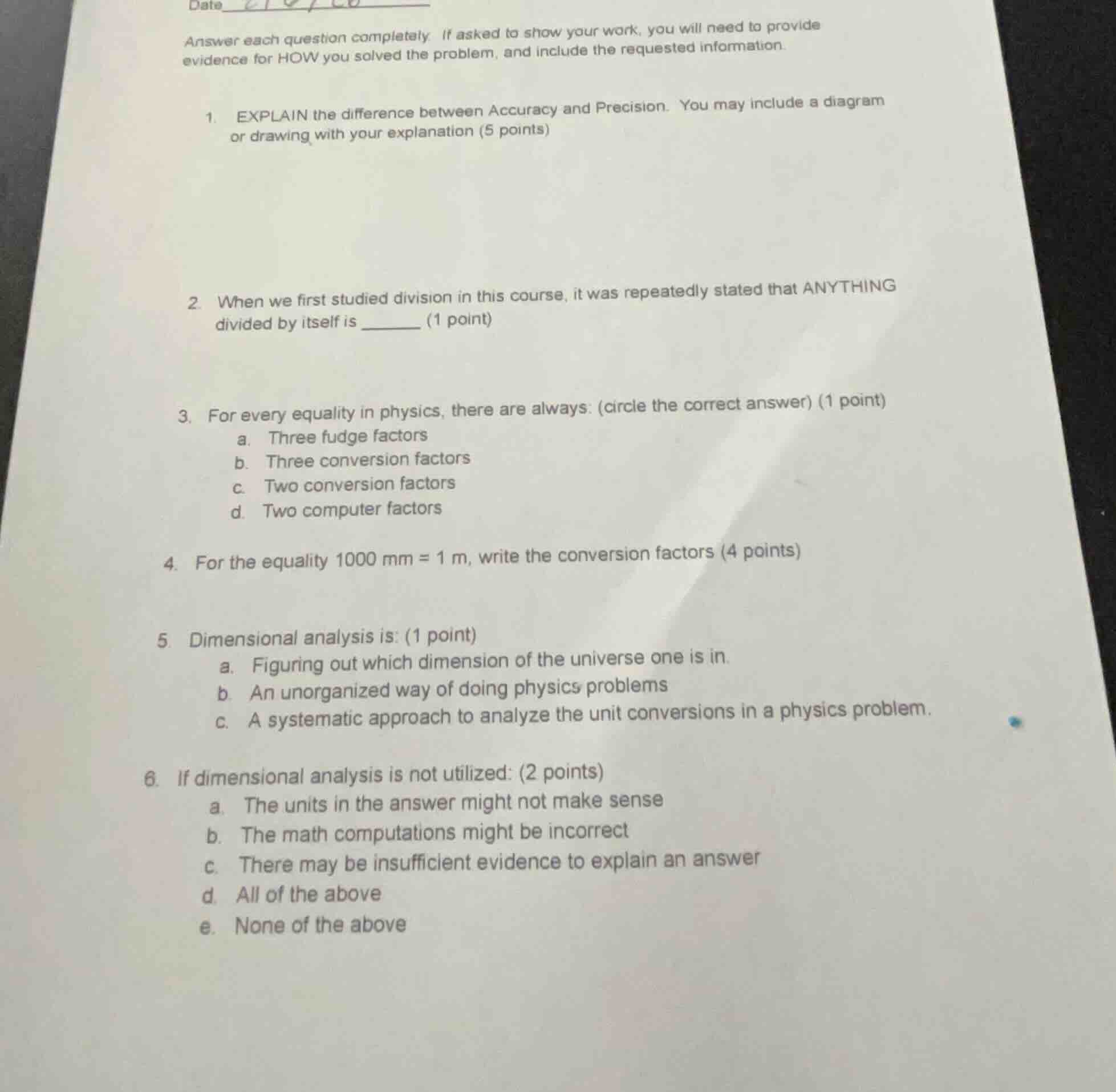
answer each question completely. if asked to show your work, you will need to provide evidence for how you solved the problem, and include the requested information. 1. explain the difference between accuracy and precision. you may include a diagram or drawing with your explanation (5 points) 2. when we first studied division in this course, it was repeatedly stated that anything divided by itself is ______ (1 point) 3. for every equality in physics, there are always: (circle the correct answer) (1 point) a. three fudge factors b. three conversion factors c. two conversion factors d. two computer factors 4. for the equality 1000 mm = 1 m, write the conversion factors (4 points) 5. dimensional analysis is: (1 point) a. figuring out which dimension of the universe one is in. b. an unorganized way of doing physics problems c. a systematic approach to analyze the unit conversions in a physics problem. 6. if dimensional analysis is not utilized: (2 points) a. the units in the answer might not make sense b. the math computations might be incorrect c. there may be insufficient evidence to explain an answer d. all of the above e. none of the above
Question 1
Accuracy refers to how close a measured value is to the true or accepted value. For example, if the true weight of an object is 5 kg, and a scale measures it as 4.98 kg, that's accurate. Precision refers to how close multiple measured values are to each other, regardless of how close they are to the true value. For instance, if a scale repeatedly measures an object as 3.2 kg, 3.21 kg, 3.19 kg, it's precise (even if the true value is 5 kg). A diagram can be thought of as: for accuracy, darts clustered around the bullseye (true value); for precision, darts clustered tightly together (even if not near bullseye).
Step1: Recall the division property
Any non - zero number \( a \) divided by itself (\( a\div a \)) is equal to 1. We also consider the case when \( a = 0 \), but \( 0\div0 \) is undefined. In the context of basic division (usually non - zero numbers in introductory courses), anything (non - zero) divided by itself is 1.
In physics, for any equality (like \( 1\ m=100\ cm \)), we can form two conversion factors. For example, from \( 1\ m = 100\ cm \), the conversion factors are \( \frac{1\ m}{100\ cm} \) and \( \frac{100\ cm}{1\ m} \). So for every equality, there are two conversion factors. Option a is incorrect (fudge factors are not related to basic equalities), option b is incorrect (not three), option d is incorrect (computer factors are irrelevant).

Snap & solve any problem in the app
Get step-by-step solutions on Sovi AI
Photo-based solutions with guided steps
Explore more problems and detailed explanations
Accuracy is closeness to true value; Precision is closeness of measurements to each other.