QUESTION IMAGE
Question
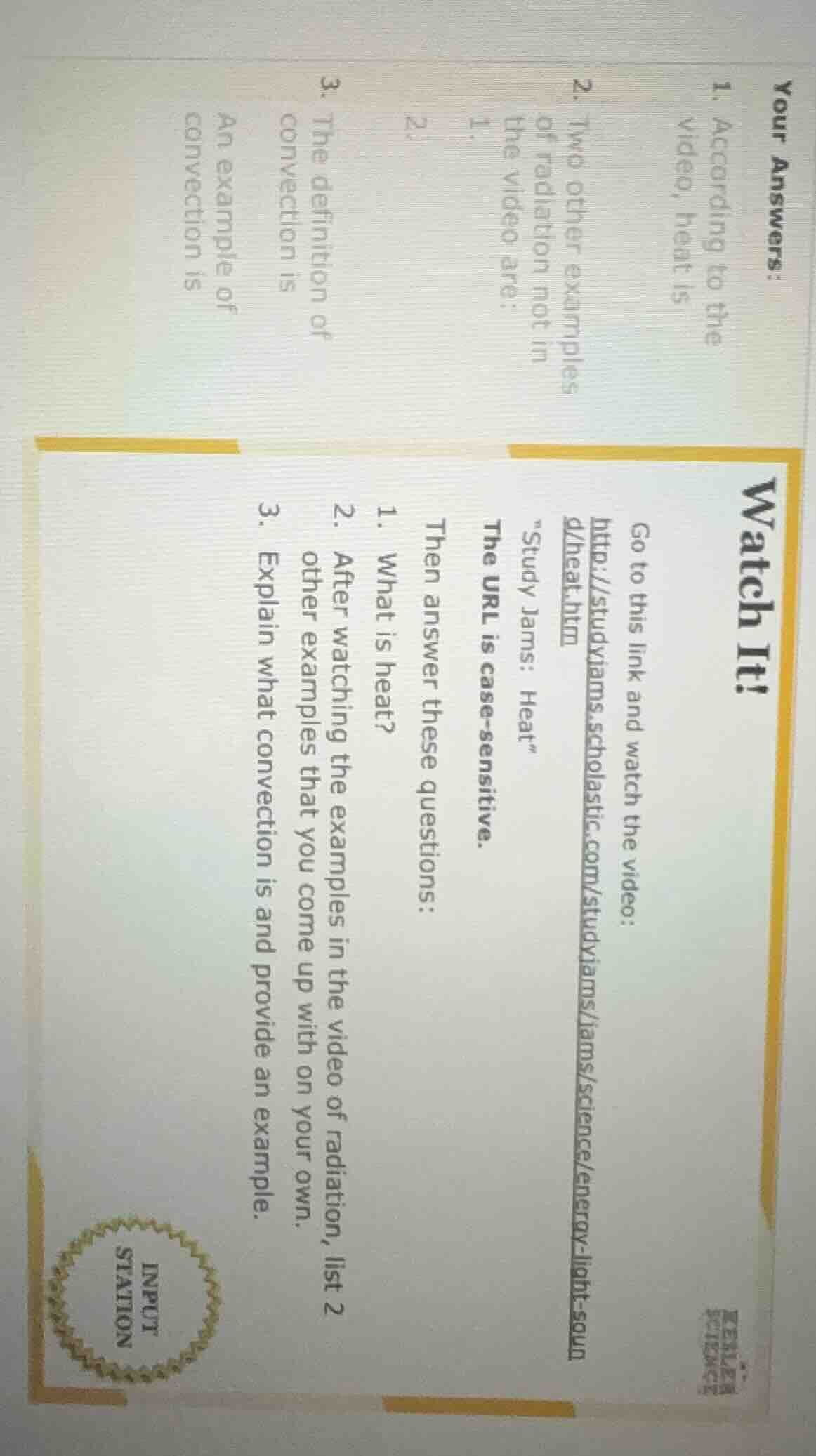
your answers:
- according to the video, heat is
- two other examples of radiation not in the video are:
1.
2.
- the definition of convection is
an example of convection is
watch it!
go to this link and watch the video:
http://studyjams.scholastic.com/studyjams/jams/science/energy-light-soun
d/heat.htm
\study jams: heat\
the url is case - sensitive.
then answer these questions:
- what is heat?
- after watching the examples in the video of radiation, list 2 other examples that you come up with on your own.
- explain what convection is and provide an example.
input station
To answer these questions, we first need to watch the video at the provided URL (http://studyjams.scholastic.com/studyjams/jams/science/energy-light-sound/heat.htm) as it contains the necessary information about heat, radiation, and convection. Here's how we can approach each question after watching the video:
Question 1: What is heat?
After watching the video, we can define heat based on the information presented. Heat is a form of energy that is transferred between objects or systems due to a temperature difference. It flows from a region of higher temperature to a region of lower temperature.
Question 2: After watching the examples in the video of radiation, list 2 other examples that you come up with on your own.
First, recall that radiation is the transfer of heat through electromagnetic waves, without the need for a medium (like air or a solid). Examples from the video might include the sun's heat reaching the Earth, or a fire radiating heat. Our own examples could be:
- The heat emitted by a light bulb (the bulb gets hot and radiates heat in all directions).
- The heat from a microwave oven (the microwaves transfer energy to the food, but the oven also radiates some heat outward).
Question 3: Explain what convection is and provide an example.
Convection is the transfer of heat through the movement of a fluid (liquid or gas). As the fluid is heated, it becomes less dense and rises, while the cooler, denser fluid sinks. This creates a circular motion (convection current) that transfers heat.
Example: Boiling water in a pot. The water at the bottom of the pot is heated by the stove. This hot water becomes less dense and rises to the top, while the cooler water at the top sinks to the bottom to be heated. This movement of the water transfers heat throughout the pot, causing the water to boil. Another example is the air circulation in a room heated by a radiator. The air near the radiator is heated, rises, and is replaced by cooler air, which is then heated, creating a convection current that warms the room.
Since the video is required to answer these questions accurately, make sure to watch it to get the specific examples and definitions provided there, and then supplement with your own examples as needed.

Snap & solve any problem in the app
Get step-by-step solutions on Sovi AI
Photo-based solutions with guided steps
Explore more problems and detailed explanations
To answer these questions, we first need to watch the video at the provided URL (http://studyjams.scholastic.com/studyjams/jams/science/energy-light-sound/heat.htm) as it contains the necessary information about heat, radiation, and convection. Here's how we can approach each question after watching the video:
Question 1: What is heat?
After watching the video, we can define heat based on the information presented. Heat is a form of energy that is transferred between objects or systems due to a temperature difference. It flows from a region of higher temperature to a region of lower temperature.
Question 2: After watching the examples in the video of radiation, list 2 other examples that you come up with on your own.
First, recall that radiation is the transfer of heat through electromagnetic waves, without the need for a medium (like air or a solid). Examples from the video might include the sun's heat reaching the Earth, or a fire radiating heat. Our own examples could be:
- The heat emitted by a light bulb (the bulb gets hot and radiates heat in all directions).
- The heat from a microwave oven (the microwaves transfer energy to the food, but the oven also radiates some heat outward).
Question 3: Explain what convection is and provide an example.
Convection is the transfer of heat through the movement of a fluid (liquid or gas). As the fluid is heated, it becomes less dense and rises, while the cooler, denser fluid sinks. This creates a circular motion (convection current) that transfers heat.
Example: Boiling water in a pot. The water at the bottom of the pot is heated by the stove. This hot water becomes less dense and rises to the top, while the cooler water at the top sinks to the bottom to be heated. This movement of the water transfers heat throughout the pot, causing the water to boil. Another example is the air circulation in a room heated by a radiator. The air near the radiator is heated, rises, and is replaced by cooler air, which is then heated, creating a convection current that warms the room.
Since the video is required to answer these questions accurately, make sure to watch it to get the specific examples and definitions provided there, and then supplement with your own examples as needed.