QUESTION IMAGE
Question
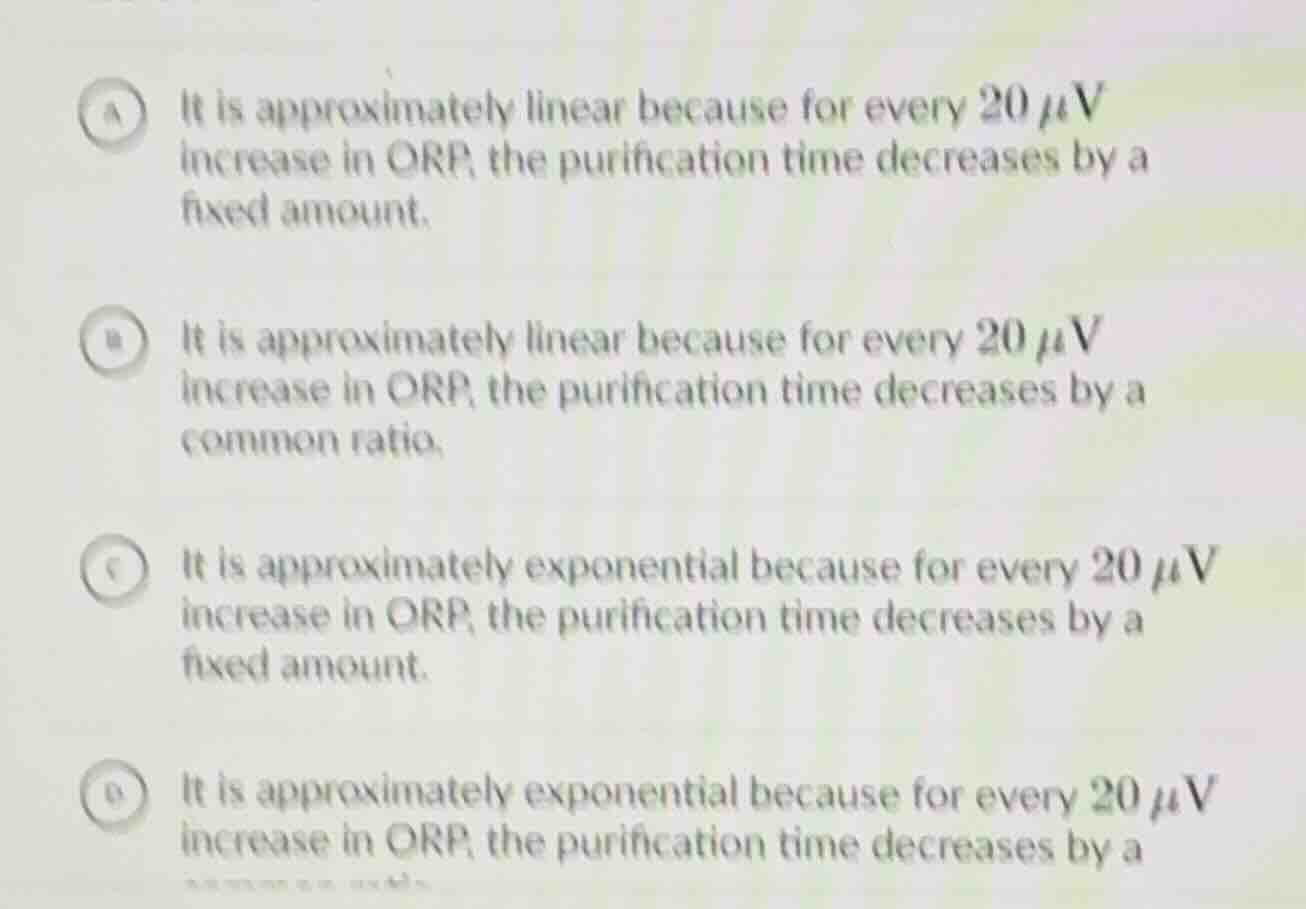
a it is approximately linear because for every 20 μv increase in orp, the purification time decreases by a fixed amount. b it is approximately linear because for every 20 μv increase in orp, the purification time decreases by a common ratio. c it is approximately exponential because for every 20 μv increase in orp, the purification time decreases by a fixed amount. d it is approximately exponential because for every 20 μv increase in orp, the purification time decreases by a
To determine the correct option, we recall the definitions of linear and exponential relationships:
- A linear relationship has a constant rate of change (a fixed amount increase or decrease) for a constant change in the independent variable.
- An exponential relationship has a constant ratio of change (a common ratio) for a constant change in the independent variable.
Analyzing each option:
- Option A: States the relationship is linear because a fixed amount decrease in purification time occurs for every \( 20\ \mu\text{V} \) increase in ORP. This matches the definition of a linear relationship (constant rate of change, fixed amount change).
- Option B: Claims linearity but attributes it to a common ratio (which is characteristic of exponential, not linear). This is incorrect.
- Option C: Claims exponential but attributes it to a fixed amount change (which is linear, not exponential). This is incorrect.
- Option D: The text is cut off, but from the pattern, it would likely incorrectly mix exponential and linear characteristics.

Snap & solve any problem in the app
Get step-by-step solutions on Sovi AI
Photo-based solutions with guided steps
Explore more problems and detailed explanations
A. It is approximately linear because for every \( 20\ \mu\text{V} \) increase in ORP, the purification time decreases by a fixed amount.