QUESTION IMAGE
Question
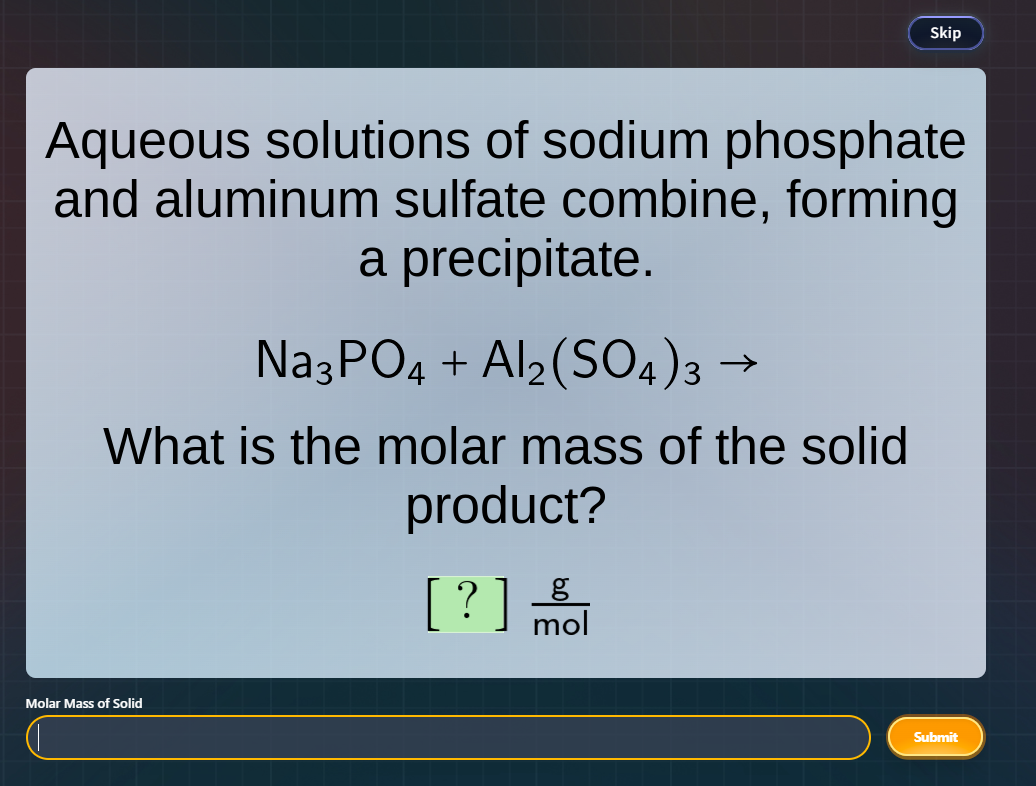
aqueous solutions of sodium phosphate and aluminum sulfate combine, forming a precipitate.
na₃po₄ + al₂(so₄)₃ →
what is the molar mass of the solid product?
? \\(\frac{g}{mol}\\)
Step1: Identify the precipitate (solid product)
First, we need to determine the products of the double - displacement reaction between $\ce{Na_{3}PO_{4}}$ and $\ce{Al_{2}(SO_{4})_{3}}$. In a double - displacement reaction, the cations and anions switch partners. The cations are $\ce{Na^{+}}$ and $\ce{Al^{3+}}$, and the anions are $\ce{PO_{4}^{3 - }}$ and $\ce{SO_{4}^{2 - }}$. So the possible products are $\ce{Na_{2}SO_{4}}$ and $\ce{AlPO_{4}}$. We know that sodium sulfate ($\ce{Na_{2}SO_{4}}$) is soluble in water, while aluminum phosphate ($\ce{AlPO_{4}}$) is insoluble (forms a precipitate). The balanced chemical equation for the reaction is:
So the solid product is $\ce{AlPO_{4}}$.
Step2: Calculate the molar mass of $\ce{AlPO_{4}}$
The molar mass of a compound is the sum of the molar masses of its constituent atoms.
- The molar mass of $\ce{Al}$ (aluminum) is approximately $26.98\space g/mol$.
- The molar mass of $\ce{P}$ (phosphorus) is approximately $30.97\space g/mol$.
- The molar mass of $\ce{O}$ (oxygen) is approximately $16.00\space g/mol$.
For $\ce{AlPO_{4}}$, we have 1 atom of $\ce{Al}$, 1 atom of $\ce{P}$, and 4 atoms of $\ce{O}$.
The molar mass ($M$) of $\ce{AlPO_{4}}$ is calculated as follows:
$$M = M(\ce{Al})+M(\ce{P}) + 4\times M(\ce{O})$$
Substitute the values:
$$M=26.98\space g/mol + 30.97\space g/mol+4\times16.00\space g/mol$$
First, calculate $4\times16.00 = 64.00\space g/mol$
Then, $26.98+30.97 + 64.00=26.98 + 30.97=57.95; 57.95+64.00 = 121.95\space g/mol$

Snap & solve any problem in the app
Get step-by-step solutions on Sovi AI
Photo-based solutions with guided steps
Explore more problems and detailed explanations
$121.95$