QUESTION IMAGE
Question
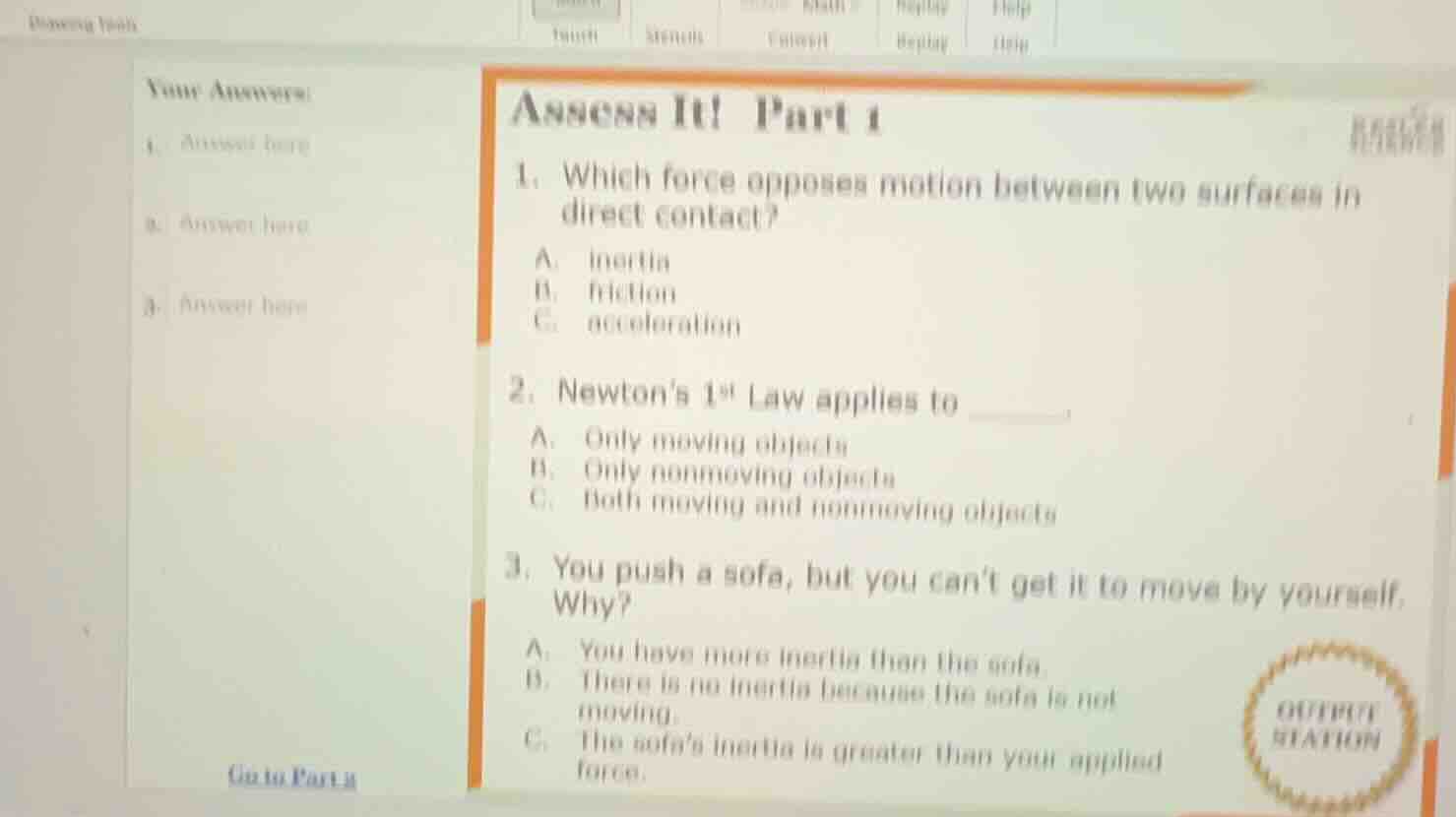
assess it! part 1
- which force opposes motion between two surfaces in direct contact?
a. inertia
b. friction
c. acceleration
- newton’s 1st law applies to ______.
a. only moving objects
b. only nonmoving objects
c. both moving and nonmoving objects
- you push a sofa, but you can’t get it to move by yourself. why?
a. you have more inertia than the sofa.
b. there is no inertia because the sofa is not moving.
c. the sofa’s inertia is greater than your applied force.
Question 1:
To determine the force opposing motion between two surfaces in direct contact, we analyze each option:
- Option A: Inertia is the tendency of an object to resist changes in its state of motion, not a force opposing motion between surfaces.
- Option B: Friction is defined as the force that opposes the relative motion or tendency of such motion between two surfaces in contact.
- Option C: Acceleration is the rate of change of velocity, not a force opposing motion between surfaces.
Newton's 1st Law (Law of Inertia) states that an object at rest remains at rest, and an object in motion remains in motion with a constant velocity unless acted upon by a net external force. This law applies to all objects, whether they are moving or not moving.
- Option A: Incorrect, as the law also applies to non - moving objects.
- Option B: Incorrect, as the law also applies to moving objects.
- Option C: Correct, as the law is applicable to both moving and non - moving objects.
Inertia is the resistance of an object to a change in its state of motion. The amount of inertia an object has is related to its mass (more mass means more inertia). When you push a sofa and it doesn't move, it's because the sofa's inertia (resistance to moving, related to its mass) is greater than the force you apply.
- Option A: Inertia depends on mass, not on who is pushing. A sofa typically has more mass than a person, so this is incorrect.
- Option B: All objects have inertia, regardless of whether they are moving or not. So this is incorrect.
- Option C: Correct, as the sofa's inertia (due to its mass) is greater than the force you apply, so it doesn't move.

Snap & solve any problem in the app
Get step-by-step solutions on Sovi AI
Photo-based solutions with guided steps
Explore more problems and detailed explanations
B. friction