QUESTION IMAGE
Question
assign the number on the graph to the correct description.
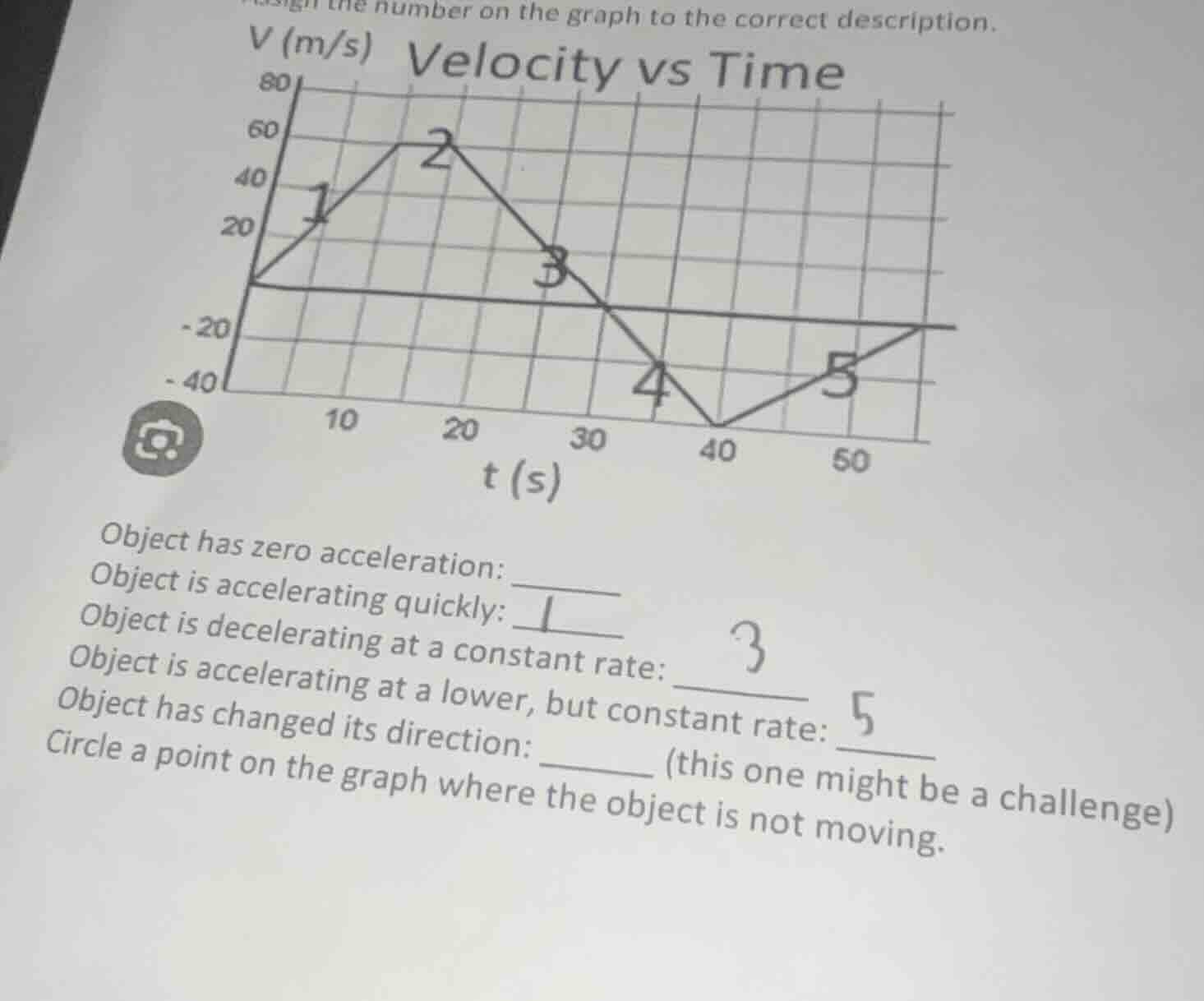
velocity vs time graph (axes: v (m/s) with 80, 60, 40, 20, -20, -40; t (s) with 10, 20, 30, 40, 50; points 1,2,3,4,5 marked)
object has zero acceleration:
object is accelerating quickly: 1
object is decelerating at a constant rate: 3
object is accelerating at a lower, but constant rate: 5
object has changed its direction: (this one might be a challenge)
circle a point on the graph where the object is not moving.
For "Object has zero acceleration"
Step1: Recall acceleration from velocity - time graph
Acceleration is the slope of the velocity - time graph. When the slope is zero (a horizontal line), acceleration is zero. In the graph, segment 2 is a horizontal line (constant velocity), so the slope (acceleration) is zero.
Step2: Determine the number
From the graph, the segment with zero acceleration is segment 2.
For "Object is decelerating at a constant rate"
Step1: Recall deceleration and constant rate
Deceleration means the velocity is decreasing, and a constant rate means the slope of the velocity - time graph is constant (a straight line). Segment 3 shows a constant decrease in velocity (negative slope with constant magnitude), so it is decelerating at a constant rate.
Step2: Determine the number
The segment where the object is decelerating at a constant rate is segment 3.
For "Object has changed its direction"
Step1: Recall direction change in velocity - time graph
A change in direction occurs when the velocity changes sign (from positive to negative or vice - versa). The point where the velocity crosses the time axis (v = 0) and then becomes negative (or positive) is where the direction changes. Looking at the graph, around the point where the velocity goes from positive to negative (or vice - versa), we can see that the velocity crosses zero between segment 3 and 4, and then becomes negative. The number associated with the region where direction changes is 4 (or the point around there). But more precisely, the point where velocity is zero (between 3 and 4) is where direction changes. But from the given numbers, the number corresponding to the region where direction changes is 4 (since after that the velocity is negative).
For "Circle a point on the graph where the object is not moving"

Snap & solve any problem in the app
Get step-by-step solutions on Sovi AI
Photo-based solutions with guided steps
Explore more problems and detailed explanations
s:
- Object has zero acceleration: 2
- Object is decelerating at a constant rate: 3
- Object has changed its direction: 4
- Circle a point on the graph where the object is not moving: The point at t where v = 0 (around the point marked 3 or the intersection of the graph with the t - axis, or the point at t = 0, but more appropriately, the point where v = 0 between mark 3 and 4, or the point at t = 0. If we consider the given marks, we can circle the point at mark 3 (where v = 0) or the point at t = 0. But from the graph, the point at t = 0 (v = 0) or the point where the graph crosses the t - axis (v = 0) between mark 3 and 4.