QUESTION IMAGE
Question
assignment
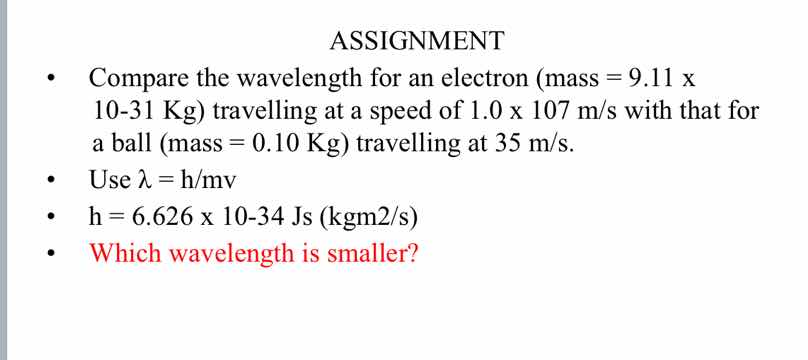
- compare the wavelength for an electron (mass = 9.11 x 10⁻³¹ kg) travelling at a speed of 1.0 x 10⁷ m/s with that for a ball (mass = 0.10 kg) travelling at 35 m/s.
- use $\lambda = \frac{h}{mv}$
- $h = 6.626 x 10⁻³⁴ js (kgm2/s)$
- which wavelength is smaller?
Step1: Calculate wavelength of electron
Using the formula \(\lambda = \frac{h}{mv}\), where \(h = 6.626\times 10^{-34}\space Js\), \(m_{electron}=9.11\times 10^{-31}\space Kg\), \(v_{electron}=1.0\times 10^{7}\space m/s\).
\(\lambda_{electron}=\frac{6.626\times 10^{-34}}{(9.11\times 10^{-31})\times(1.0\times 10^{7})}\)
First, calculate the denominator: \((9.11\times 10^{-31})\times(1.0\times 10^{7}) = 9.11\times 10^{-24}\)
Then, \(\lambda_{electron}=\frac{6.626\times 10^{-34}}{9.11\times 10^{-24}}\approx 7.27\times 10^{-11}\space m\)
Step2: Calculate wavelength of ball
Using the same formula, where \(m_{ball}=0.10\space Kg\), \(v_{ball}=35\space m/s\).
\(\lambda_{ball}=\frac{6.626\times 10^{-34}}{(0.10)\times(35)}\)
Calculate the denominator: \(0.10\times35 = 3.5\)
Then, \(\lambda_{ball}=\frac{6.626\times 10^{-34}}{3.5}\approx 1.89\times 10^{-34}\space m\)
Step3: Compare the two wavelengths
Compare \(\lambda_{electron}\approx 7.27\times 10^{-11}\space m\) and \(\lambda_{ball}\approx 1.89\times 10^{-34}\space m\). Since \(1.89\times 10^{-34}<7.27\times 10^{-11}\), the wavelength of the ball is smaller.

Snap & solve any problem in the app
Get step-by-step solutions on Sovi AI
Photo-based solutions with guided steps
Explore more problems and detailed explanations
The wavelength of the ball (mass = 0.10 Kg travelling at 35 m/s) is smaller.