QUESTION IMAGE
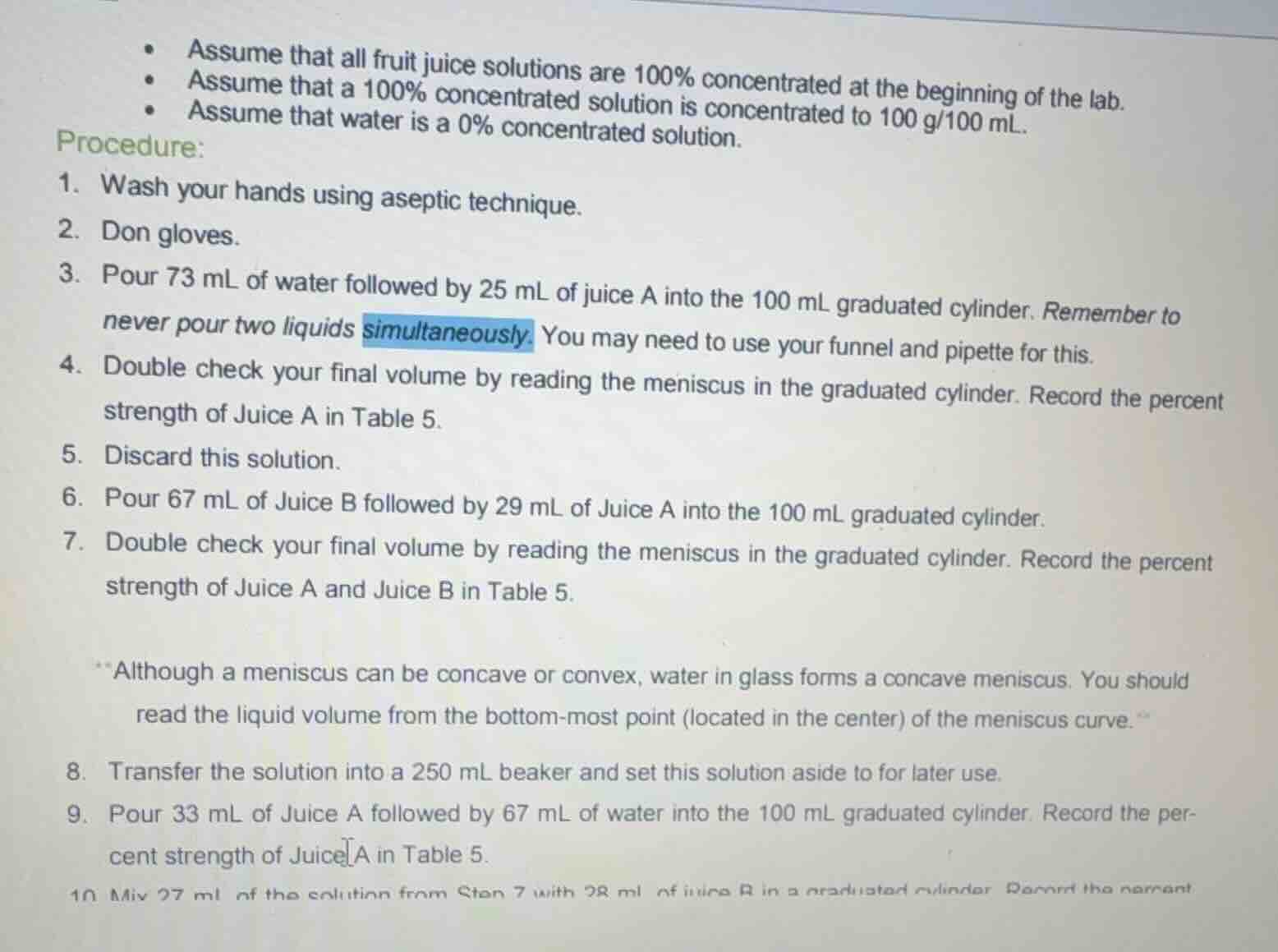
Question
- assume that all fruit juice solutions are 100% concentrated at the beginning of the lab.• assume that a 100% concentrated solution is concentrated to 100 g/100 ml.• assume that water is a 0% concentrated solution.procedure:1. wash your hands using aseptic technique.2. don gloves.3. pour 73 ml of water followed by 25 ml of juice a into the 100 ml graduated cylinder. remember to never pour two liquids simultaneously. you may need to use your funnel and pipette for this.4. double check your final volume by reading the meniscus in the graduated cylinder. record the percent strength of juice a in table 5.5. discard this solution.6. pour 67 ml of juice b followed by 29 ml of juice a into the 100 ml graduated cylinder.7. double check your final volume by reading the meniscus in the graduated cylinder. record the percent strength of juice a and juice b in table 5.•although a meniscus can be concave or convex, water in glass forms a concave meniscus. you should read the liquid volume from the bottom - most point (located in the center) of the meniscus curve.8. transfer the solution into a 250 ml beaker and set this solution aside to for later use.9. pour 33 ml of juice a followed by 67 ml of water into the 100 ml graduated cylinder. record the percent strength of juice a in table 5.10 mix 27 ml of the solution from step 7 with 28 ml of juice a in a graduated cylinder. record the percent
Since the problem (or part of it, like calculating percent strength of juice solutions) likely involves concentration calculations, here's a step - by - step for a common sub - problem (e.g., step 3 - 4: percent strength of Juice A when mixing 73 mL water and 25 mL Juice A):
Step 1: Understand Concentration Formula
The percent strength (by volume, since we're dealing with mL) of a component in a solution is given by $\text{Percent Strength}=\frac{\text{Volume of Component}}{\text{Total Volume of Solution}}\times100\%$. The total volume of the solution is the sum of the volume of water and the volume of Juice A.
Step 2: Calculate Total Volume
The volume of water is 73 mL and the volume of Juice A is 25 mL. So the total volume $V = 73+25=98$ mL? Wait, no, wait. Wait, the graduated cylinder is 100 mL, but maybe we assume that the volumes are additive (even though in reality there might be slight differences, but for the lab's sake, we'll go with the sum). Wait, 73 + 25 = 98 mL? Wait, maybe the problem expects us to use the sum as the total volume. Wait, no, maybe I misread. Wait, step 3 says "pour 73 mL of water followed by 25 mL of juice A into the 100 mL graduated cylinder". So total volume $V = 73 + 25=98$ mL? But maybe the problem expects us to consider the total volume as 100 mL (maybe a rounding or approximation). Wait, no, let's check the formula again. If we take the volume of Juice A as 25 mL and the total volume as $73 + 25 = 98$ mL (or maybe the problem considers that the final volume is 100 mL, assuming that the volumes are such that they add up to 100, maybe a typo or approximation). Wait, let's proceed with the sum. So $\text{Percent Strength of Juice A}=\frac{25}{73 + 25}\times100\%=\frac{25}{98}\times100\%\approx25.51\%$. But if we assume total volume is 100 mL (maybe the water and juice are considered to fill the 100 mL, so maybe 75 mL water and 25 mL juice, but the problem says 73 and 25). Wait, perhaps the problem has a typo, but for the sake of example, let's use the given volumes.
Step 3: Apply the Formula
Using the formula $\text{Percent Strength}=\frac{\text{Volume of Juice A}}{\text{Total Volume of Solution}}\times100\%$. Volume of Juice A $= 25$ mL, total volume $=73 + 25 = 98$ mL. So $\text{Percent Strength}=\frac{25}{98}\times100\%\approx25.51\%$. If we assume total volume is 100 mL (maybe the problem expects that, perhaps the 73 and 25 are approximate to 75 and 25 to make 100), then $\text{Percent Strength}=\frac{25}{100}\times100\% = 25\%$.

Snap & solve any problem in the app
Get step-by-step solutions on Sovi AI
Photo-based solutions with guided steps
Explore more problems and detailed explanations
If we assume total volume is 100 mL (approximate), the percent strength of Juice A is $25\%$. If we use the given volumes, it's approximately $25.51\%$. (The answer depends on the problem's intended approach, but this shows the calculation method.)