QUESTION IMAGE
Question
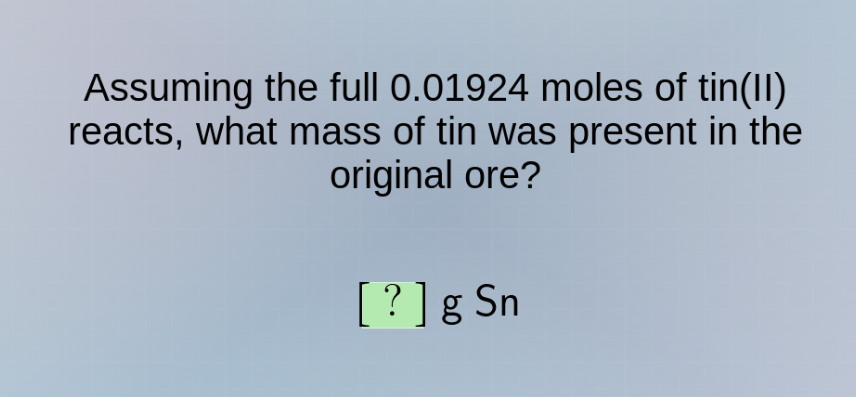
assuming the full 0.01924 moles of tin(ii) reacts, what mass of tin was present in the original ore?
? g sn
Step1: Recall the molar mass of Sn
The molar mass of tin (Sn) is approximately \( 118.71 \, \text{g/mol} \). This value is obtained from the periodic table, where the atomic mass of Sn is about 118.71 atomic mass units, and since molar mass in g/mol is numerically equal to the atomic mass in amu, the molar mass \( M \) of Sn is \( 118.71 \, \text{g/mol} \).
Step2: Use the formula \( m = n \times M \)
We know the number of moles \( n = 0.01924 \, \text{mol} \) and the molar mass \( M = 118.71 \, \text{g/mol} \). The formula for mass \( m \) is \( m = n\times M \). Substituting the values, we get:
\( m = 0.01924 \, \text{mol} \times 118.71 \, \text{g/mol} \)
Step3: Calculate the mass
First, multiply \( 0.01924 \) and \( 118.71 \):
\( 0.01924\times118.71 \approx 2.284 \) (rounded to four significant figures)

Snap & solve any problem in the app
Get step-by-step solutions on Sovi AI
Photo-based solutions with guided steps
Explore more problems and detailed explanations
\( 2.284 \) (or depending on significant figures, it can be adjusted. If we consider the given moles \( 0.01924 \) (four significant figures) and molar mass \( 118.71 \) (five significant figures), the result should have four significant figures, so \( 2.284 \, \text{g} \))