QUESTION IMAGE
Question
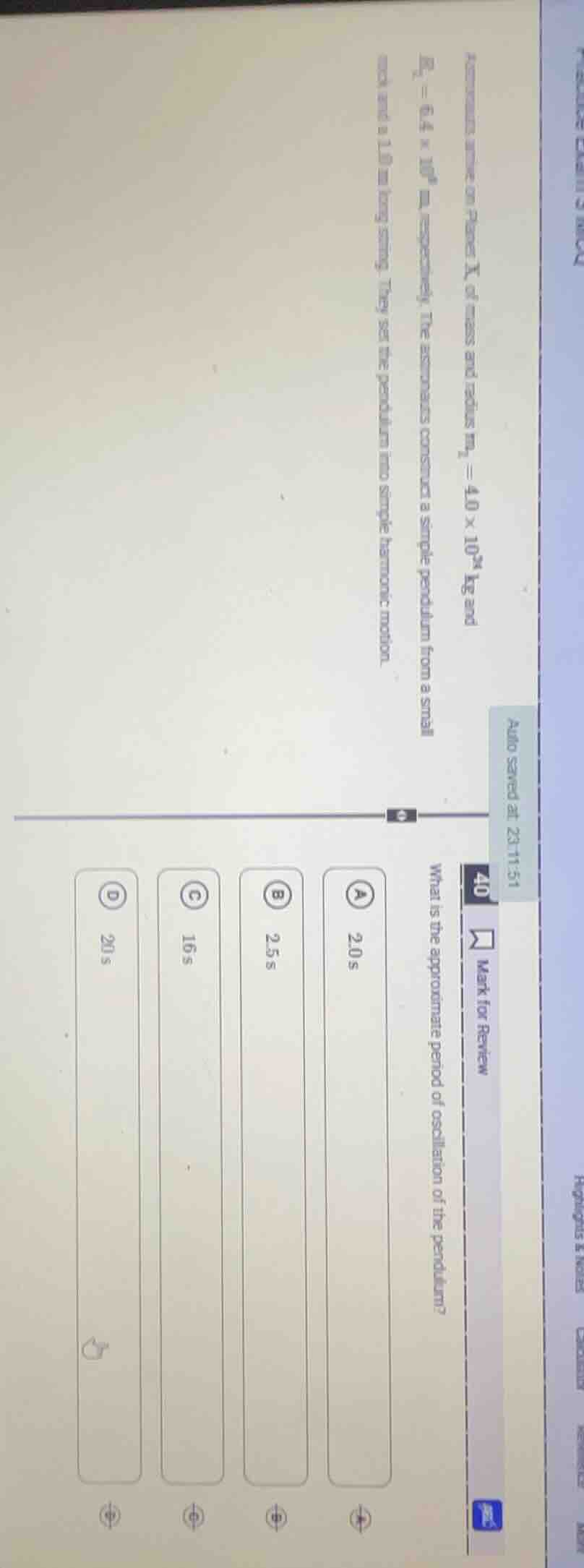
astronauts arrive on planet x, of mass ( m_x = 4.0 \times 10^{24} ) kg and ( r_x = 6.4 \times 10^6 ) m respectively. the astronauts construct a simple pendulum from a small rock and a 1.0 m long string. they set the pendulum into simple harmonic motion.
what is the approximate period of oscillation of the pendulum?
a 2.0 s
b 2.5 s
c 1.6 s
d 2.0 s
Step1: Find gravitational acceleration on Planet X
First, we calculate the gravitational acceleration \( g \) on Planet X using the formula for gravitational field strength: \( g = \frac{G M}{R^2} \), where \( G = 6.67 \times 10^{-11} \, \text{N m}^2/\text{kg}^2 \), \( M = 4.0 \times 10^{24} \, \text{kg} \), and \( R = 6.4 \times 10^6 \, \text{m} \).
\[
g = \frac{6.67 \times 10^{-11} \times 4.0 \times 10^{24}}{(6.4 \times 10^6)^2}
\]
\[
g = \frac{2.668 \times 10^{14}}{4.096 \times 10^{13}} \approx 6.51 \, \text{m/s}^2
\]
Step2: Calculate period of simple pendulum
The formula for the period \( T \) of a simple pendulum is \( T = 2\pi \sqrt{\frac{L}{g}} \), where \( L = 1.0 \, \text{m} \) (length of the pendulum) and \( g \approx 6.51 \, \text{m/s}^2 \) (from Step 1).
\[
T = 2\pi \sqrt{\frac{1.0}{6.51}}
\]
\[
T = 2\pi \sqrt{0.1536}
\]
\[
T = 2\pi \times 0.392
\]
\[
T \approx 2 \times 3.1416 \times 0.392 \approx 2.46 \, \text{s}
\]
Wait, there might be a miscalculation. Wait, let's recheck the values. Wait, maybe the mass of the planet is \( 4.0 \times 10^{24} \, \text{kg} \) and radius \( 6.4 \times 10^6 \, \text{m} \). Let's recalculate \( g \):
\( G M = 6.67e-11 * 4.0e24 = 2.668e14 \)
\( R^2 = (6.4e6)^2 = 4.096e13 \)
\( g = 2.668e14 / 4.096e13 ≈ 6.51 \, \text{m/s}^2 \) (correct). Then \( T = 2\pi \sqrt{1/6.51} ≈ 2\pi * 0.392 ≈ 2.46 \, \text{s} \). But the options are 2.0s, 2.5s, 1.6s, 2.0s. Wait, maybe the radius is \( 6.4 \times 10^6 \, \text{m} \) (correct), mass \( 4.0 \times 10^{24} \, \text{kg} \) (correct). Wait, maybe I made a mistake in the pendulum length? Wait, the problem says "1.0 m long string". So \( L = 1.0 \, \text{m} \).
Wait, let's use \( g = 9.8 \, \text{m/s}^2 \) on Earth for comparison, but no, we need to use the calculated \( g \). Wait, maybe the options have a typo, or I miscalculated. Wait, let's recalculate \( T \):
\( \sqrt{1/6.51} ≈ \sqrt{0.1536} ≈ 0.392 \)
\( 2\pi * 0.392 ≈ 2.46 \, \text{s} \), which is close to 2.5s (option B). So the approximate period is 2.5s.

Snap & solve any problem in the app
Get step-by-step solutions on Sovi AI
Photo-based solutions with guided steps
Explore more problems and detailed explanations
B. 2.5 s