QUESTION IMAGE
Question
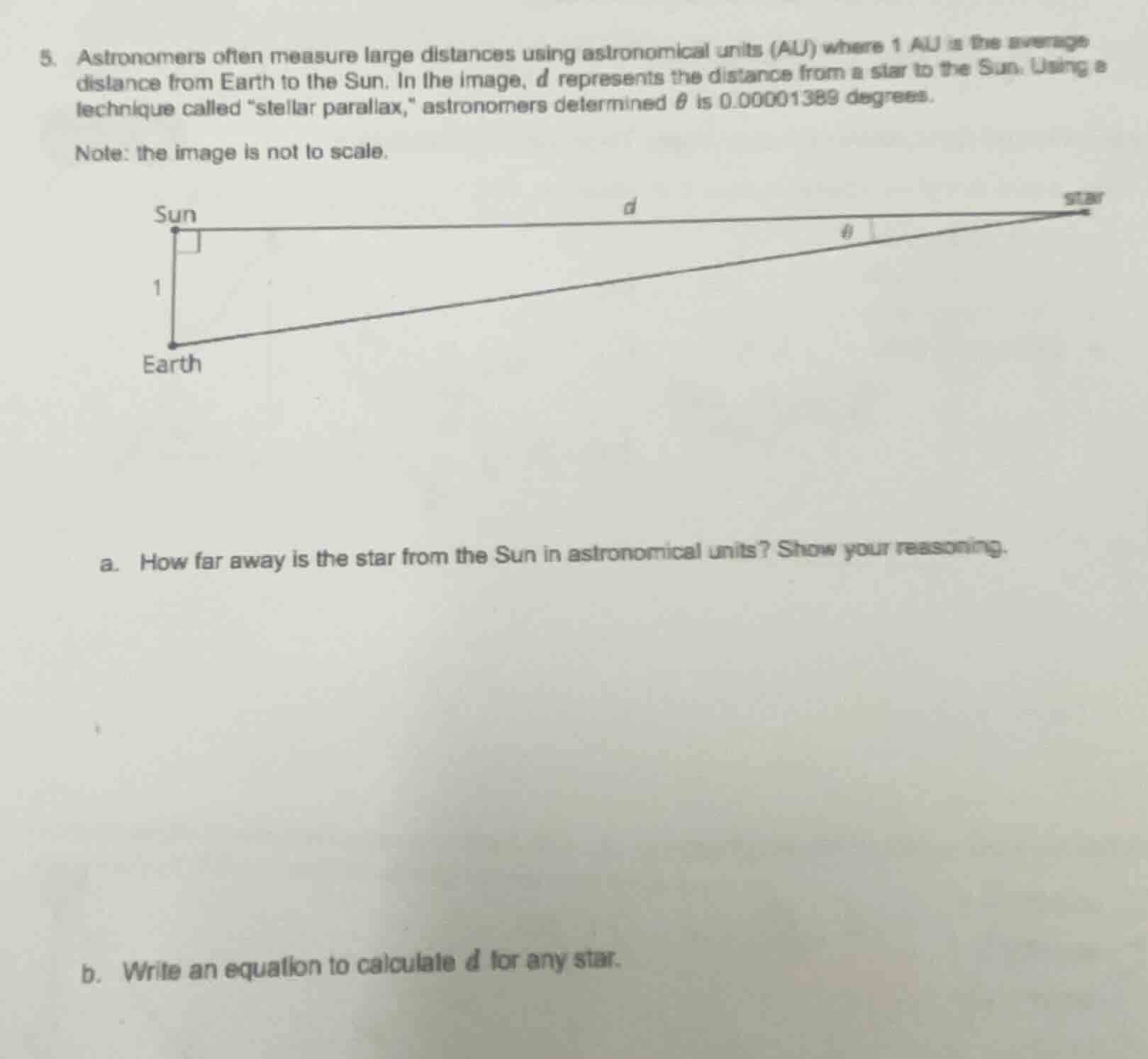
- astronomers often measure large distances using astronomical units (au) where 1 au is the average distance from earth to the sun. in the image, ( d ) represents the distance from a star to the sun. using a technique called \stellar parallax,\ astronomers determined ( \theta ) is 0.00001389 degrees.
note: the image is not to scale.
image of a right triangle with sun, earth, and star; sun to earth is 1 (vertical leg), sun to star is ( d ) (horizontal leg), earth to star is the hypotenuse, and ( \theta ) is the angle at the star between sun-star and earth-star
a. how far away is the star from the sun in astronomical units? show your reasoning.
b. write an equation to calculate ( d ) for any star.
Step1: Identify trigonometric ratio
We have a right triangle, with opposite side to $\theta$ equal to 1 AU, adjacent side $d$. Use tangent:
$\tan(\theta) = \frac{1}{d}$
Step2: Rearrange to solve for $d$
Isolate $d$ by cross-multiplying:
$d = \frac{1}{\tan(\theta)}$
Step3: Substitute $\theta = 0.00001389^\circ$
Calculate the value using a calculator:
$d = \frac{1}{\tan(0.00001389^\circ)}$
$\tan(0.00001389^\circ) \approx 2.424 \times 10^{-8}$
$d \approx \frac{1}{2.424 \times 10^{-8}} \approx 4.125 \times 10^7$
Step4: Generalize for any star
Use the same trigonometric relationship from Step1, rearranged for any $\theta$:
$d = \frac{1}{\tan(\theta)}$

Snap & solve any problem in the app
Get step-by-step solutions on Sovi AI
Photo-based solutions with guided steps
Explore more problems and detailed explanations
a. $\boldsymbol{4.13 \times 10^7}$ astronomical units (rounded to 3 significant figures)
b. $\boldsymbol{d = \frac{1}{\tan(\theta)}}$ where $\theta$ is the stellar parallax angle in degrees, and $d$ is the distance in AU.