QUESTION IMAGE
Question
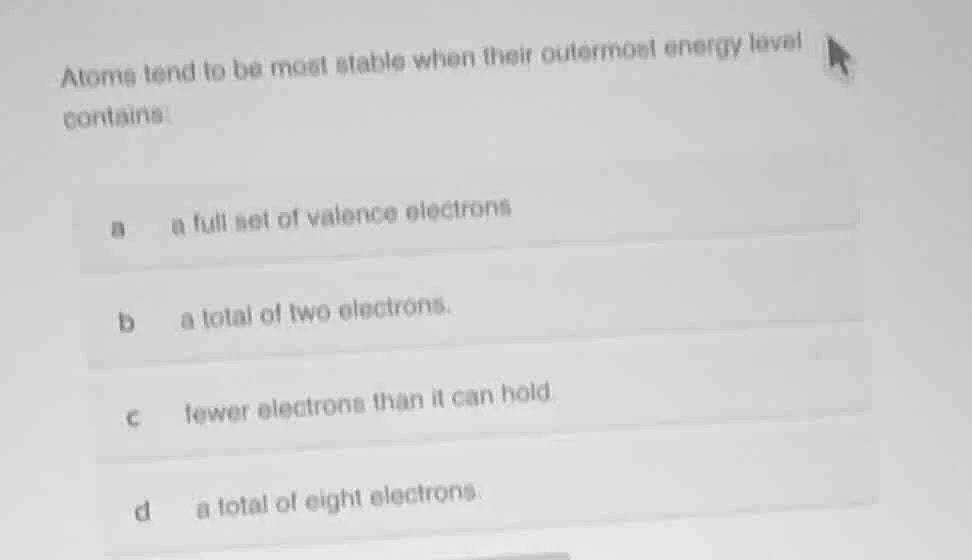
atoms tend to be most stable when their outermost energy level contains:
a a full set of valence electrons
b a total of two electrons.
c fewer electrons than it can hold
d a total of eight electrons.
Brief Explanations
To determine the correct answer, we analyze each option:
- Option a: Atoms are most stable when their outermost (valence) energy level has a full set of valence electrons. The octet rule (for many atoms) and the duet rule (for some like H, He) are about having a full outer shell. A full set of valence electrons means the outer shell is complete, which is the key to stability.
- Option b: Only a few atoms (like He) have a stable outermost level with 2 electrons. Most atoms need 8 (octet) to be stable, so this is not a general rule.
- Option c: Having fewer electrons than it can hold means the atom is not stable and will tend to gain, lose, or share electrons to complete the outer shell.
- Option d: While the octet rule (8 electrons) applies to many atoms, some atoms (like H, He, Li⁺) are stable with fewer. The most general statement is a full set of valence electrons, as the number of electrons in a full set can vary (2 for duet, 8 for octet, etc.).
So the best answer is a as it is the most general and accurate description of atomic stability related to the outermost energy level.

Snap & solve any problem in the app
Get step-by-step solutions on Sovi AI
Photo-based solutions with guided steps
Explore more problems and detailed explanations
a. a full set of valence electrons