QUESTION IMAGE
Question
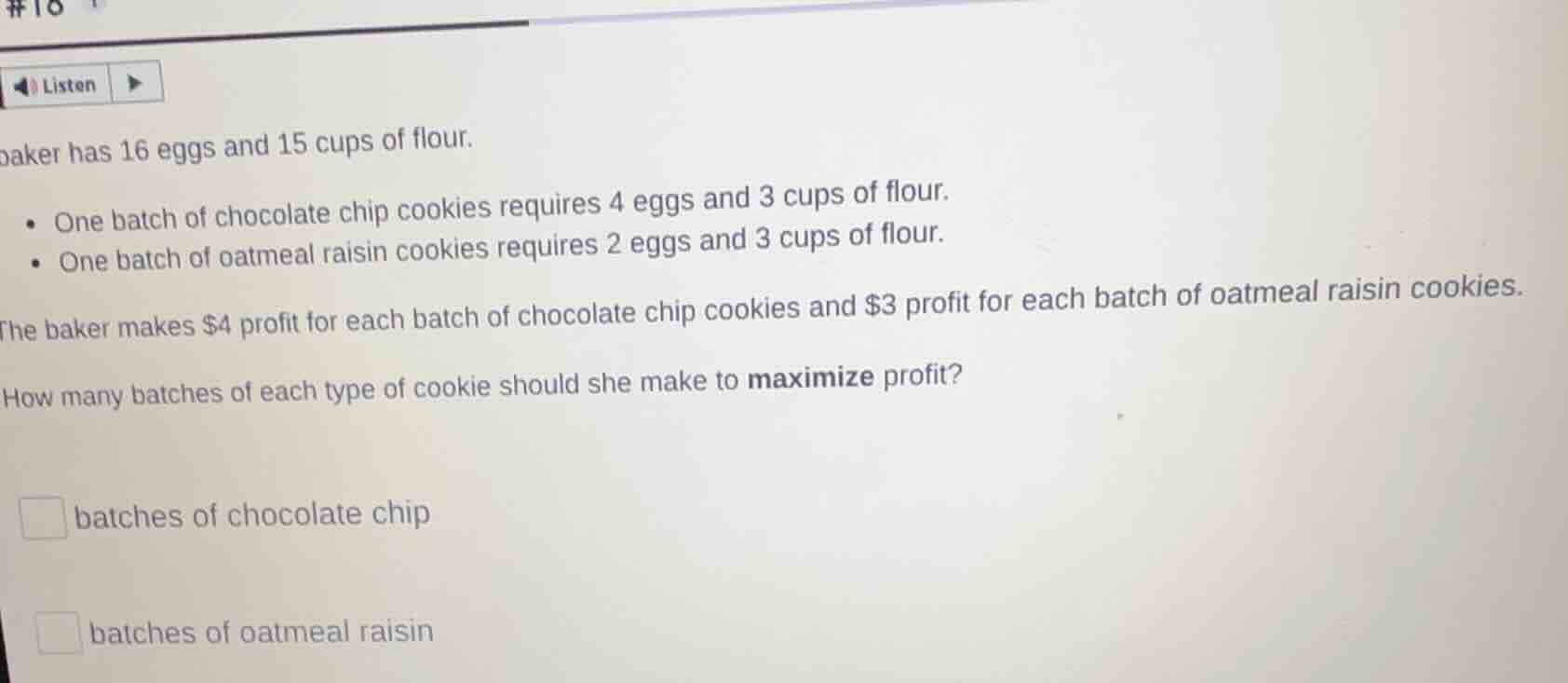
a baker has 16 eggs and 15 cups of flour.
- one batch of chocolate chip cookies requires 4 eggs and 3 cups of flour.
- one batch of oatmeal raisin cookies requires 2 eggs and 3 cups of flour.
the baker makes $4 profit for each batch of chocolate chip cookies and $3 profit for each batch of oatmeal raisin cookies.
how many batches of each type of cookie should she make to maximize profit?
____ batches of chocolate chip
____ batches of oatmeal raisin
Step1: Define Variables
Let \( x \) be the number of batches of chocolate chip cookies and \( y \) be the number of batches of oatmeal raisin cookies.
Step2: Set Up Constraints
- Egg Constraint: \( 4x + 2y \leq 16 \) (simplify: \( 2x + y \leq 8 \))
- Flour Constraint: \( 3x + 3y \leq 15 \) (simplify: \( x + y \leq 5 \))
- Non - negativity: \( x \geq 0, y \geq 0 \) (and \( x,y \) are integers)
Step3: Set Up Objective Function
The profit function \( P = 4x+3y \), which we want to maximize.
Step4: Find Feasible Region Vertices
- Intersection of \( 2x + y=8 \) and \( x + y = 5 \):
Subtract the second equation from the first: \( (2x + y)-(x + y)=8 - 5\Rightarrow x = 3 \). Substitute \( x = 3 \) into \( x + y=5 \), we get \( y = 2 \).
- Intersection of \( x + y=5 \) and \( y = 0 \): \( x=5,y = 0 \)
- Intersection of \( 2x + y=8 \) and \( x = 0 \): \( y = 8 \), but from \( x + y\leq5 \), when \( x = 0 \), \( y\leq5 \), so the intersection of \( x = 0 \) and \( x + y=5 \) is \( (0,5) \)
- Intersection of \( y = 0 \) and \( 2x + y=8 \): \( x = 4,y = 0 \)
Step5: Evaluate Profit at Vertices
- At \( (3,2) \): \( P=4\times3 + 3\times2=12 + 6=18 \)
- At \( (5,0) \): \( P=4\times5+3\times0 = 20 \)? Wait, no, check the flour constraint. If \( x = 5 \), flour used is \( 3\times5+3\times0=15 \), egg used is \( 4\times5+2\times0 = 20>16 \). So \( (5,0) \) is not in the feasible region.
- At \( (0,5) \): \( P=4\times0+3\times5 = 15 \)
- At \( (4,0) \): \( P=4\times4+3\times0=16 \)
- Wait, we made a mistake in the first vertex calculation. Let's re - check the constraints. The egg constraint is \( 4x + 2y\leq16 \), flour constraint \( 3x + 3y\leq15 \).
Let's list all integer points in the feasible region:
From \( x + y\leq5 \) and \( 2x + y\leq8 \) and \( x,y\geq0 \) integers.
Possible \( x \) values from 0 to 4 (since \( 4x\leq16\Rightarrow x\leq4 \))
- \( x = 0 \):
- \( y \) can be 0 - 5. \( P(0,y)=3y \). Max at \( y = 5 \), \( P = 15 \)
- \( x = 1 \):
- From \( x + y\leq5\Rightarrow y\leq4 \); from \( 2x + y\leq8\Rightarrow y\leq6 \). So \( y\leq4 \). \( P(1,y)=4 + 3y \). At \( y = 4 \), \( P=4 + 12 = 16 \)
- \( x = 2 \):
- From \( x + y\leq5\Rightarrow y\leq3 \); from \( 2x + y\leq8\Rightarrow y\leq4 \). So \( y\leq3 \). \( P(2,y)=8 + 3y \). At \( y = 3 \), \( P=8 + 9 = 17 \)
- \( x = 3 \):
- From \( x + y\leq5\Rightarrow y\leq2 \); from \( 2x + y\leq8\Rightarrow y\leq2 \). So \( y = 2 \). \( P(3,2)=12 + 6 = 18 \)
- \( x = 4 \):
- From \( x + y\leq5\Rightarrow y\leq1 \); from \( 2x + y\leq8\Rightarrow y\leq0 \). So \( y = 0 \). \( P(4,0)=16 \)
Wait, earlier mistake: when \( x = 5 \), egg usage is \( 4\times5=20>16 \), so \( x = 5 \) is not feasible. Let's re - express the egg constraint correctly. The egg constraint is \( 4x+2y\leq16 \), so when \( x = 3 \), \( 4\times3+2\times2=12 + 4 = 16 \) (correct), flour: \( 3\times3+3\times2=9 + 6 = 15 \) (correct). When \( x = 4 \), egg: \( 4\times4=16 \), flour: \( 3\times4=12\leq15 \). Wait, \( x = 4,y = 0 \): egg \( 16 \), flour \( 12 \). Profit \( P = 16 \). When \( x = 3,y = 2 \): profit \( 18 \). When \( x = 2,y = 3 \): egg \( 4\times2+2\times3=8 + 6 = 14\leq16 \), flour \( 3\times2+3\times3=6 + 9 = 15 \). Profit \( 4\times2+3\times3=8 + 9 = 17 \). When \( x = 1,y = 4 \): egg \( 4\times1+2\times4=4 + 8 = 12\leq16 \), flour \( 3\times1+3\times4=3 + 12 = 15 \). Profit \( 4\times1+3\times4=4 + 12 = 16 \). When \( x = 0,y = 5 \): egg \( 2\times5 = 10\leq16 \), flour \( 3\times5=15 \). Profit \( 15 \).
Wait, another way: Let's graph the inequalities.
The egg inequal…

Snap & solve any problem in the app
Get step-by-step solutions on Sovi AI
Photo-based solutions with guided steps
Explore more problems and detailed explanations
3 batches of chocolate chip, 2 batches of oatmeal raisin