QUESTION IMAGE
Question
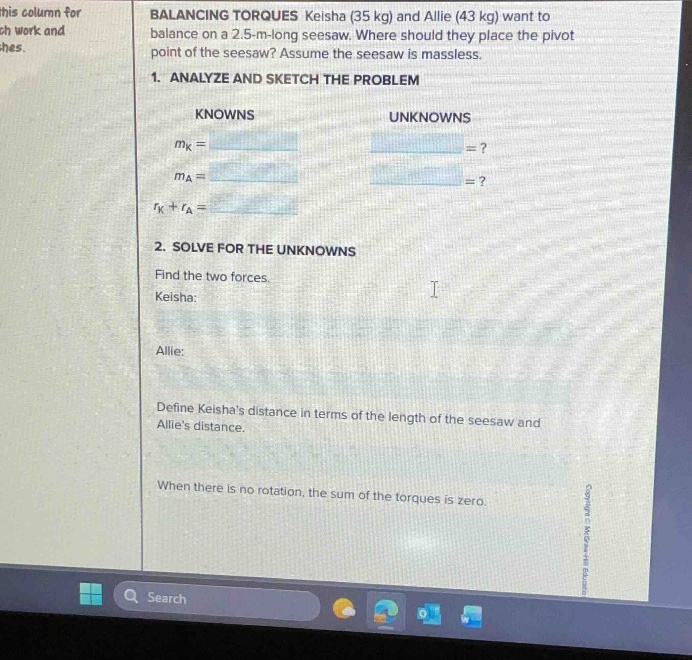
balancing torques keisha (35 kg) and allie (43 kg) want to balance on a 2.5-m-long seesaw. where should they place the pivot point of the seesaw? assume the seesaw is massless.
- analyze and sketch the problem
knowns unknowns
$m_k = $ $ = ?$
$m_a = $ $ = ?$
$r_k + r_a = $
- solve for the unknowns
find the two forces.
keisha:
allie:
define keisha’s distance in terms of the length of the seesaw and allie’s distance.
when there is no rotation, the sum of the torques is zero.
Step1: Identify Knowns
We know Keisha's mass \( m_K = 35\space kg \), Allie's mass \( m_A = 43\space kg \), and the length of the seesaw \( L = r_K + r_A = 2.5\space m \). Let \( r_K \) be Keisha's distance from the pivot and \( r_A \) be Allie's distance from the pivot.
Step2: Forces Calculation (Weight)
The force due to gravity (weight) for Keisha: \( F_K = m_Kg \), where \( g = 9.8\space m/s^2 \). So \( F_K = 35\times9.8 = 343\space N \).
For Allie: \( F_A = m_Ag = 43\times9.8 = 421.4\space N \).
Step3: Torque Balance Condition
Torque \( \tau = rF\sin\theta \). Since the seesaw is horizontal and forces are vertical, \( \sin\theta = 1 \). For equilibrium, \( \tau_K = \tau_A \) (assuming torques in opposite directions balance), so \( r_KF_K = r_AF_A \). Also, \( r_K + r_A = L = 2.5\space m \), so \( r_K = 2.5 - r_A \).
Substitute \( r_K \) into torque balance: \( (2.5 - r_A)F_K = r_AF_A \)
Step4: Solve for \( r_A \)
Expand: \( 2.5F_K - r_AF_K = r_AF_A \)
Rearrange: \( 2.5F_K = r_A(F_K + F_A) \)
Substitute \( F_K = 343\space N \), \( F_A = 421.4\space N \):
\( 2.5\times343 = r_A(343 + 421.4) \)
\( 857.5 = r_A(764.4) \)
\( r_A = \frac{857.5}{764.4} \approx 1.122\space m \) (Wait, no, wait. Wait, actually, since \( F_K = m_Kg \), \( F_A = m_Ag \), so \( r_Km_Kg = r_Am_Ag \), \( g \) cancels. So \( r_Km_K = r_Am_A \), and \( r_K = L - r_A \). So \( (L - r_A)m_K = r_Am_A \), \( Lm_K = r_A(m_A + m_K) \), so \( r_A = \frac{Lm_K}{m_A + m_K} \)? Wait, no, wait: torque balance: if Keisha is on one side, Allie on the other, then \( \tau_K = r_KF_K \), \( \tau_A = r_AF_A \), and for equilibrium, \( \tau_K = \tau_A \) (magnitude, opposite direction). So \( r_KF_K = r_AF_A \), \( F_K = m_Kg \), \( F_A = m_Ag \), so \( r_Km_K = r_Am_A \), and \( r_K + r_A = L \). So \( r_K = \frac{r_Am_A}{m_K} \). Then \( \frac{r_Am_A}{m_K} + r_A = L \), \( r_A(\frac{m_A}{m_K} + 1) = L \), \( r_A = \frac{Lm_K}{m_A + m_K} \)? Wait, no, that would be if we solve for \( r_A \) in terms of \( r_K \). Wait, let's do it correctly:
From \( r_Km_K = r_Am_A \), we get \( r_K = \frac{m_A}{m_K}r_A \)
Then \( r_K + r_A = L \) => \( \frac{m_A}{m_K}r_A + r_A = L \) => \( r_A(\frac{m_A + m_K}{m_K}) = L \) => \( r_A = \frac{Lm_K}{m_A + m_K} \)? Wait, no, that gives \( r_A = \frac{Lm_K}{m_A + m_K} \), but let's plug numbers: \( L = 2.5 \), \( m_K = 35 \), \( m_A = 43 \). So \( r_A = \frac{2.5\times35}{35 + 43} = \frac{87.5}{78} \approx 1.122\space m \)? Wait, no, that can't be, because if Allie is heavier, she should be closer to the pivot. Wait, I had the torque directions wrong. Let's assume Keisha is on the left, Allie on the right. Torque from Keisha is \( r_KF_K \) (clockwise or counter-clockwise?). Let's say pivot is at distance \( r_K \) from Keisha, \( r_A \) from Allie, so \( r_K + r_A = L \). The torque due to Keisha is \( r_KF_K \) (let's say counter-clockwise), and Allie's torque is \( r_AF_A \) (clockwise). For equilibrium, they must be equal: \( r_KF_K = r_AF_A \). Since \( F_K = m_Kg \), \( F_A = m_Ag \), so \( r_Km_K = r_Am_A \). So \( r_K = \frac{m_A}{m_K}r_A \). Then \( r_K + r_A = L \) => \( \frac{m_A}{m_K}r_A + r_A = L \) => \( r_A(\frac{m_A + m_K}{m_K}) = L \) => \( r_A = \frac{Lm_K}{m_A + m_K} \). Wait, but if \( m_A > m_K \), then \( r_A < r_K \), which makes sense (heavier person closer to pivot). So \( r_A = \frac{2.5\times35}{35 + 43} = \frac{87.5}{78} \approx 1.122\space m \), and \( r_K = 2.5 - 1.122 \approx 1.378\space m \). Wait, but 35 kg is lighter, so she should be farther from the pivot. So \( r_K \) (Keisha's distance) shou…

Snap & solve any problem in the app
Get step-by-step solutions on Sovi AI
Photo-based solutions with guided steps
Explore more problems and detailed explanations
The pivot should be placed approximately \( \boldsymbol{1.38\space m} \) from Keisha (or \( \boldsymbol{1.12\space m} \) from Allie) along the 2.5 - m - long seesaw. (For the force calculations: Keisha's force \( F_K = 35\times9.8 = 343\space N \), Allie's force \( F_A = 43\times9.8 = 421.4\space N \); using torque balance \( r_Km_K = r_Am_A \) and \( r_K + r_A = 2.5 \), we solve to find the pivot positions.)