QUESTION IMAGE
Question
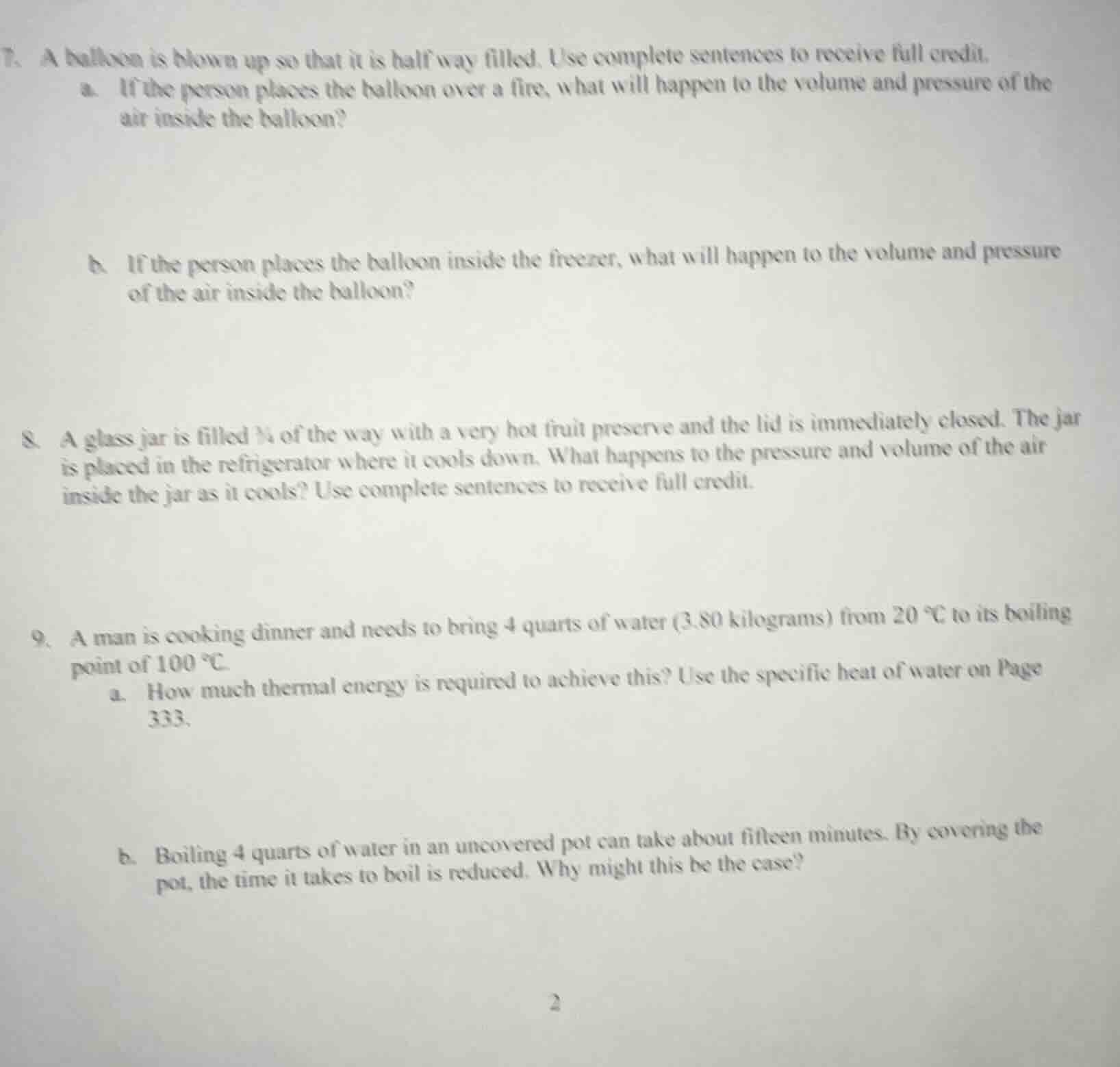
- a balloon is blown up so that it is halfway filled. use complete sentences to receive full credit.
a. if the person places the balloon over a fire, what will happen to the volume and pressure of the air inside the balloon?
b. if the person places the balloon inside the freezer, what will happen to the volume and pressure of the air inside the balloon?
- a glass jar is filled ¾ of the way with a very hot fruit preserve and the lid is immediately closed. the jar is placed in the refrigerator where it cools down. what happens to the pressure and volume of the air inside the jar as it cools? use complete sentences to receive full credit.
- a man is cooking dinner and needs to bring 4 quarts of water (3.80 kilograms) from 20 ℃ to its boiling point of 100 ℃.
a. how much thermal energy is required to achieve this? use the specific heat of water on page 333.
b. boiling 4 quarts of water in an uncovered pot can take about fifteen minutes. by covering the pot, the time it takes to boil is reduced. why might this be the case?
Question 7
a. When the balloon is heated over a fire, the temperature of the air inside increases. Since the balloon is flexible, the air will expand first, increasing the volume until the internal pressure matches the external atmospheric pressure; once the balloon is fully stretched, further heating would slightly increase pressure, but the primary change is a significant volume increase with pressure remaining roughly equal to atmospheric pressure initially.
b. When the balloon is placed in a freezer, the air inside cools, so its temperature drops. The flexible balloon will contract, decreasing the volume of the air inside, while the pressure will stay approximately equal to the external atmospheric pressure as the balloon adjusts its size.
The glass jar is a rigid container, so the volume of the trapped air cannot change. As the jar cools, the temperature of the air inside drops. According to gas laws, for a fixed volume of gas, a decrease in temperature leads to a decrease in pressure.
Step1: Recall specific heat formula
The formula for thermal energy is $Q = mc\Delta T$, where $Q$ is thermal energy, $m$ is mass, $c$ is specific heat of water ($4186 \, \text{J/kg·℃}$), and $\Delta T$ is temperature change.
Step2: Calculate temperature change
$\Delta T = T_f - T_i = 100^\circ\text{C} - 20^\circ\text{C} = 80^\circ\text{C}$
Step3: Plug values into formula
$Q = 3.80 \, \text{kg} \times 4186 \, \text{J/kg·℃} \times 80^\circ\text{C}$
$Q = 3.80 \times 4186 \times 80 = 1.27 \times 10^6 \, \text{J}$

Snap & solve any problem in the app
Get step-by-step solutions on Sovi AI
Photo-based solutions with guided steps
Explore more problems and detailed explanations
a. The volume of the air inside the balloon will increase, and the pressure will remain approximately equal to the outside atmospheric pressure (or increase slightly once the balloon is fully expanded) as the heat from the fire increases the air temperature and the flexible balloon allows the air to expand.
b. The volume of the air inside the balloon will decrease, and the pressure will stay close to the outside atmospheric pressure as the cold temperature of the freezer causes the air to contract, and the balloon shrinks to match the internal air volume change.
---