QUESTION IMAGE
Question
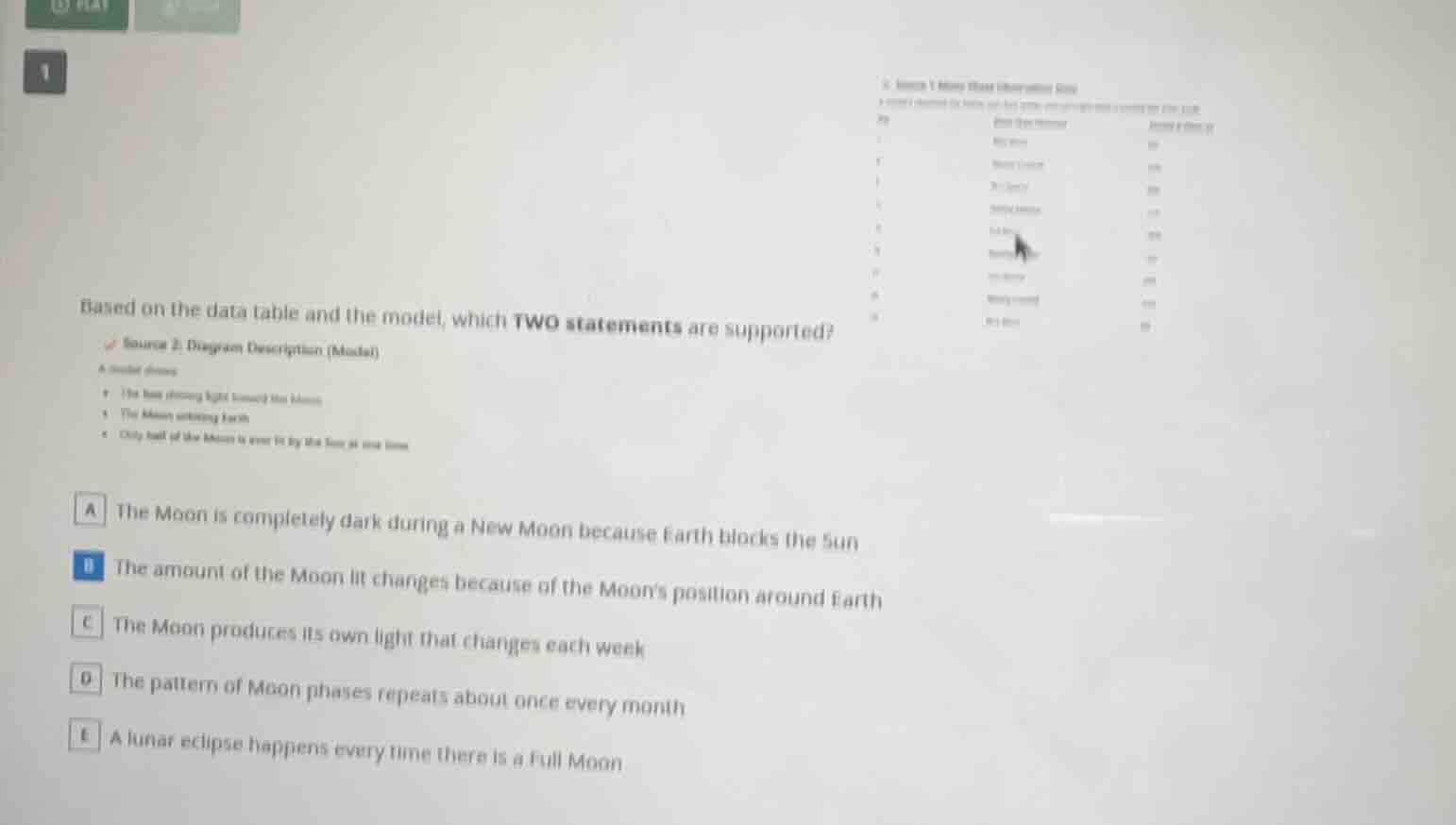
based on the data table and the model, which two statements are supported?
source 2: diagram description (model)
a model shows
- the sun shining light toward the moon
- the moon orbiting earth
- only half of the moon is ever lit by the sun at one time
a the moon is completely dark during a new moon because earth blocks the sun
b the amount of the moon lit changes because of the moon’s position around earth
c the moon produces its own light that changes each week
d the pattern of moon phases repeats about once every month
e a lunar eclipse happens every time there is a full moon
- Option A: In a New Moon, the Moon is between Earth and the Sun, and the side facing Earth is not lit by the Sun (not because Earth blocks the Sun; Earth blocking the Sun causes a solar eclipse, not the New Moon's darkness). So A is incorrect.
- Option B: The model shows the Moon orbiting Earth, and the Sun's light hits different parts of the Moon as it orbits, so the lit portion (phase) changes due to its position around Earth. This is correct.
- Option C: The Moon does not produce its own light; it reflects sunlight. So C is incorrect.
- Option D: The lunar cycle (pattern of Moon phases) takes about 29.5 days, which is approximately once a month. This is supported by the model and our understanding of Moon phases. So D is correct.
- Option E: A lunar eclipse occurs when Earth is between the Sun and the Moon, and the Moon enters Earth's shadow. This does not happen every full Moon because the Moon's orbit is tilted relative to Earth's orbit around the Sun, so the alignment for an eclipse is less frequent. So E is incorrect.

Snap & solve any problem in the app
Get step-by-step solutions on Sovi AI
Photo-based solutions with guided steps
Explore more problems and detailed explanations
B. The amount of the Moon lit changes because of the Moon's position around Earth
D. The pattern of Moon phases repeats about once every month