QUESTION IMAGE
Question
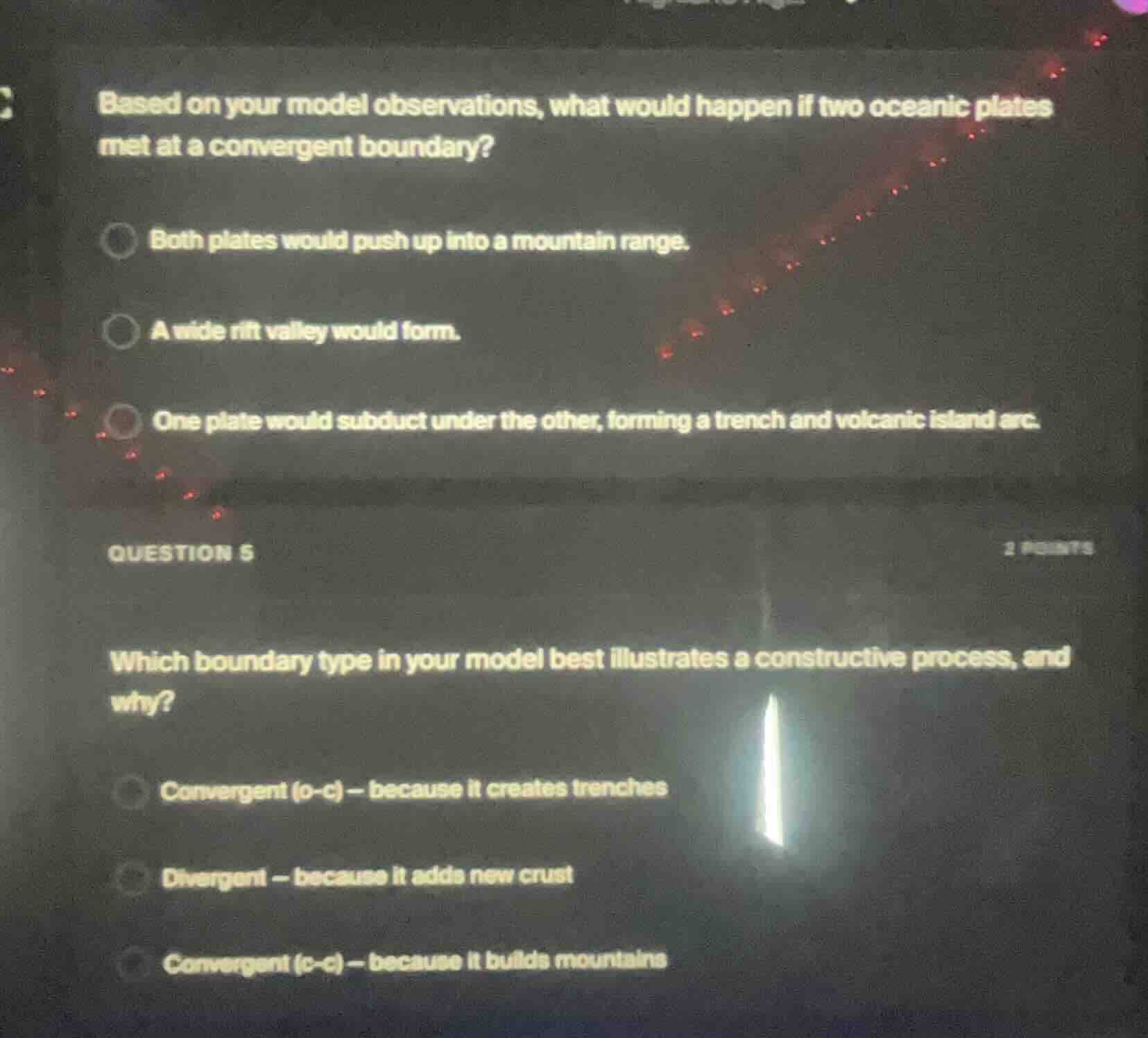
based on your model observations, what would happen if two oceanic plates met at a convergent boundary? both plates would push up into a mountain range. a wide rift valley would form. one plate would subduct under the other, forming a trench and volcanic island arc. question 5 2 points which boundary type in your model best illustrates a constructive process, and why? convergent (o-c) — because it creates trenches divergent — because it adds new crust convergent (c-c) — because it builds mountains
Response
Question (about two oceanic plates at convergent boundary)
Brief Explanations
- For the first option: Mountain ranges form at convergent boundaries of continental - continental plates, not oceanic - oceanic. So this is incorrect.
- For the second option: Rift valleys form at divergent boundaries, not convergent. So this is incorrect.
- For the third option: At a convergent boundary of two oceanic plates, the denser plate subducts under the less dense one. This subduction forms a trench at the boundary and a volcanic island arc as magma rises from the subducted plate. So this is correct.
Brief Explanations
- Constructive processes add new material to the Earth's crust.
- Divergent boundaries are where tectonic plates move apart. Magma rises from the mantle to fill the gap, cooling and solidifying to form new crust (like mid - ocean ridges).
- Convergent (o - c) boundaries involve subduction (a destructive process as crust is destroyed), and convergent (c - c) boundaries form mountains by compressing crust, not adding new crust. So the divergent boundary is the one with a constructive process as it adds new crust.

Snap & solve any problem in the app
Get step-by-step solutions on Sovi AI
Photo-based solutions with guided steps
Explore more problems and detailed explanations
One plate would subduct under the other, forming a trench and volcanic island arc.