QUESTION IMAGE
Question
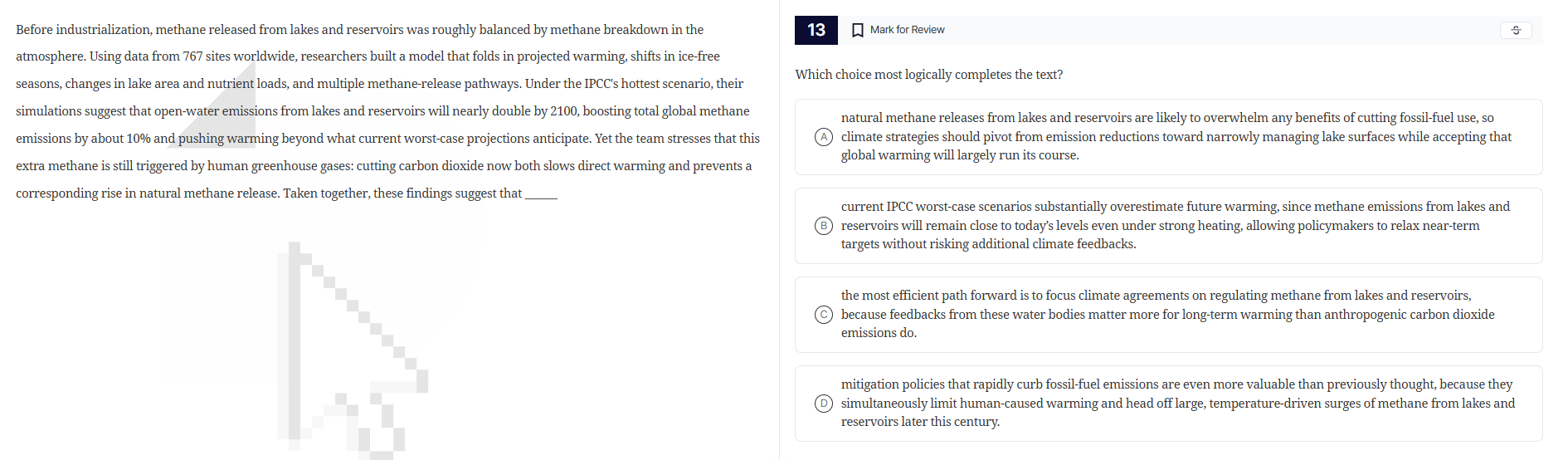
before industrialization, methane released from lakes and reservoirs was roughly balanced by methane breakdown in the atmosphere. using data from 767 sites worldwide, researchers built a model that folds in projected warming, shifts in ice - free seasons, changes in lake area and nutrient loads, and multiple methane - release pathways. under the ipccs hottest scenario, their simulations suggest that open - water emissions from lakes and reservoirs will nearly double by 2100, boosting total global methane emissions by about 10% and pushing warming beyond what current worst - case projections anticipate. yet the team stresses that this extra methane is still triggered by human greenhouse gases: cutting carbon dioxide now both slows direct warming and prevents a corresponding rise in natural methane release. taken together, these findings suggest that ______
13 mark for review
which choice most logically completes the text?
a natural methane releases from lakes and reservoirs are likely to overwhelm any benefits of cutting fossil - fuel use, so climate strategies should pivot from emission reductions toward narrowly managing lake surfaces while accepting that global warming will largely run its course.
b current ipcc worst - case scenarios substantially overestimate future warming, since methane emissions from lakes and reservoirs will remain close to todays levels even under strong heating, allowing policymakers to relax near - term targets without risking additional climate feedbacks.
c the most efficient path forward is to focus climate agreements on regulating methane from lakes and reservoirs, because feedbacks from these water bodies matter more for long - term warming than anthropogenic carbon dioxide emissions do.
d mitigation policies that rapidly curb fossil - fuel emissions are even more valuable than previously thought, because they simultaneously limit human - caused warming and head off large, temperature - driven surges of methane from lakes and reservoirs later this century.
To solve this, we analyze the text and each option:
- The text states that cutting carbon dioxide slows direct warming and prevents natural methane release.
- Option A: The text doesn't suggest pivoting from emission reductions, so A is wrong.
- Option B: The simulations show methane emissions from lakes will nearly double, so B's claim that they'll stay near today's levels is false.
- Option C: The text says cutting CO₂ helps, so C's claim that lake methane matters more than anthropogenic CO₂ is wrong.
- Option D: Since cutting fossil - fuel (CO₂) emissions both slow warming and prevent natural methane release (which will surge with warming), mitigation policies curbing fossil - fuel emissions are more valuable as they address both, matching the text's findings.

Snap & solve any problem in the app
Get step-by-step solutions on Sovi AI
Photo-based solutions with guided steps
Explore more problems and detailed explanations
D. mitigation policies that rapidly curb fossil - fuel emissions are even more valuable than previously thought, because they simultaneously limit human - caused warming and head off large, temperature - driven surges of methane from lakes and reservoirs later this century.