QUESTION IMAGE
Question
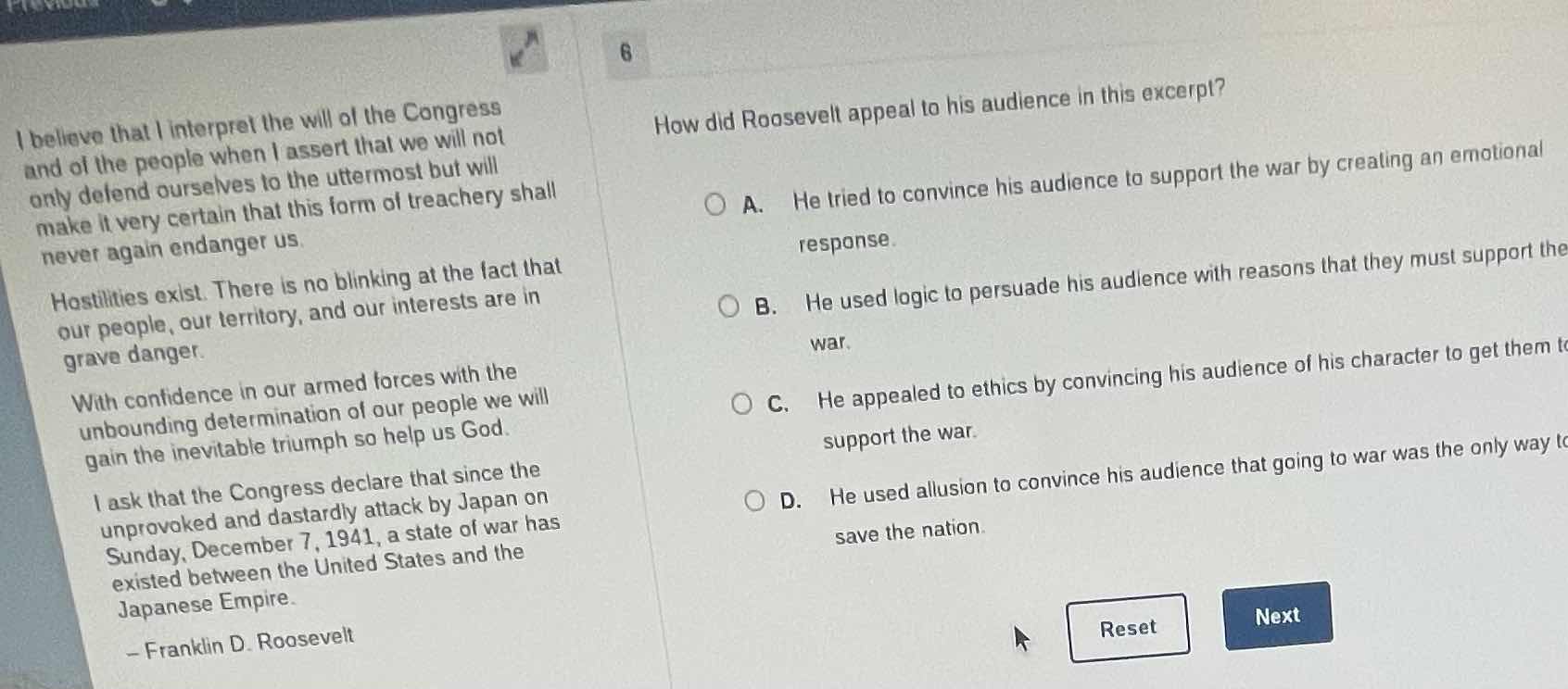
i believe that i interpret the will of the congress and of the people when i assert that we will not only defend ourselves to the uttermost but will make it very certain that this form of treachery shall never again endanger us. hostilities exist. there is no blinking at the fact that our people, our territory, and our interests are in grave danger. with confidence in our armed forces with the unbounding determination of our people we will gain the inevitable triumph so help us god. i ask that the congress declare that since the unprovoked and dastardly attack by japan on sunday, december 7, 1941, a state of war has existed between the united states and the japanese empire. —franklin d. roosevelt 6 how did roosevelt appeal to his audience in this excerpt? a. he tried to convince his audience to support the war by creating an emotional response. b. he used logic to persuade his audience with reasons that they must support the war. c. he appealed to ethics by convincing his audience of his character to get them to support the war. d. he used allusion to convince his audience that going to war was the only way to save the nation.
To determine how Roosevelt appealed to his audience, we analyze each option:
- Option A: The excerpt has phrases like "treachery", "grave danger", and "so help us God" which aim to evoke emotions (patriotism, outrage, determination) to get support for war.
- Option B: There's no logical reasoning (like facts/statistics) shown; it's more emotional.
- Option C: The excerpt doesn't focus on his character/ethics (like moral credentials) but on the situation and emotions.
- Option D: No allusion (reference to other works/ideas) is used; it's direct about the attack and danger.
So, Roosevelt used emotional appeals.

Snap & solve any problem in the app
Get step-by-step solutions on Sovi AI
Photo-based solutions with guided steps
Explore more problems and detailed explanations
A. He tried to convince his audience to support the war by creating an emotional response.