QUESTION IMAGE
Question
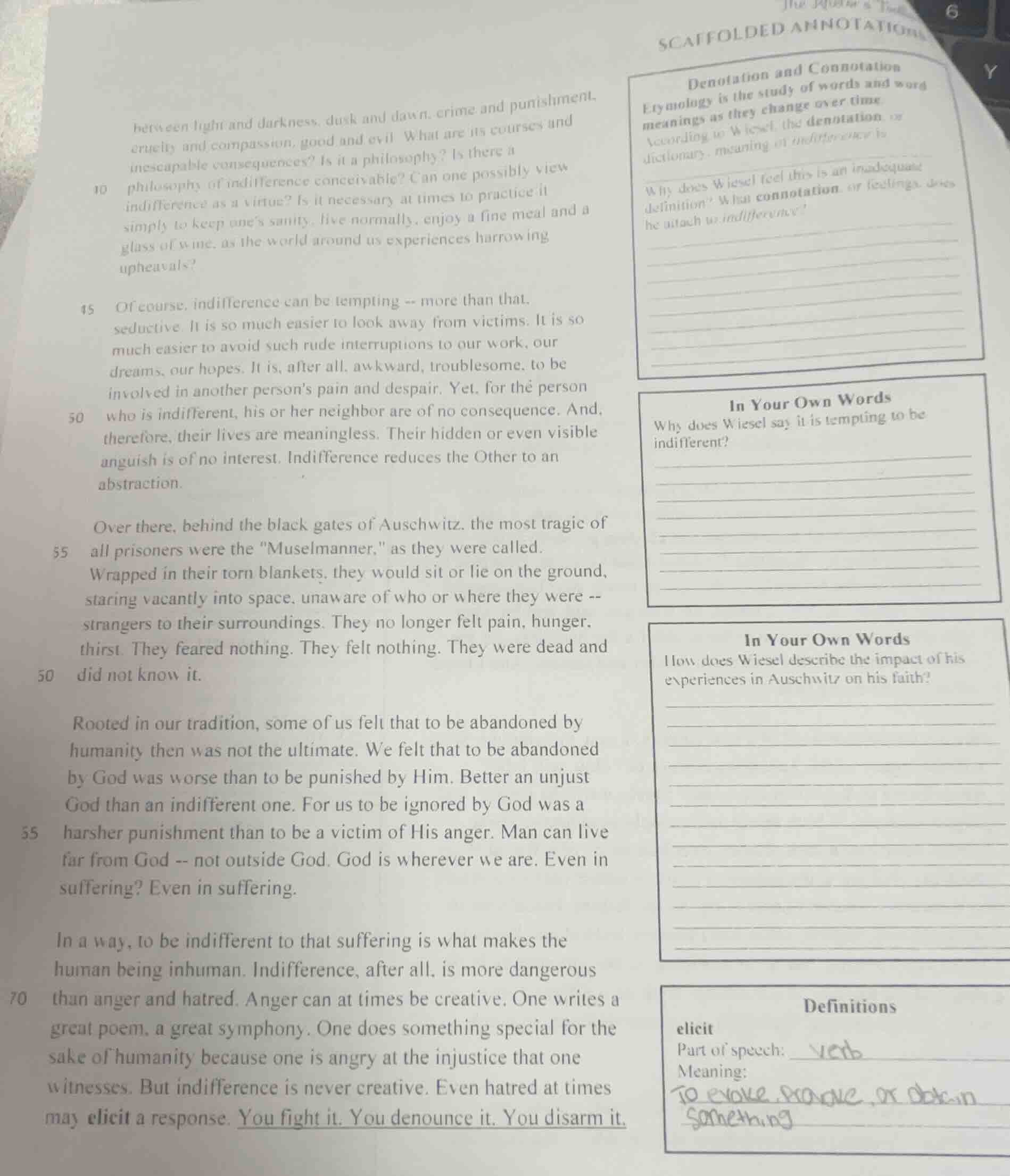
between light and darkness, dusk and dawn, crime and punishment, cruelty and compassion, good and evil. what are its courses and inescapable consequences? is it a philosophy? is there a philosophy of indifference conceivable? can one possibly view indifference as a virtue? is it necessary at times to practice it simply to keep one’s sanity, live normally, enjoy a fine meal and a glass of wine, as the world around us experiences harrowing upheavals?
15 of course, indifference can be tempting -- more than that, seductive. it is so much easier to look away from victims. it is so much easier to avoid such rude interruptions to our work, our dreams, our hopes. it is, after all, awkward, troublesome, to be involved in another person’s pain and despair. yet, for the person
50 who is indifferent, his or her neighbor are of no consequence. and, therefore, their lives are meaningless. their hidden or even visible anguish is of no interest. indifference reduces the other to an abstraction.
over there, behind the black gates of auschwitz, the most tragic of
55 all prisoners were the \muselmannner,\ as they were called. wrapped in their torn blankets, they would sit or lie on the ground, staring vacantly into space, unaware of who or where they were -- strangers to their surroundings. they no longer felt pain, hunger, thirst. they feared nothing. they felt nothing. they were dead and
did not know it.
rooted in our tradition, some of us felt that to be abandoned by humanity then was not the ultimate. we felt that to be abandoned by god was worse than to be punished by him. better an unjust god than an indifferent one. for us to be ignored by god was a
35 harsher punishment than to be a victim of his anger. man can live far from god -- not outside god. god is wherever we are. even in suffering? even in suffering.
in a way, to be indifferent to that suffering is what makes the human being inhuman. indifference, after all, is more dangerous
70 than anger and hatred. anger can at times be creative. one writes a great poem, a great symphony. one does something special for the sake of humanity because one is angry at the injustice that one witnesses. but indifference is never creative. even hatred at times may elicit a response. you fight it. you denounce it. you disarm it.
denotation and connotation
etymology is the study of words and word meanings as they change over time
according to wiesel, the denotation, or dictionary, meaning of indifference is
why does wiesel feel this is an inadequate definition? what connotation, or feelings, does he attach to indifference?
in your own words
why does wiesel say it is tempting to be indifferent?
in your own words
how does wiesel describe the impact of his experiences in auschwitz on his faith?
definitions
elicit
part of speech:
meaning:
- Denotation and Connotation: Wiesel finds the dictionary definition of indifference (lack of concern) inadequate because it ignores the moral weight and dehumanizing harm indifference causes. He attaches connotations of cruelty, moral failure, and dehumanization to indifference, as it reduces suffering people to meaningless abstractions.
- In Your Own Words (Tempting Indifference): Wiesel says indifference is tempting because it lets people avoid the discomfort of engaging with others' pain, and allows them to carry on with normal life instead of confronting harrowing upheavals around them.
- In Your Own Words (Faith Impact): Wiesel describes that his Auschwitz experience made him question God's presence; he felt being abandoned by an indifferent God was a harsher punishment than God's anger, as being ignored felt worse than facing divine wrath, even as he clung to the idea God exists in suffering.

Snap & solve any problem in the app
Get step-by-step solutions on Sovi AI
Photo-based solutions with guided steps
Explore more problems and detailed explanations
- Denotation and Connotation: Wiesel rejects the flat dictionary definition because it misses indifference's dehumanizing harm; he links it to moral failure and cruelty.
- Tempting Indifference: It lets people avoid others' pain and maintain normalcy.
- Faith Impact: He felt God's indifference was worse than anger, shaking his faith while still clinging to the idea God exists in suffering.