QUESTION IMAGE
Question
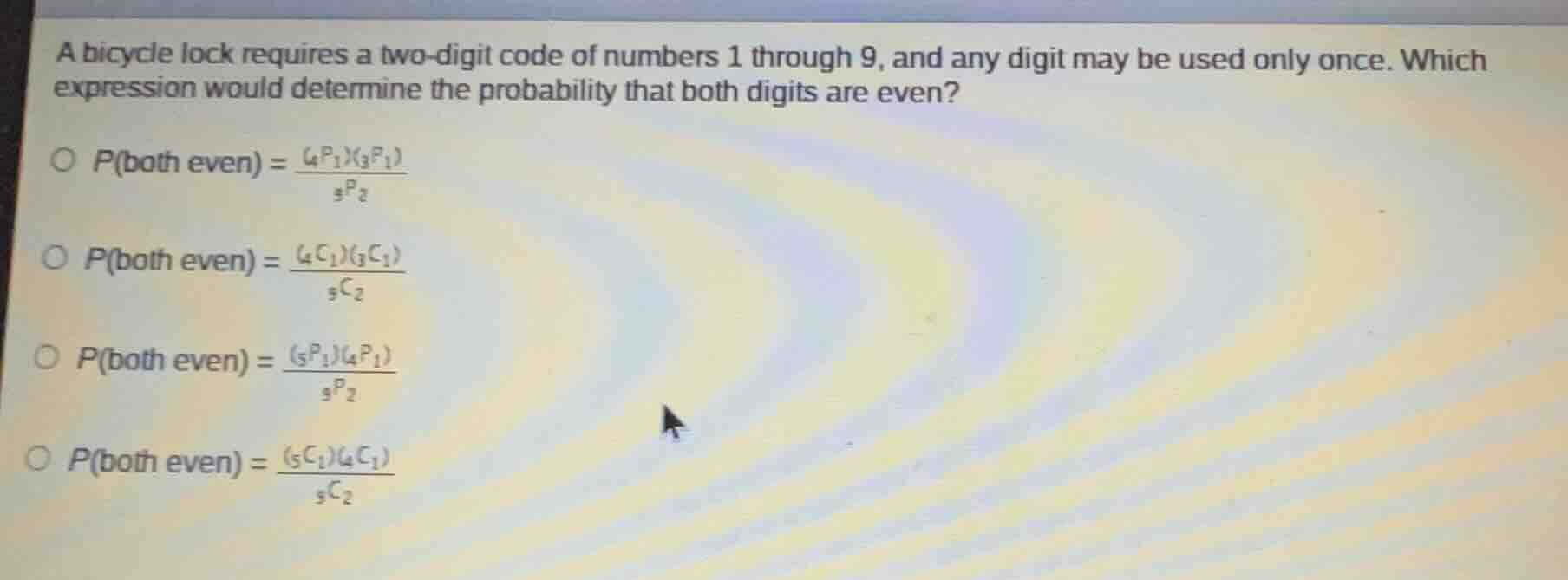
a bicycle lock requires a two - digit code of numbers 1 through 9, and any digit may be used only once. which expression would determine the probability that both digits are even?
- ( p(\text{both even})=\frac{(_{4}p_{1})(_{3}p_{1})}{_{9}p_{2}} )
- ( p(\text{both even})=\frac{(_{4}c_{1})(_{3}c_{1})}{_{9}c_{2}} )
- ( p(\text{both even})=\frac{(_{5}p_{1})(_{4}p_{1})}{_{9}p_{2}} )
- ( p(\text{both even})=\frac{(_{5}c_{1})(_{4}c_{1})}{_{9}c_{2}} )
Step1: Identify even numbers from 1 - 9
Even numbers between 1 and 9 are 2, 4, 6, 8. So there are 4 even numbers.
Step2: Determine the type of arrangement (permutation or combination)
Since the code is a two - digit code and the order of digits matters (e.g., 24 is different from 42), we use permutations. The number of ways to choose and arrange 2 digits from 4 even numbers: first digit can be chosen in \(_{4}P_{1}\) ways and the second digit (after choosing the first) can be chosen in \(_{3}P_{1}\) ways (because one digit is already used). The total number of ways to choose and arrange 2 digits from 9 numbers (1 - 9) is \(_{9}P_{2}\) (permutation of 9 numbers taken 2 at a time).
The probability \(P=\frac{\text{Number of favorable outcomes}}{\text{Total number of outcomes}}\). The number of favorable outcomes (both digits even) is \((_{4}P_{1})(_{3}P_{1})\) and total number of outcomes is \(_{9}P_{2}\). So \(P(\text{both even})=\frac{(_{4}P_{1})(_{3}P_{1})}{_{9}P_{2}}\)

Snap & solve any problem in the app
Get step-by-step solutions on Sovi AI
Photo-based solutions with guided steps
Explore more problems and detailed explanations
\(P(\text{both even})=\frac{(_{4}P_{1})(_{3}P_{1})}{_{9}P_{2}}\) (the first option)