QUESTION IMAGE
Question
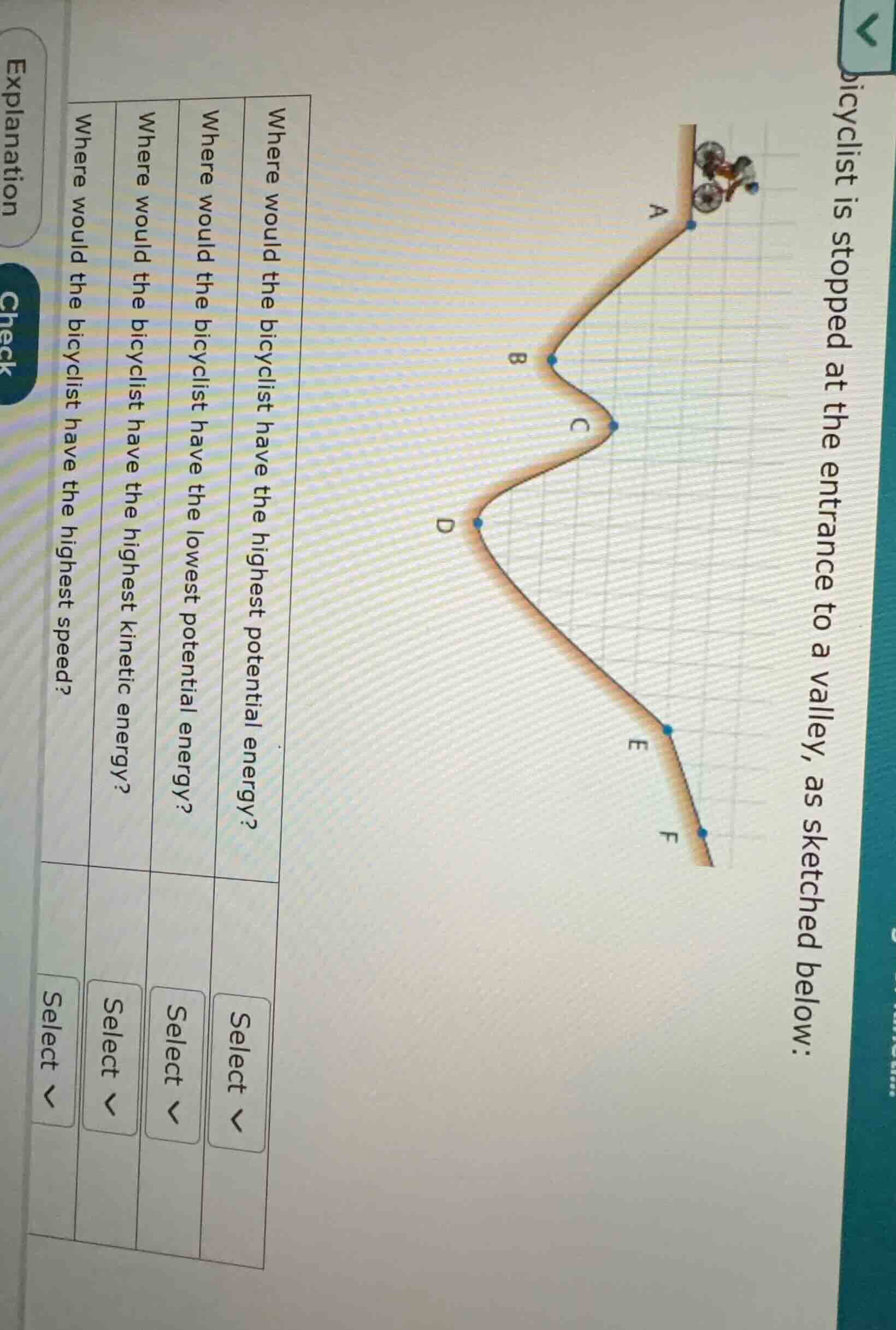
bicyclist is stopped at the entrance to a valley, as sketched below:
where would the bicyclist have the highest potential energy? select
where would the bicyclist have the lowest potential energy? select
where would the bicyclist have the highest kinetic energy? select
where would the bicyclist have the highest speed? select
1. Where would the bicyclist have the highest potential energy?
Potential energy (PE) in the context of gravitational potential energy is given by \( PE = mgh \), where \( m \) is mass, \( g \) is acceleration due to gravity, and \( h \) is height. Higher height means higher potential energy (assuming mass and \( g \) are constant). From the diagram, point A is the highest point among A, B, C, D, E, F. So at point A, the height \( h \) is maximum, so potential energy is maximum.
Using \( PE = mgh \), lower height means lower potential energy. Among the points, point D (or check the diagram for the lowest height; typically the lowest point in the valley - looking at the diagram, D or maybe another low point, but generally the lowest height point will have lowest PE. Assuming D is the lowest (or check the vertical position: the lowest y - coordinate). So the point with the lowest height (closest to the bottom) will have the lowest PE.
Kinetic energy \( KE=\frac{1}{2}mv^{2} \). By conservation of mechanical energy (ignoring non - conservative forces like friction), \( PE + KE=\text{constant} \). So when PE is lowest, KE is highest (since total energy is constant). The point with the lowest PE (from part 2, say D) will have the highest KE, because as the bicyclist moves down, PE is converted to KE. So the point with the lowest PE (lowest height) will have the highest KE.

Snap & solve any problem in the app
Get step-by-step solutions on Sovi AI
Photo-based solutions with guided steps
Explore more problems and detailed explanations
A (Point A)