QUESTION IMAGE
Question
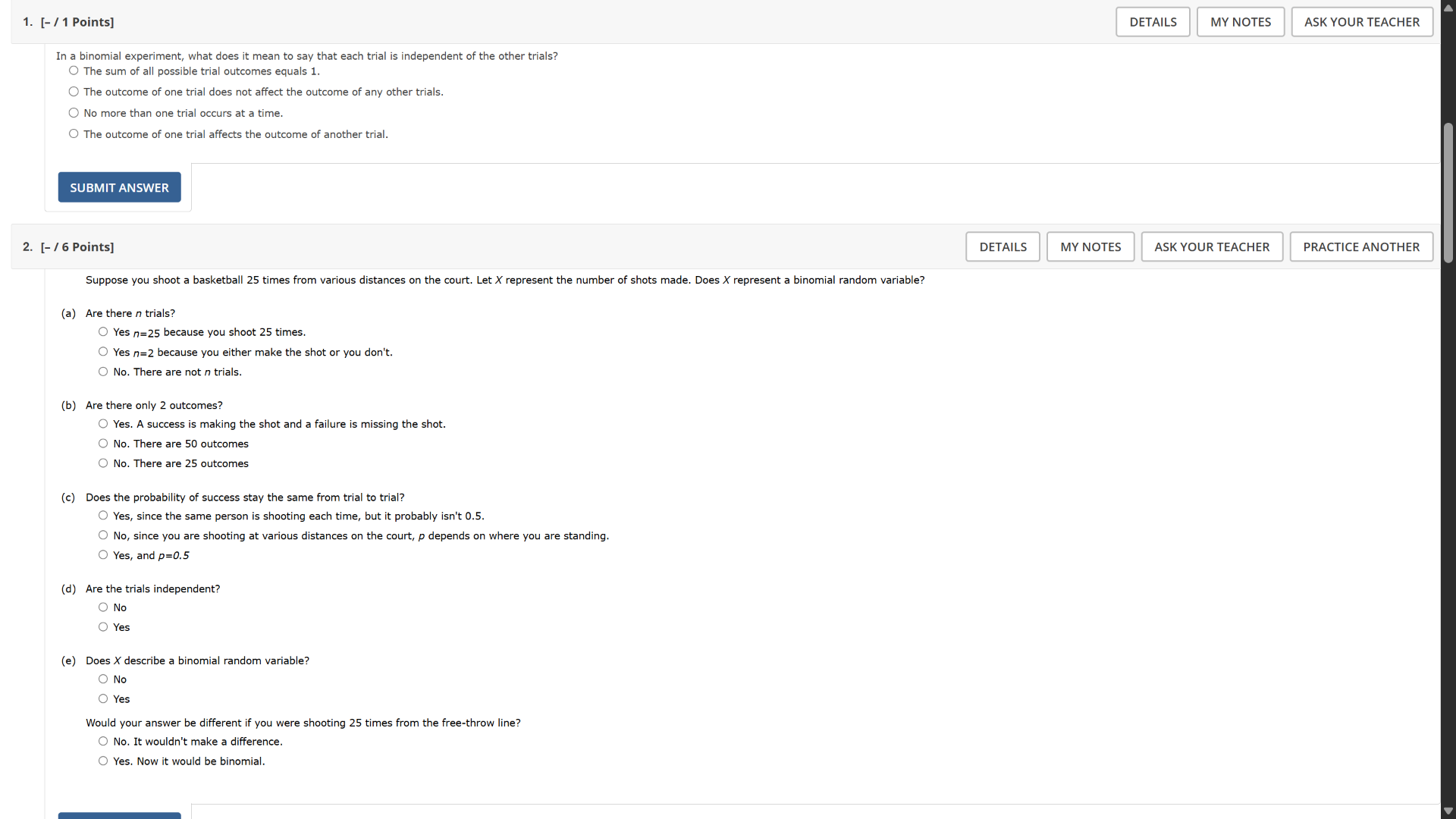
- in a binomial experiment, what does it mean to say that each trial is independent of the other trials?
the sum of all possible trial outcomes equals 1.
the outcome of one trial does not affect the outcome of any other trials.
no more than one trial occurs at a time.
the outcome of one trial affects the outcome of another trial.
- suppose you shoot a basketball 25 times from various distances on the court. let x represent the number of shots made. does x represent a binomial random variable?
(a) are there n trials?
yes n=25 because you shoot 25 times.
yes n=2 because you either make the shot or you dont.
no. there are not n trials.
(b) are there only 2 outcomes?
yes. a success is making the shot and a failure is missing the shot.
no. there are 50 outcomes
no. there are 25 outcomes
(c) does the probability of success stay the same from trial to trial?
yes, since the same person is shooting each time, but it probably isnt 0.5.
no, since you are shooting at various distances on the court, p depends on where you are standing.
yes, and p=0.5
(d) are the trials independent?
no
yes
(e) does x describe a binomial random variable?
no
yes
would your answer be different if you were shooting 25 times from the free - throw line?
no. it wouldnt make a difference.
yes. now it would be binomial.
Question 1
To determine the correct option for the meaning of independent trials in a binomial experiment, we recall the definition of independent events in probability: the outcome of one trial should not influence the outcome of another.
- The first option refers to the sum of probabilities of all outcomes (which is always 1 for a probability distribution, not related to independence).
- The third option is about the timing of trials, not independence.
- The fourth option is the opposite of independence.
- The second option correctly states that the outcome of one trial does not affect the outcome of any other trials.
In a binomial experiment, \( n \) represents the number of independent trials. Here, shooting a basketball 25 times means there are 25 trials. So \( n = 25 \). The second option confuses the number of outcomes (success/failure) with the number of trials. The third option is incorrect as there are 25 trials.
For a binomial experiment, there are two possible outcomes for each trial: success (making the shot) or failure (missing the shot). The other options (50 or 25 outcomes) are incorrect as each shot has only two possible results.

Snap & solve any problem in the app
Get step-by-step solutions on Sovi AI
Photo-based solutions with guided steps
Explore more problems and detailed explanations
B. The outcome of one trial does not affect the outcome of any other trials.