QUESTION IMAGE
Question
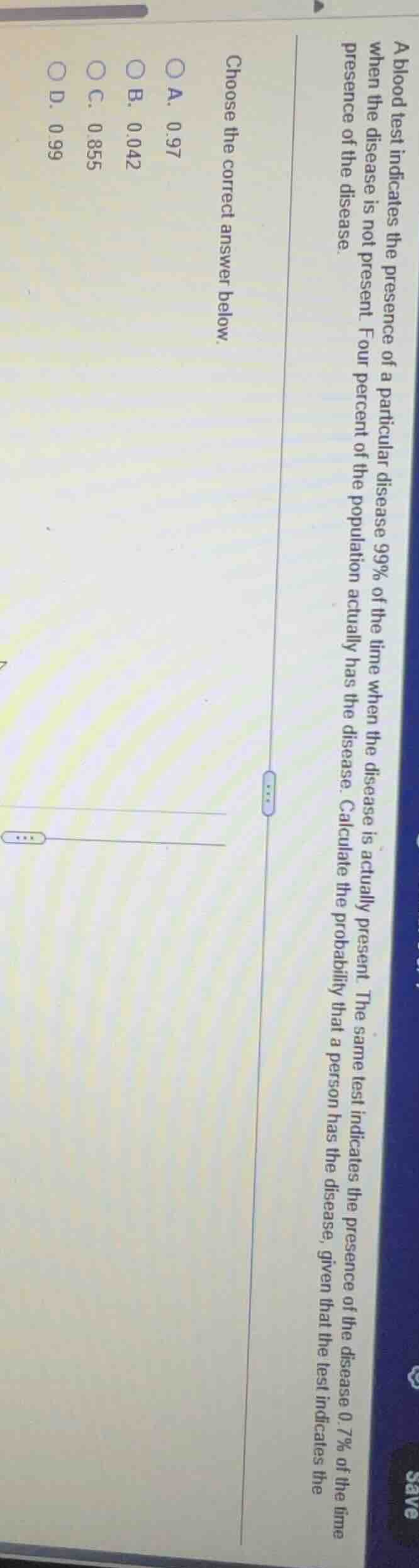
a blood test indicates the presence of a particular disease 99% of the time when the disease is actually present. the same test indicates the presence of the disease 0.7% of the time when the disease is not present. four percent of the population actually has the disease. calculate the probability that a person has the disease, given that the test indicates the presence of the disease. choose the correct answer below. a. 0.97 b. 0.042 c. 0.855 d. 0.99
Step1: Define events and probabilities
Let $D$ = person has disease, $+$ = test positive.
$P(D) = 0.04$, $P(
eg D) = 1 - 0.04 = 0.96$
$P(+|D) = 0.99$, $P(+|
eg D) = 0.007$
Step2: Apply Bayes' Theorem
We need $P(D|+) = \frac{P(+|D)P(D)}{P(+|D)P(D) + P(+|
eg D)P(
eg D)}$
Step3: Calculate numerator
$P(+|D)P(D) = 0.99 \times 0.04 = 0.0396$
Step4: Calculate denominator
$P(+|D)P(D) + P(+|
eg D)P(
eg D) = 0.0396 + (0.007 \times 0.96) = 0.0396 + 0.00672 = 0.04632$
Step5: Compute final probability
$P(D|+) = \frac{0.0396}{0.04632} \approx 0.855$

Snap & solve any problem in the app
Get step-by-step solutions on Sovi AI
Photo-based solutions with guided steps
Explore more problems and detailed explanations
C. 0.855