QUESTION IMAGE
Question
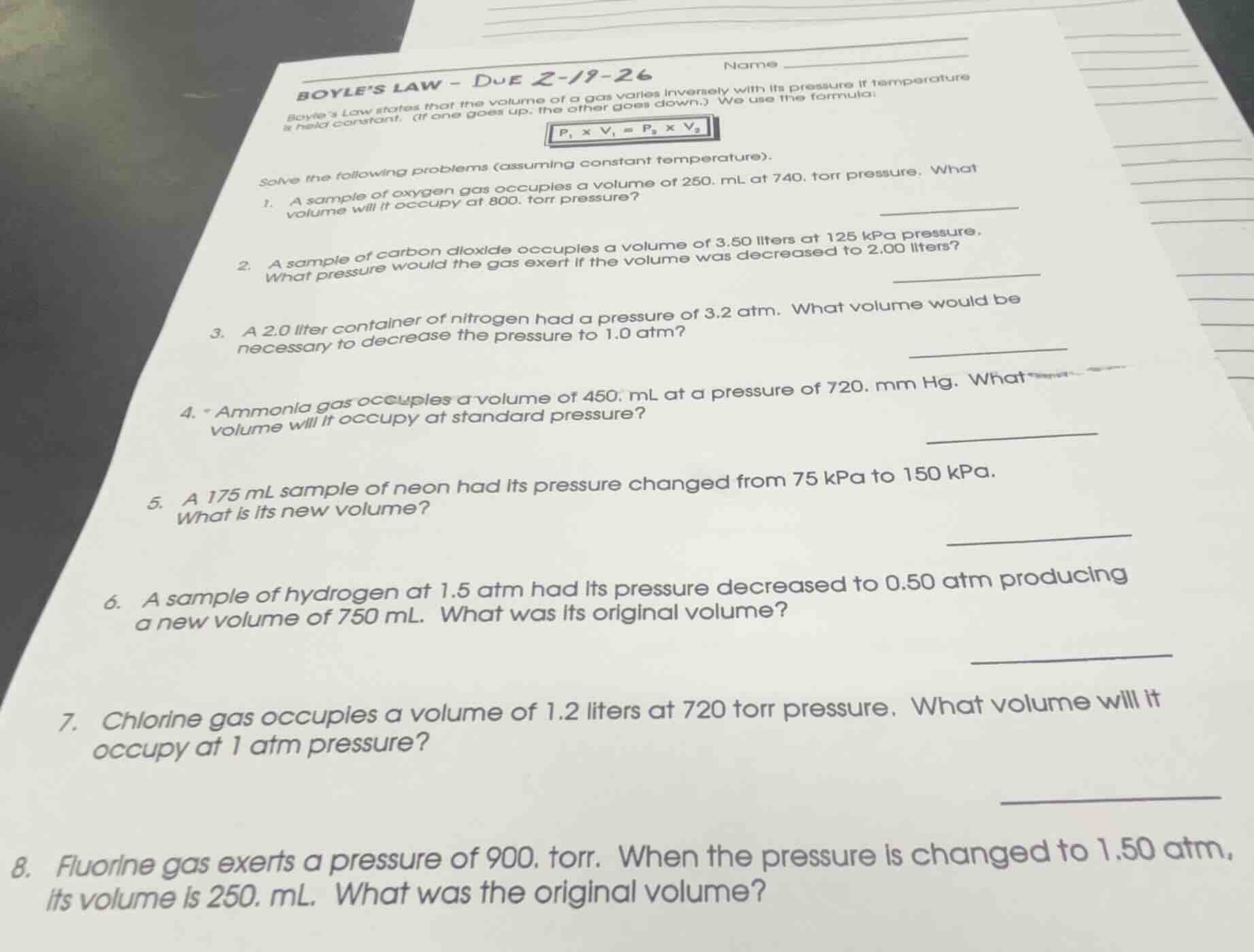
boyles law - due 2-19-26
name
boyles law states that the volume of a gas varies inversely with its pressure if temperature
is held constant. (if one goes up, the other goes down.) we use the formula:
$p_1 \times v_1 = p_2 \times v_2$
solve the following problems (assuming constant temperature).
- a sample of oxygen gas occupies a volume of 250. ml at 740. torr pressure. what
volume will it occupy at 800. torr pressure?
- a sample of carbon dioxide occupies a volume of 3.50 liters at 125 kpa pressure.
what pressure would the gas exert if the volume was decreased to 2.00 liters?
- a 2.0 liter container of nitrogen had a pressure of 3.2 atm. what volume would be
necessary to decrease the pressure to 1.0 atm?
- ammonia gas occupies a volume of 450. ml at a pressure of 720. mm hg. what
volume will it occupy at standard pressure?
- a 175 ml sample of neon had its pressure changed from 75 kpa to 150 kpa.
what is its new volume?
- a sample of hydrogen at 1.5 atm had its pressure decreased to 0.50 atm producing
a new volume of 750 ml. what was its original volume?
- chlorine gas occupies a volume of 1.2 liters at 720 torr pressure. what volume will it
occupy at 1 atm pressure?
- fluorine gas exerts a pressure of 900. torr. when the pressure is changed to 1.50 atm,
its volume is 250. ml. what was the original volume?
Step1: Rearrange Boyle's Law for $V_2$
$V_2 = \frac{P_1 V_1}{P_2}$
Step2: Substitute values for Q1
$V_2 = \frac{740. \text{ torr} \times 250. \text{ mL}}{800. \text{ torr}} = 231.25 \text{ mL}$
Step3: Rearrange Boyle's Law for $P_2$
$P_2 = \frac{P_1 V_1}{V_2}$
Step4: Substitute values for Q2
$P_2 = \frac{125 \text{ kPa} \times 3.50 \text{ L}}{2.00 \text{ L}} = 218.75 \text{ kPa}$
Step5: Substitute values for Q3
$V_2 = \frac{3.2 \text{ atm} \times 2.0 \text{ L}}{1.0 \text{ atm}} = 6.4 \text{ L}$
Step6: Use standard pressure (760 mm Hg) for Q4
$V_2 = \frac{720. \text{ mm Hg} \times 450. \text{ mL}}{760. \text{ mm Hg}} \approx 426.32 \text{ mL}$
Step7: Substitute values for Q5
$V_2 = \frac{75 \text{ kPa} \times 175 \text{ mL}}{150 \text{ kPa}} = 87.5 \text{ mL}$
Step8: Rearrange for original $V_1$ (Q6)
$V_1 = \frac{P_2 V_2}{P_1}$
Step9: Substitute values for Q6
$V_1 = \frac{0.50 \text{ atm} \times 750 \text{ mL}}{1.5 \text{ atm}} = 250 \text{ mL}$
Step10: Convert 1 atm to 760 torr (Q7)
$V_2 = \frac{720 \text{ torr} \times 1.2 \text{ L}}{760 \text{ torr}} \approx 1.13 \text{ L}$
Step11: Convert 1.50 atm to 1140 torr (Q8)
$V_1 = \frac{1140 \text{ torr} \times 250. \text{ mL}}{900. \text{ torr}} \approx 316.67 \text{ mL}$

Snap & solve any problem in the app
Get step-by-step solutions on Sovi AI
Photo-based solutions with guided steps
Explore more problems and detailed explanations
- $231 \text{ mL}$ (rounded to 3 sig figs)
- $219 \text{ kPa}$ (rounded to 3 sig figs)
- $6.4 \text{ L}$
- $426 \text{ mL}$ (rounded to 3 sig figs)
- $88 \text{ mL}$ (rounded to 2 sig figs)
- $250 \text{ mL}$
- $1.1 \text{ L}$ (rounded to 2 sig figs)
- $317 \text{ mL}$ (rounded to 3 sig figs)