QUESTION IMAGE
Question
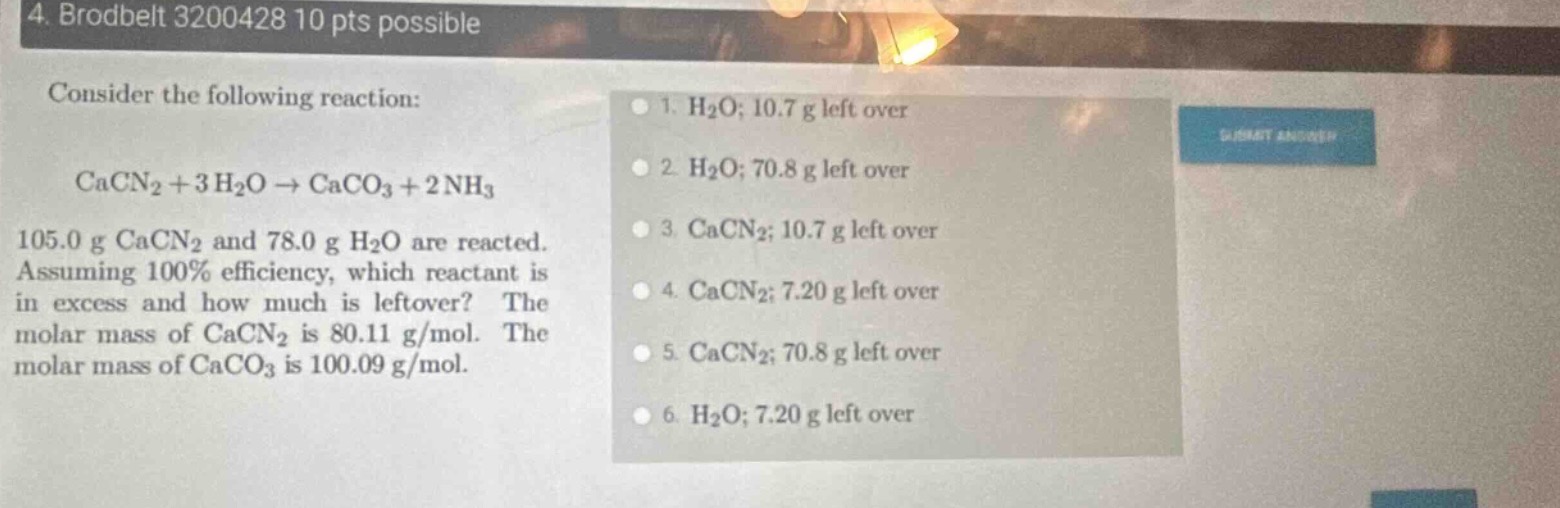
- brodbelt 3200428 10 pts possible
consider the following reaction:
\ce{cacn2 + 3 h2o -> caco3 + 2 nh3}
105.0 g \ce{cacn2} and 78.0 g \ce{h2o} are reacted. assuming 100% efficiency, which reactant is in excess and how much is leftover? the molar mass of \ce{cacn2} is 80.11 g/mol. the molar mass of \ce{caco3} is 100.09 g/mol.
\\(\boldsymbol{\circ}\\) 1. \ce{h2o}; 10.7 g left over
\\(\boldsymbol{\circ}\\) 2. \ce{h2o}; 70.8 g left over
\\(\boldsymbol{\circ}\\) 3. \ce{cacn2}; 10.7 g left over
\\(\boldsymbol{\circ}\\) 4. \ce{cacn2}; 7.20 g left over
\\(\boldsymbol{\circ}\\) 5. \ce{cacn2}; 70.8 g left over
\\(\boldsymbol{\circ}\\) 6. \ce{h2o}; 7.20 g left over
Step 1: Calculate moles of \( \text{CaCN}_2 \)
Moles of \( \text{CaCN}_2 = \frac{\text{mass}}{\text{molar mass}} = \frac{105.0\ \text{g}}{80.11\ \text{g/mol}} \approx 1.311\ \text{mol} \)
Step 2: Calculate moles of \( \text{H}_2\text{O} \)
Molar mass of \( \text{H}_2\text{O} = 18.02\ \text{g/mol} \) (since \( 2(1.008) + 16.00 = 18.016 \approx 18.02 \))
Moles of \( \text{H}_2\text{O} = \frac{78.0\ \text{g}}{18.02\ \text{g/mol}} \approx 4.328\ \text{mol} \)
Step 3: Determine stoichiometric ratio
From the reaction \( \text{CaCN}_2 + 3\text{H}_2\text{O}
ightarrow \text{CaCO}_3 + 2\text{NH}_3 \), the ratio of \( \text{CaCN}_2 \) to \( \text{H}_2\text{O} \) is \( 1:3 \).
For \( 1.311\ \text{mol}\ \text{CaCN}_2 \), moles of \( \text{H}_2\text{O} \) required = \( 1.311\ \text{mol} \times 3 = 3.933\ \text{mol} \)
Step 4: Identify limiting and excess reactant
We have \( 4.328\ \text{mol}\ \text{H}_2\text{O} \), which is more than \( 3.933\ \text{mol} \) required. So \( \text{H}_2\text{O} \) is in excess? Wait, no—wait, let's check the other way. Wait, maybe I mixed up. Wait, let's check how much \( \text{CaCN}_2 \) is needed for \( \text{H}_2\text{O} \).
Moles of \( \text{CaCN}_2 \) required for \( 4.328\ \text{mol}\ \text{H}_2\text{O} = \frac{4.328\ \text{mol}}{3} \approx 1.443\ \text{mol} \). But we have only \( 1.311\ \text{mol}\ \text{CaCN}_2 \), so \( \text{CaCN}_2 \) is limiting, and \( \text{H}_2\text{O} \) is excess? Wait, no—wait, no, let's re-express.
Wait, the reaction is 1 mol \( \text{CaCN}_2 \) reacts with 3 mol \( \text{H}_2\text{O} \).
If \( \text{CaCN}_2 \) is 1.311 mol, then \( \text{H}_2\text{O} \) needed is \( 1.311 \times 3 = 3.933 \) mol. We have 4.328 mol \( \text{H}_2\text{O} \), so excess \( \text{H}_2\text{O} \) moles = \( 4.328 - 3.933 = 0.395\ \text{mol} \)
Wait, but the options have \( \text{CaCN}_2 \) as excess? Wait, maybe I made a mistake. Wait, let's recalculate.
Wait, maybe I flipped. Let's check the mass of \( \text{CaCN}_2 \) and \( \text{H}_2\text{O} \) again. Wait, the problem says 105.0 g \( \text{CaCN}_2 \) and 78.0 g \( \text{H}_2\text{O} \).
Wait, let's calculate the mass of \( \text{H}_2\text{O} \) required to react with 105.0 g \( \text{CaCN}_2 \).
Moles of \( \text{CaCN}_2 = 105.0 / 80.11 ≈ 1.3107\ \text{mol} \)
Moles of \( \text{H}_2\text{O} \) required = \( 1.3107 \times 3 = 3.9321\ \text{mol} \)
Mass of \( \text{H}_2\text{O} \) required = \( 3.9321\ \text{mol} \times 18.02\ \text{g/mol} ≈ 70.86\ \text{g} \)
We have 78.0 g \( \text{H}_2\text{O} \), so excess \( \text{H}_2\text{O} \) = \( 78.0 - 70.86 ≈ 7.14\ \text{g} \)? Wait, but the options have \( \text{CaCN}_2 \) as excess? Wait, no—wait, maybe I messed up the limiting reactant. Wait, let's check the other way: how much \( \text{CaCN}_2 \) is needed for 78.0 g \( \text{H}_2\text{O} \).
Moles of \( \text{H}_2\text{O} = 78.0 / 18.02 ≈ 4.328\ \text{mol} \)
Moles of \( \text{CaCN}_2 \) required = \( 4.328 / 3 ≈ 1.4427\ \text{mol} \)
Mass of \( \text{CaCN}_2 \) required = \( 1.4427\ \text{mol} \times 80.11\ \text{g/mol} ≈ 115.5\ \text{g} \)
But we have only 105.0 g \( \text{CaCN}_2 \), which is less than 115.5 g. So \( \text{CaCN}_2 \) is limiting, and \( \text{H}_2\text{O} \) is in excess. Wait, but the options have \( \text{CaCN}_2 \) as excess? Wait, no—wait, the options are:
- \( \text{H}_2\text{O} \); 10.7 g left over
- \( \text{H}_2\text{O} \); 70.8 g left over
- \( \text{CaCN}_2 \); 10.7 g left over
- \( \text{CaCN}_2 \); 7.20 g left over
- \( \text{CaCN}_2 \); 70.8 g left over
- \( \text{H}_2\text{O} \);…

Snap & solve any problem in the app
Get step-by-step solutions on Sovi AI
Photo-based solutions with guided steps
Explore more problems and detailed explanations
- \( \text{H}_2\text{O} \); 7.20 g left over