QUESTION IMAGE
Question
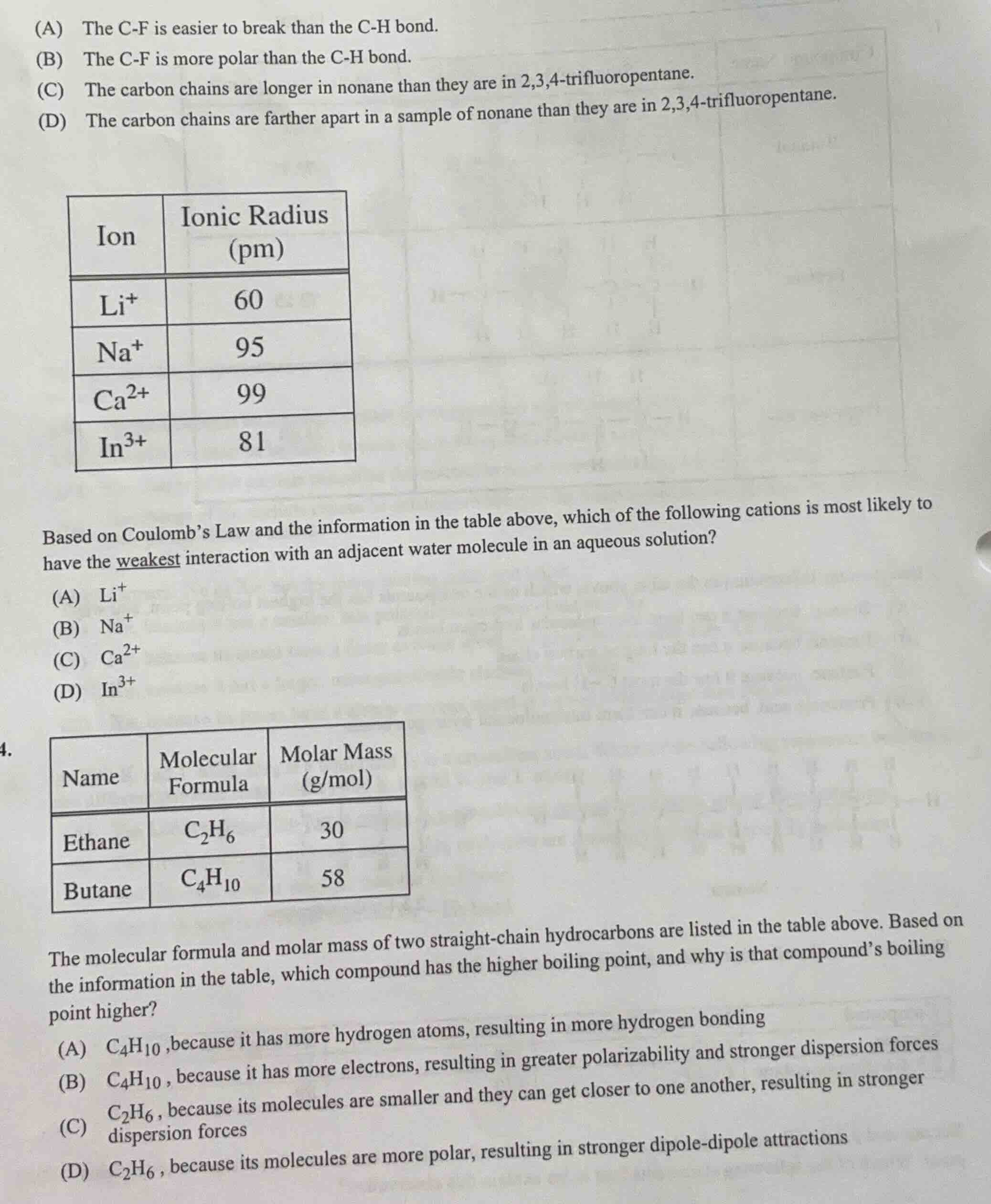
(a) the c-f is easier to break than the c-h bond.
(b) the c-f is more polar than the c-h bond.
(c) the carbon chains are longer in nonane than they are in 2,3,4 - trifluoropentane.
(d) the carbon chains are farther apart in a sample of nonane than they are in 2,3,4 - trifluoropentane.
| ion | ionic radius (pm) |
|---|---|
| na⁺ | 95 |
| ca²⁺ | 99 |
| in³⁺ | 81 |
based on coulomb’s law and the information in the table above, which of the following cations is most likely to have the weakest interaction with an adjacent water molecule in an aqueous solution?
(a) li⁺
(b) na⁺
(c) ca²⁺
(d) in³⁺
4.
| name | molecular formula | molar mass (g/mol) |
|---|---|---|
| butane | c₄h₁₀ | 58 |
the molecular formula and molar mass of two straight - chain hydrocarbons are listed in the table above. based on the information in the table, which compound has the higher boiling point, and why is that compound’s boiling point higher?
(a) c₄h₁₀, because it has more hydrogen atoms, resulting in more hydrogen bonding
(b) c₄h₁₀, because it has more electrons, resulting in greater polarizability and stronger dispersion forces
(c) c₂h₆, because its molecules are smaller and they can get closer to one another, resulting in stronger dispersion forces
(d) c₂h₆, because its molecules are more polar, resulting in stronger dipole - dipole attractions
First Question (Ionic Interaction with Water)
Coulomb’s Law for interaction strength (\(F\)) is \(F \propto \frac{q_1q_2}{r^2}\), where \(q\) is charge and \(r\) is distance (ionic radius here). For water (polar, \(q_2\) is dipole charge), weaker interaction needs smaller \(q_1\) (charge) and larger \(r\) (ionic radius).
- \( \text{Li}^+ \): charge \(+1\), radius \(60\) pm.
- \( \text{Na}^+ \): charge \(+1\), radius \(95\) pm (larger radius than \(\text{Li}^+\), same charge).
- \( \text{Ca}^{2+} \): charge \(+2\) (higher charge than \(+1\), so stronger interaction).
- \( \text{In}^{3+} \): charge \(+3\) (higher charge, stronger interaction).
Among \(+1\) charged ions, \(\text{Na}^+\) has larger radius, so its interaction with water’s dipole is weakest (since \(F\) depends on \(1/r^2\) and same charge; larger \(r\) means smaller \(F\)).
Hydrocarbons (ethane, butane) are nonpolar, so boiling point depends on London dispersion forces (LDF). LDF strength increases with molar mass (more electrons, greater polarizability).
- Ethane (\( \text{C}_2\text{H}_6 \)): molar mass \(30\) g/mol.
- Butane (\( \text{C}_4\text{H}_{10} \)): molar mass \(58\) g/mol (higher molar mass, more electrons).
Option A: Hydrocarbons don’t form H - bonds (no O, N, F bonded to H). Option C: Smaller molecules have weaker LDF (closer molecules don’t overcome molar mass effect). Option D: Hydrocarbons are nonpolar, no dipole - dipole. Option B: Butane has more electrons, greater polarizability, stronger LDF, so higher boiling point.

Snap & solve any problem in the app
Get step-by-step solutions on Sovi AI
Photo-based solutions with guided steps
Explore more problems and detailed explanations
B. \( \text{Na}^+ \)