QUESTION IMAGE
Question
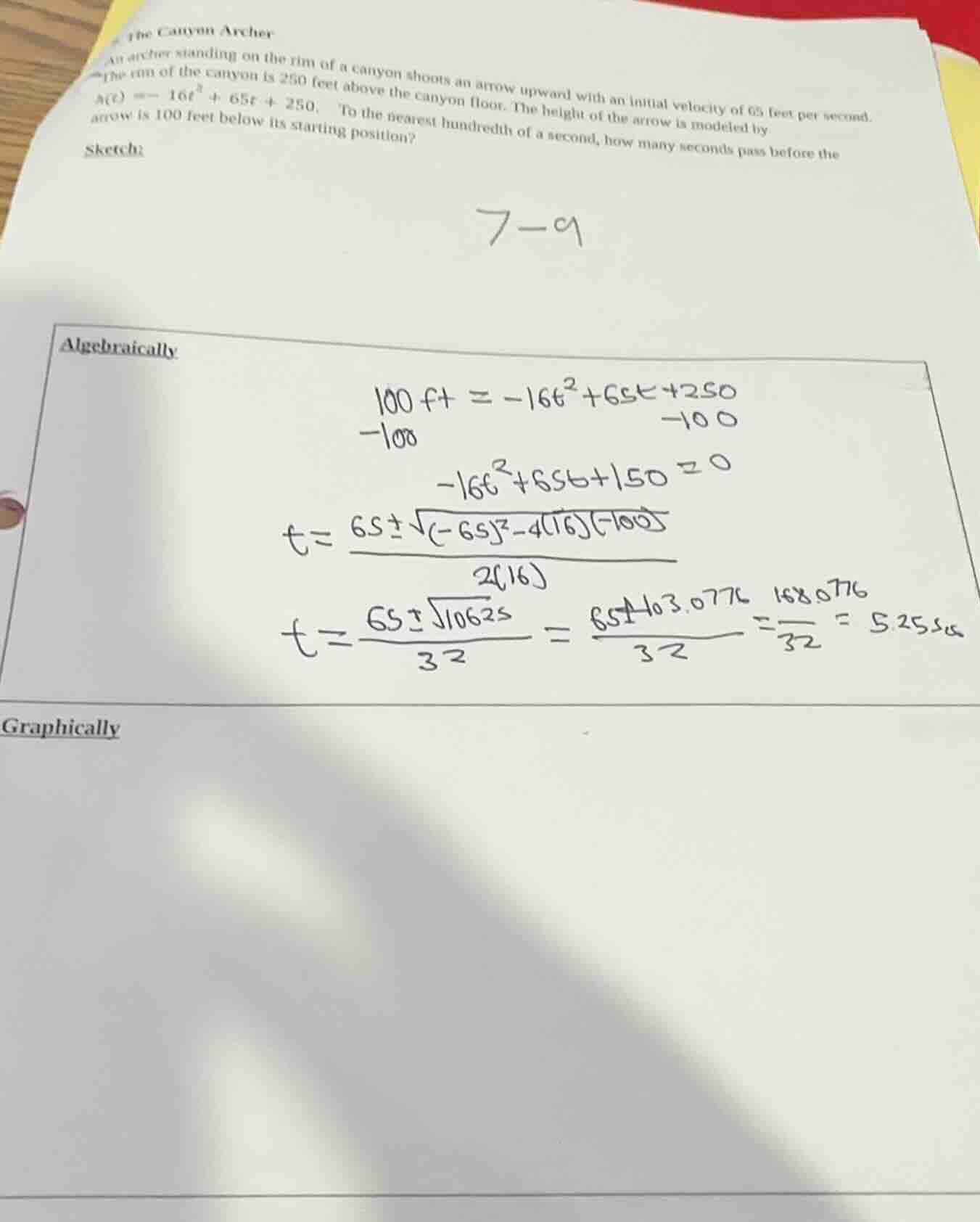
the canyon archer
an archer standing on the rim of a canyon shoots an arrow upward with an initial velocity of 65 feet per second. the rim of the canyon is 250 feet above the canyon floor. the height of the arrow is modeled by ( a(t) = -16t^2 + 65t + 250 ). to the nearest hundredth of a second, how many seconds pass before the arrow is 100 feet below its starting position?
sketch:
algebraically:
( 100 = -16t^2 + 65t + 250 )
( -16t^2 + 65t + 150 = 0 )
( t = \frac{65 pm sqrt{(-65)^2 - 4(16)(-150)}}{2(16)} )
( t = \frac{65 pm sqrt{10625}}{32} = \frac{65 pm 103.0776}{32} = \frac{168.0776}{32} = 5.2556 )
graphically
Step1: Define target height
The starting height is 250 ft. 100 ft below this is $250 - 100 = 150$ ft. Set $h(t)=150$.
$$150 = -16t^2 + 65t + 250$$
Step2: Rearrange to standard quadratic form
Subtract 150 from both sides to set equation to 0.
$$-16t^2 + 65t + 100 = 0$$
Multiply by -1 for simplicity:
$$16t^2 - 65t - 100 = 0$$
Step3: Apply quadratic formula
For $at^2+bt+c=0$, $t=\frac{-b\pm\sqrt{b^2-4ac}}{2a}$. Here $a=16$, $b=-65$, $c=-100$.
$$t=\frac{65\pm\sqrt{(-65)^2-4(16)(-100)}}{2(16)}$$
Step4: Calculate discriminant
Compute the value under the square root.
$$\sqrt{4225 + 6400} = \sqrt{10625} \approx 103.0776$$
Step5: Solve for positive t
Time cannot be negative, so use the positive root.
$$t=\frac{65 + 103.0776}{32} = \frac{168.0776}{32} \approx 5.25$$

Snap & solve any problem in the app
Get step-by-step solutions on Sovi AI
Photo-based solutions with guided steps
Explore more problems and detailed explanations
$\boldsymbol{5.25}$ seconds