QUESTION IMAGE
Question
2
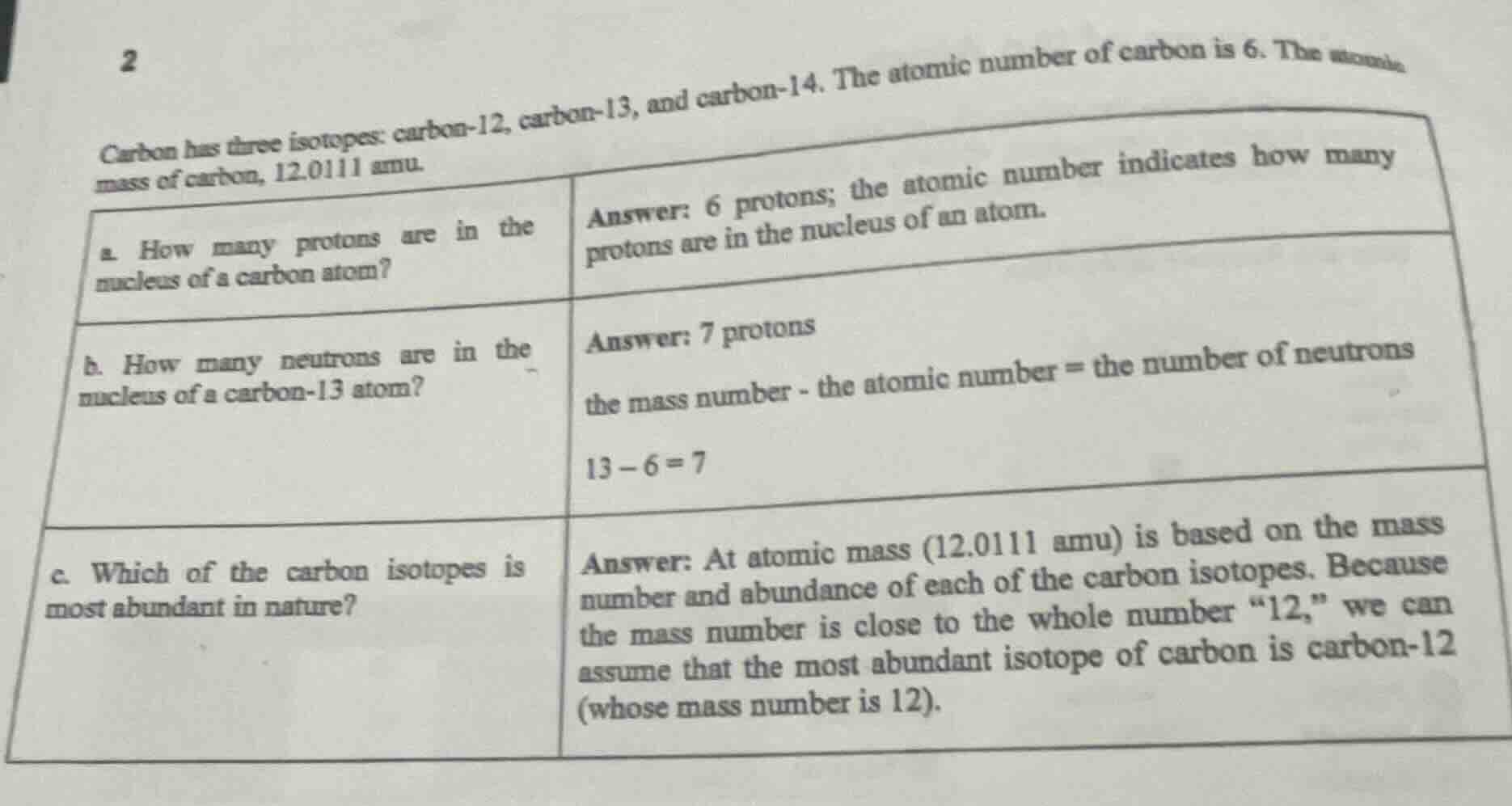
carbon has three isotopes: carbon - 12, carbon - 13, and carbon - 14. the atomic number of carbon is 6. the atomic mass of carbon, 12.0111 amu.
a. how many protons are in the nucleus of a carbon atom?
answer: 6 protons; the atomic number indicates how many protons are in the nucleus of an atom.
b. how many neutrons are in the nucleus of a carbon - 13 atom?
answer: 7 protons
the mass number - the atomic number = the number of neutrons
13−6 = 7
c. which of the carbon isotopes is most abundant in nature?
answer: at atomic mass (12.0111 amu) is based on the mass number and abundance of each of the carbon isotopes. because the mass number is close to the whole number \12,\ we can assume that the most abundant isotope of carbon is carbon - 12 (whose mass number is 12).
Part a
The atomic number of an element is equal to the number of protons in its nucleus. Carbon has an atomic number of 6, so a carbon atom has 6 protons.
Step1: Recall the formula for neutrons
The number of neutrons in an atom is calculated by subtracting the atomic number from the mass number, i.e., $neutrons = mass\ number - atomic\ number$.
Step2: Identify values for carbon - 13
For carbon - 13, the mass number is 13 and the atomic number of carbon is 6.
Step3: Calculate the number of neutrons
Substitute the values into the formula: $13 - 6 = 7$.
The atomic mass of an element is a weighted average of the masses of its isotopes, taking into account their relative abundances. The atomic mass of carbon is 12.0111 amu, which is very close to 12. This means the isotope with a mass number of 12 (carbon - 12) is the most abundant because the weighted average is heavily influenced by the most abundant isotope.

Snap & solve any problem in the app
Get step-by-step solutions on Sovi AI
Photo-based solutions with guided steps
Explore more problems and detailed explanations
6 protons