QUESTION IMAGE
Question
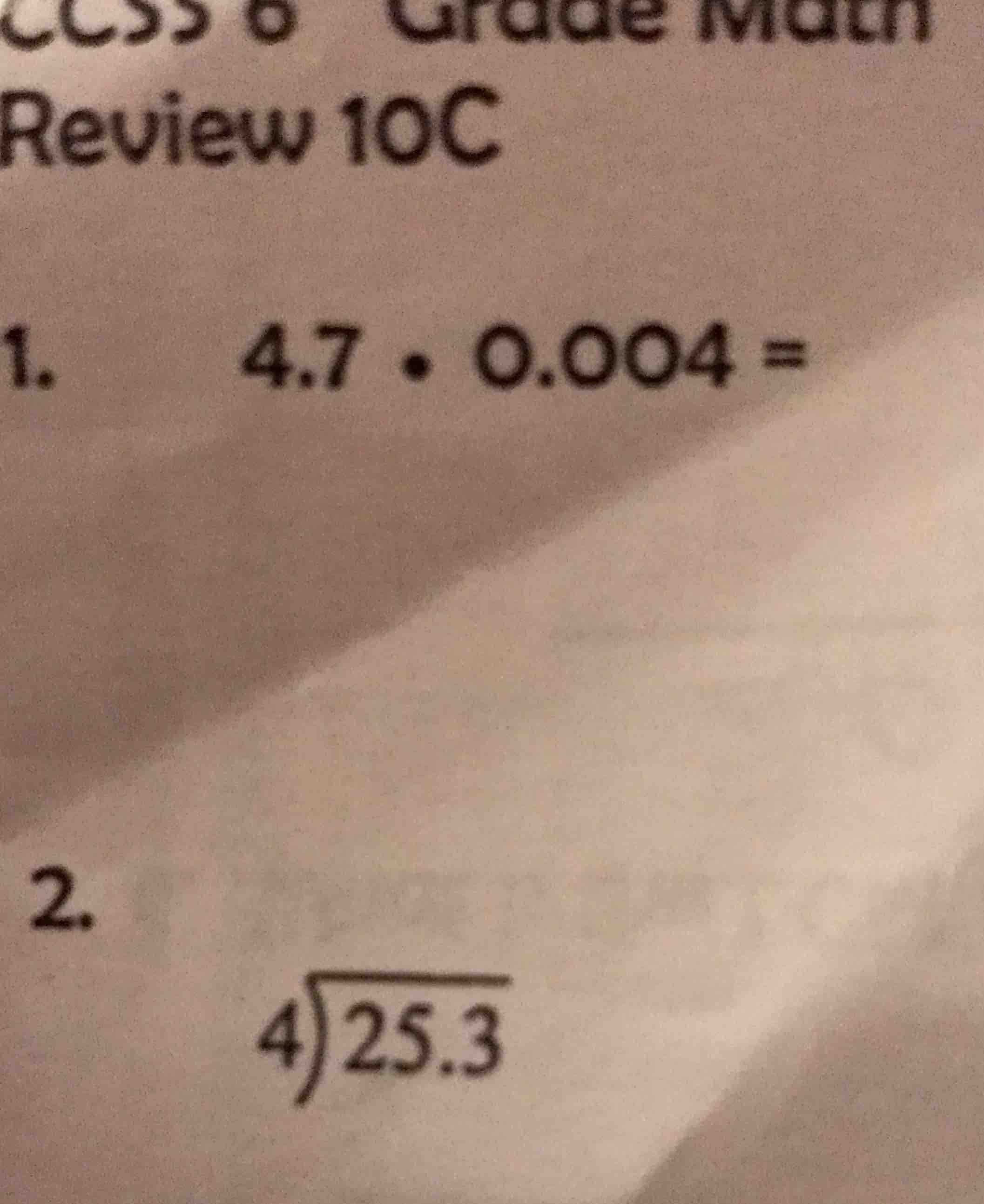
ccss 6 grade math
review 10c
- 4.7 · 0.004 =
2.
\overline{\smash{4\overline{)25.3}}}
Problem 1:
Step1: Multiply the numbers as decimals
To multiply \(4.7\) and \(0.004\), we can first ignore the decimal points and multiply \(47\) and \(4\) (since \(4.7 = \frac{47}{10}\) and \(0.004=\frac{4}{1000}\)). So \(47\times4 = 188\).
Step2: Determine the number of decimal places
The number \(4.7\) has 1 decimal place and \(0.004\) has 3 decimal places. So the total number of decimal places in the product is \(1 + 3=4\) decimal places.
Step3: Place the decimal point
We take the product \(188\) and place the decimal point 4 places from the right. Since \(188\) is a whole number, we can write it as \(0.0188\) (adding leading zeros if necessary to get 4 decimal places).
Step1: Divide the whole number part
We divide \(25\) by \(4\). \(4\times6 = 24\), so we write \(6\) above the \(5\) in \(25.3\) and subtract \(24\) from \(25\) to get a remainder of \(1\).
Step2: Bring down the decimal part
Bring down the \(3\) to make the number \(13\) (now we are working with the decimal part).
Step3: Divide the new number
We divide \(13\) by \(4\). \(4\times3 = 12\), so we write \(3\) after the decimal point in the quotient and subtract \(12\) from \(13\) to get a remainder of \(1\).
Step4: Add a zero and continue (optional, but to get more precision)
We can add a zero to make the remainder \(10\). Dividing \(10\) by \(4\) gives \(2\) (since \(4\times2 = 8\)) with a remainder of \(2\). Adding another zero gives \(20\), and dividing \(20\) by \(4\) gives \(5\) with no remainder.
Putting it all together, the quotient is \(6.325\).

Snap & solve any problem in the app
Get step-by-step solutions on Sovi AI
Photo-based solutions with guided steps
Explore more problems and detailed explanations
\(0.0188\)