QUESTION IMAGE
Question
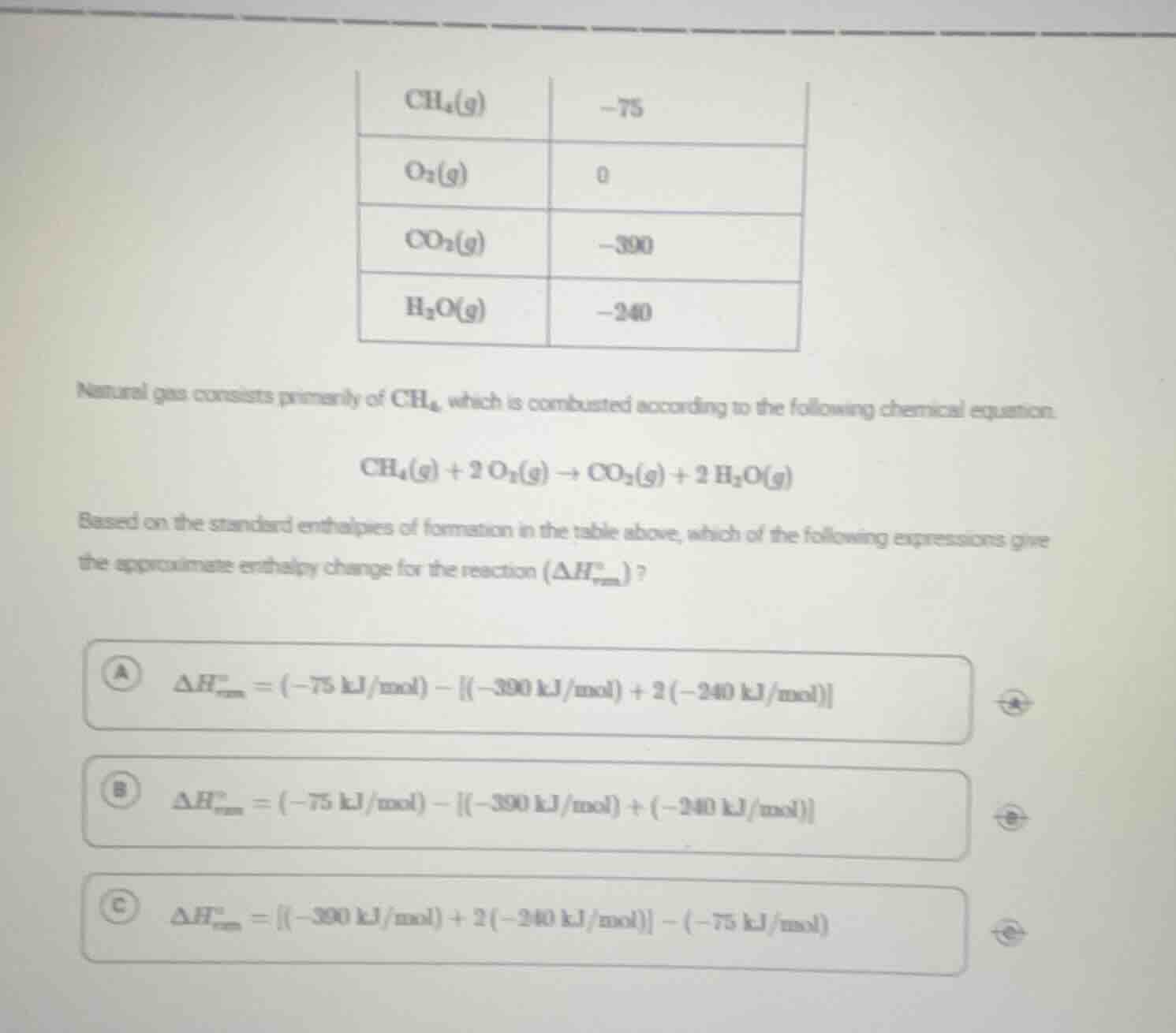
| ch₄(g) | -75 |
| o₂(g) | 0 |
| co₂(g) | -390 |
| h₂o(g) | -240 |
natural gas consists primarily of ch₄, which is combusted according to the following chemical equation.
ch₄(g) + 2 o₂(g) → co₂(g) + 2 h₂o(g)
based on the standard enthalpies of formation in the table above, which of the following expressions give the approximate enthalpy change for the reaction (δhᵣₓₙ⁰)?
a δhᵣₓₙ⁰ = (-75 kj/mol) - (-390 kj/mol) + 2(-240 kj/mol)
b δhᵣₓₙ⁰ = (-75 kj/mol) - (-390 kj/mol) + (-240 kj/mol)
c δhᵣₓₙ⁰ = (-390 kj/mol) + 2(-240 kj/mol) - (-75 kj/mol)
Step1: Recall Enthalpy Change Formula
The formula for the standard enthalpy change of a reaction ($\Delta H_{rxn}^{\circ}$) is the sum of the standard enthalpies of formation of the products minus the sum of the standard enthalpies of formation of the reactants. Mathematically, $\Delta H_{rxn}^{\circ} = \sum \Delta H_f^{\circ}(\text{products}) - \sum \Delta H_f^{\circ}(\text{reactants})$.
Step2: Identify Products and Reactants
For the reaction $\ce{CH4(g) + 2 O2(g) -> CO2(g) + 2 H2O(g)}$:
- Reactants: $\ce{CH4(g)}$ (1 mol) and $\ce{O2(g)}$ (2 mol). The standard enthalpy of formation of $\ce{O2(g)}$ is 0 kJ/mol (as given in the table), so it doesn't contribute to the sum of reactants' enthalpies.
- Products: $\ce{CO2(g)}$ (1 mol) and $\ce{H2O(g)}$ (2 mol).
Step3: Calculate Sum of Products' Enthalpies
Sum of $\Delta H_f^{\circ}$ (products) = $\Delta H_f^{\circ}(\ce{CO2(g)}) + 2 \times \Delta H_f^{\circ}(\ce{H2O(g)}) = (-390\ \text{kJ/mol}) + 2(-240\ \text{kJ/mol})$.
Step4: Calculate Sum of Reactants' Enthalpies
Sum of $\Delta H_f^{\circ}$ (reactants) = $\Delta H_f^{\circ}(\ce{CH4(g)}) + 2 \times \Delta H_f^{\circ}(\ce{O2(g)}) = (-75\ \text{kJ/mol}) + 2(0\ \text{kJ/mol}) = -75\ \text{kJ/mol}$ (since $\Delta H_f^{\circ}(\ce{O2(g)}) = 0$).
Step5: Apply the Formula
Using $\Delta H_{rxn}^{\circ} = \sum \Delta H_f^{\circ}(\text{products}) - \sum \Delta H_f^{\circ}(\text{reactants})$, we substitute the values:
$\Delta H_{rxn}^{\circ} = [(-390\ \text{kJ/mol}) + 2(-240\ \text{kJ/mol})] - (-75\ \text{kJ/mol})$.

Snap & solve any problem in the app
Get step-by-step solutions on Sovi AI
Photo-based solutions with guided steps
Explore more problems and detailed explanations
C. $\Delta H_{rxn}^{\circ} = [(-390\ \text{kJ/mol}) + 2(-240\ \text{kJ/mol})] - (-75\ \text{kJ/mol})$