QUESTION IMAGE
Question
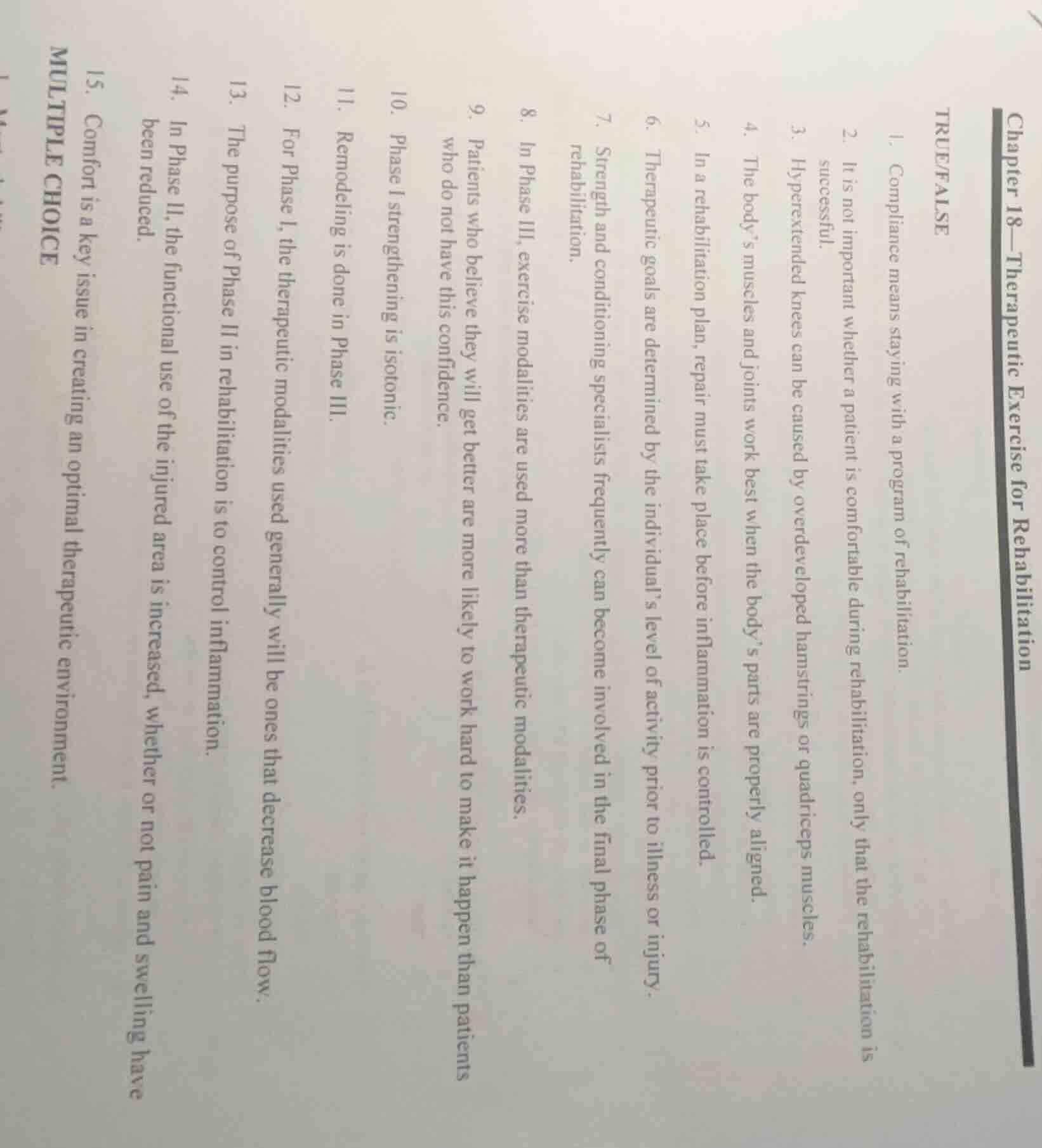
chapter 18—therapeutic exercise for rehabilitation
true/false
- compliance means staying with a program of rehabilitation.
- it is not important whether a patient is comfortable during rehabilitation, only that the rehabilitation is successful.
- hyperextended knees can be caused by overdeveloped hamstrings or quadriceps muscles.
- the body’s muscles and joints work best when the body’s parts are properly aligned.
- in a rehabilitation plan, repair must take place before inflammation is controlled.
- therapeutic goals are determined by the individual’s level of activity prior to illness or injury.
- strength and conditioning specialists frequently can become involved in the final phase of rehabilitation.
- in phase iii, exercise modalities are used more than therapeutic modalities.
- patients who believe they will get better are more likely to work hard to make it happen than patients who do not have this confidence.
- phase i strengthening is isotonic.
- remodeling is done in phase iii.
- for phase i, the therapeutic modalities used generally will be ones that decrease blood flow.
- the purpose of phase ii in rehabilitation is to control inflammation.
- in phase ii, the functional use of the injured area is increased, whether or not pain and swelling have been reduced.
- comfort is a key issue in creating an optimal therapeutic environment.
multiple choice
Brief Explanations
- Compliance in rehab means following the program, so this is correct.
- Patient comfort is critical for adherence and recovery, so this is incorrect.
- Imbalanced muscle strength (overdeveloped quads/hamstrings) can cause hyperextended knees, so this is correct.
- Proper alignment optimizes muscle and joint function, so this is correct.
- Repair cannot progress effectively until inflammation is controlled, so this is correct.
- Therapeutic goals are set based on pre-injury/illness function, so this is correct.
- Strength/conditioning specialists are involved throughout rehab, not just the final phase, so this is incorrect.
- Phase III focuses on functional exercise, not modalities, so this is incorrect.
- Patient self-efficacy correlates with effort in rehab, so this is correct.
- Phase I uses isometric (not isotonic) strengthening to avoid stressing healing tissues, so this is incorrect.
- Phase III is focused on return to function; remodeling occurs in earlier phases, so this is incorrect.
- Phase I modalities aim to increase blood flow (not decrease) to support healing, so this is incorrect.
- Phase II focuses on restoring range of motion and function, not inflammation control (which is Phase I), so this is incorrect.
- Phase II gradually increases functional use only as pain/swelling reduce, so this is incorrect.
- Comfort encourages patient adherence and supports healing, so this is correct.

Snap & solve any problem in the app
Get step-by-step solutions on Sovi AI
Photo-based solutions with guided steps
Explore more problems and detailed explanations
- TRUE
- FALSE
- TRUE
- TRUE
- TRUE
- TRUE
- FALSE
- FALSE
- TRUE
- FALSE
- FALSE
- FALSE
- FALSE
- FALSE
- TRUE