QUESTION IMAGE
Question
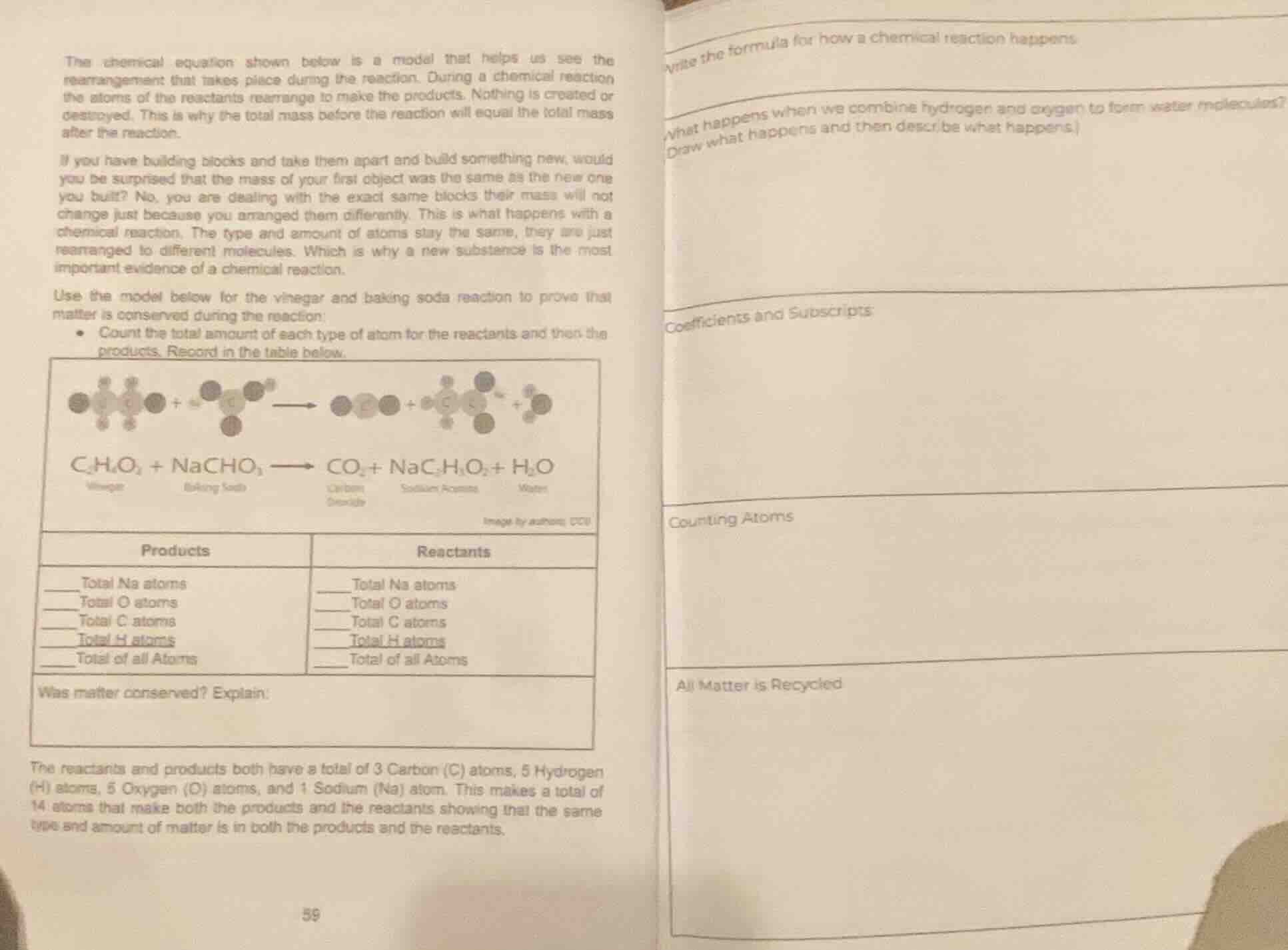
the chemical equation shown below is a model that helps us see the rearrangement that takes place during the reaction. during a chemical reaction the atoms of the reactants rearrange to make the products. nothing is created or destroyed. this is why the total mass before the reaction will equal the total mass after the reaction.
if you have building blocks and take them apart and build something new, would you be surprised that the mass of your first object was the same as the new one you built? no, you are dealing with the exact same blocks their mass will not change just because you arranged them differently. this is what happens with a chemical reaction. the type and amount of atoms stay the same, they are just rearranged to different molecules. which is why a new substance is the most important evidence of a chemical reaction.
use the model below for the vinegar and baking soda reaction to prove that matter is conserved during the reaction:
- count the total amount of each type of atom for the reactants and then the products. record in the table below.
$\ce{c_{2}h_{4}o_{2} + nacho_{3} -> co_{2} + nac_{2}h_{3}o_{2} + h_{2}o}$
| products | reactants |
|---|
was matter conserved? explain:
the reactants and products both have a total of 3 carbon (c) atoms, 5 hydrogen (h) atoms, 5 oxygen (o) atoms, and 1 sodium (na) atom. this makes a total of 14 atoms that make both the products and the reactants showing that the same type and amount of matter is in both the products and the reactants.
write the formula for how a chemical reaction happens.
what happens when we combine hydrogen and oxygen to form water molecules? (draw what happens and then describe what happens.)
coefficients and subscripts
counting atoms
all matter is recycled
Step1: Count Na atoms (Reactants)
From $\text{NaCHO}_3$, total Na atoms = $1$
Step2: Count O atoms (Reactants)
From $\text{C}_2\text{H}_4\text{O}_2$: $2$; from $\text{NaCHO}_3$: $3$. Total O atoms = $2+3=5$
Step3: Count C atoms (Reactants)
From $\text{C}_2\text{H}_4\text{O}_2$: $2$; from $\text{NaCHO}_3$: $1$. Total C atoms = $2+1=3$
Step4: Count H atoms (Reactants)
From $\text{C}_2\text{H}_4\text{O}_2$: $4$; from $\text{NaCHO}_3$: $1$. Total H atoms = $4+1=5$
Step5: Sum all reactant atoms
Total atoms = $1+5+3+5=14$
Step6: Count Na atoms (Products)
From $\text{NaC}_2\text{H}_3\text{O}_2$, total Na atoms = $1$
Step7: Count O atoms (Products)
From $\text{CO}_2$: $2$; from $\text{NaC}_2\text{H}_3\text{O}_2$: $2$; from $\text{H}_2\text{O}$: $1$. Total O atoms = $2+2+1=5$
Step8: Count C atoms (Products)
From $\text{CO}_2$: $1$; from $\text{NaC}_2\text{H}_3\text{O}_2$: $2$. Total C atoms = $1+2=3$
Step9: Count H atoms (Products)
From $\text{NaC}_2\text{H}_3\text{O}_2$: $3$; from $\text{H}_2\text{O}$: $2$. Total H atoms = $3+2=5$
Step10: Sum all product atoms
Total atoms = $1+5+3+5=14$
Step11: Evaluate matter conservation
Reactant and product atom counts match.

Snap & solve any problem in the app
Get step-by-step solutions on Sovi AI
Photo-based solutions with guided steps
Explore more problems and detailed explanations
Filled Table:
| Products | Reactants |
|---|---|
| 5 Total O atoms | 5 Total O atoms |
| 3 Total C atoms | 3 Total C atoms |
| 5 Total H atoms | 5 Total H atoms |
| 14 Total of all Atoms | 14 Total of all Atoms |
Matter Conservation Answer:
Yes, matter was conserved. The total number and type of each atom are identical in both reactants and products, so no matter is created or destroyed, only rearranged into new molecules.