QUESTION IMAGE
Question
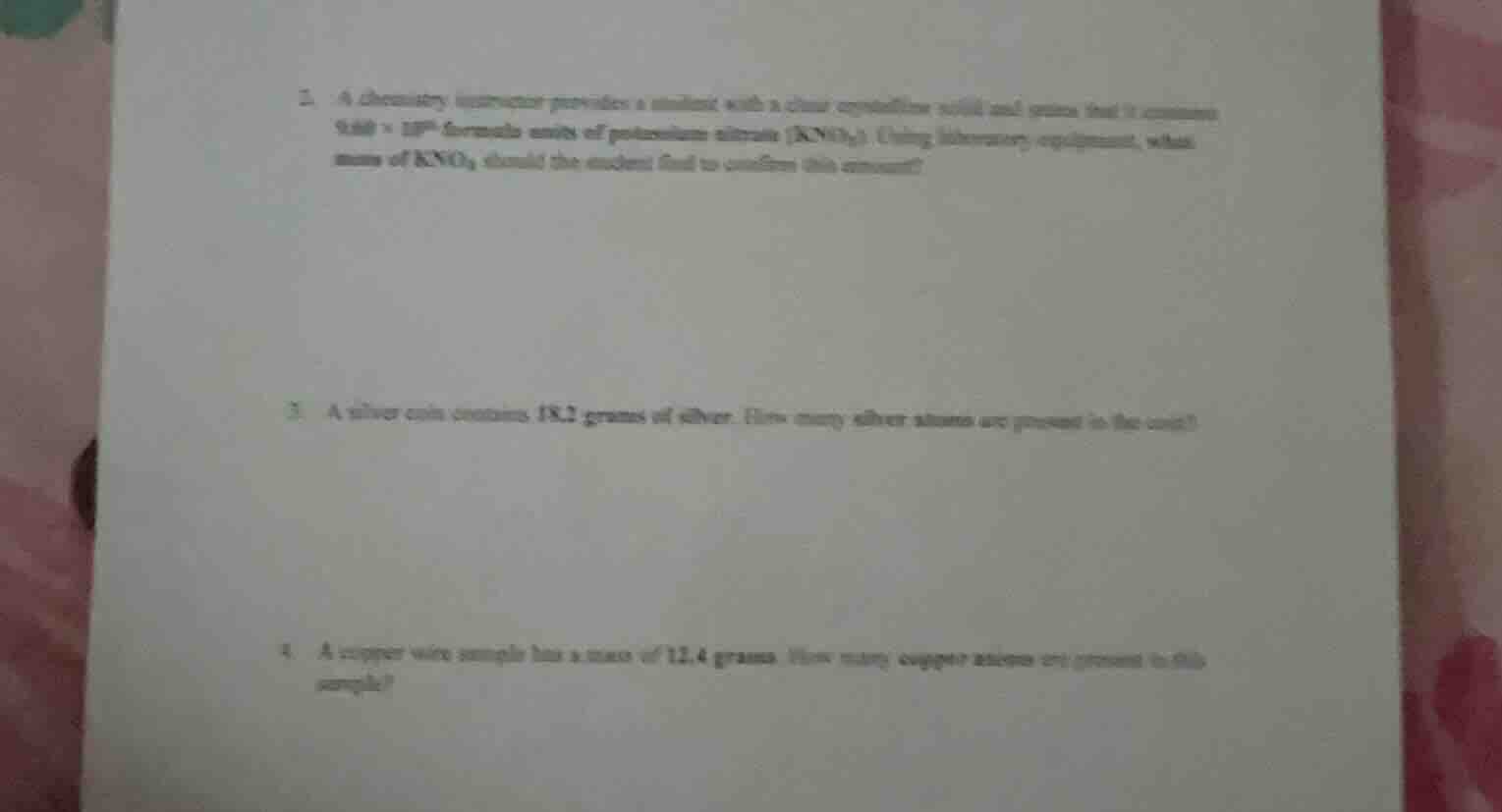
- a chemistry instructor provides a student with a clear crystalline solid and states that it contains 9.60 × 10²⁰ formula units of potassium nitrate (kno₃). using laboratory equipment, what mass of kno₃ should the student find to confirm this amount?
- a silver coin contains 18.2 grams of silver. how many silver atoms are present in the coin?
- a copper wire sample has a mass of 12.4 grams. how many copper atoms are present in this sample?
Problem 2
Step 1: Calculate molar mass of $\ce{KNO3}$
Molar mass of $\ce{K}$: $39.10\ \text{g/mol}$, $\ce{N}$: $14.01\ \text{g/mol}$, $\ce{O}$: $16.00\ \text{g/mol}$.
Molar mass of $\ce{KNO3}$ = $39.10 + 14.01 + 3\times16.00 = 101.11\ \text{g/mol}$.
Step 2: Use Avogadro's number and molar mass
Given formula units: $9.60\times10^{23}$.
Moles = $\frac{9.60\times10^{23}}{6.022\times10^{23}\ \text{mol}^{-1}} \approx 1.594\ \text{mol}$.
Mass = moles $\times$ molar mass = $1.594\ \text{mol} \times 101.11\ \text{g/mol} \approx 161\ \text{g}$.
Step 1: Molar mass of silver ($\ce{Ag}$)
Molar mass of $\ce{Ag}$ = $107.87\ \text{g/mol}$.
Step 2: Calculate moles of $\ce{Ag}$
Moles = $\frac{18.2\ \text{g}}{107.87\ \text{g/mol}} \approx 0.1687\ \text{mol}$.
Step 3: Calculate number of atoms
Atoms = moles $\times$ Avogadro's number = $0.1687\ \text{mol} \times 6.022\times10^{23}\ \text{atoms/mol} \approx 1.016\times10^{23}\ \text{atoms}$.
Step 1: Molar mass of copper ($\ce{Cu}$)
Molar mass of $\ce{Cu}$ = $63.55\ \text{g/mol}$.
Step 2: Calculate moles of $\ce{Cu}$
Moles = $\frac{12.4\ \text{g}}{63.55\ \text{g/mol}} \approx 0.1951\ \text{mol}$.
Step 3: Calculate number of atoms
Atoms = moles $\times$ Avogadro's number = $0.1951\ \text{mol} \times 6.022\times10^{23}\ \text{atoms/mol} \approx 1.175\times10^{23}\ \text{atoms}$.

Snap & solve any problem in the app
Get step-by-step solutions on Sovi AI
Photo-based solutions with guided steps
Explore more problems and detailed explanations
$\approx 161\ \text{g}$