QUESTION IMAGE
Question
choose 1 answer:
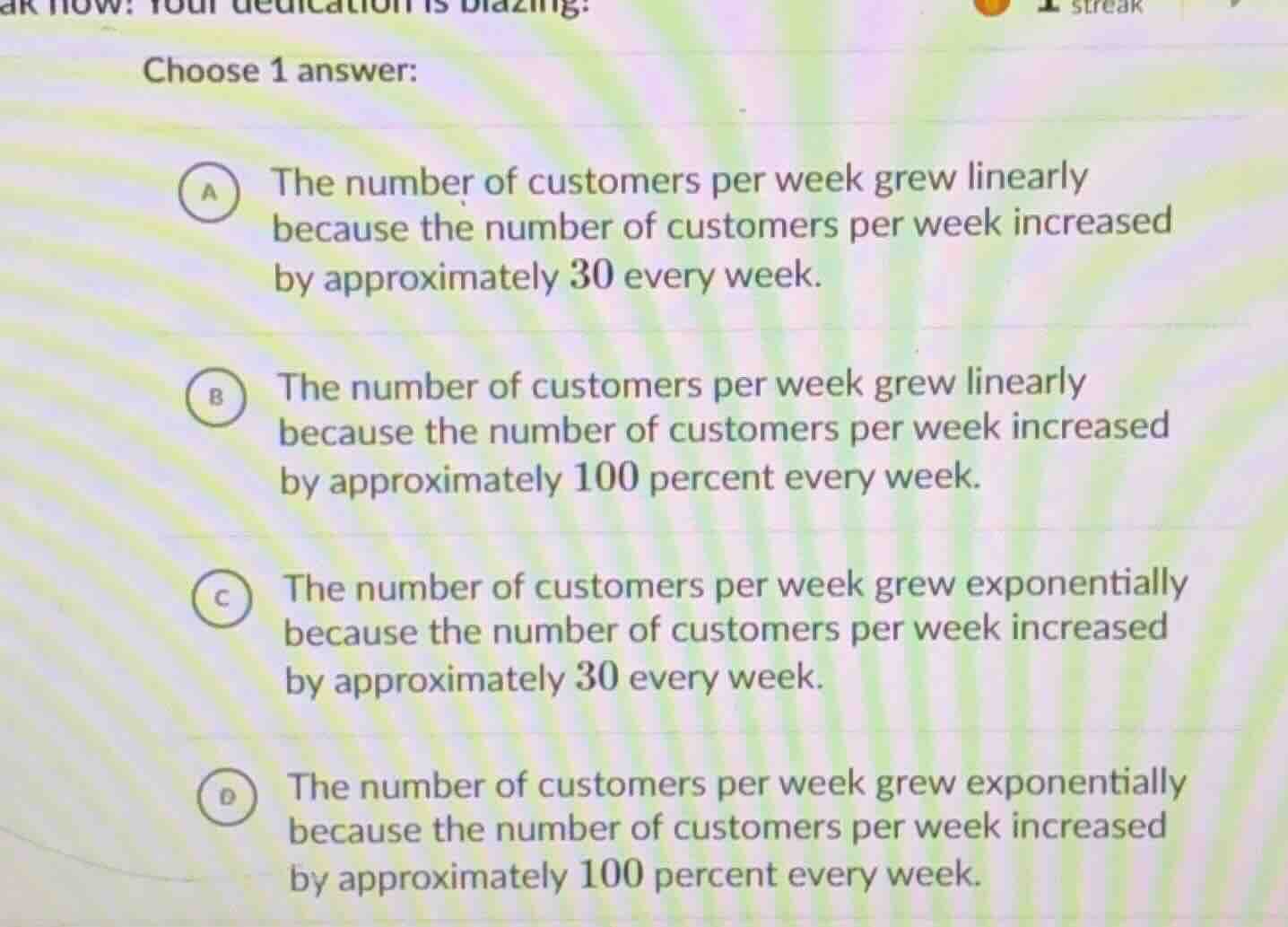
a the number of customers per week grew linearly because the number of customers per week increased by approximately 30 every week.
b the number of customers per week grew linearly because the number of customers per week increased by approximately 100 percent every week.
c the number of customers per week grew exponentially because the number of customers per week increased by approximately 30 every week.
d the number of customers per week grew exponentially because the number of customers per week increased by approximately 100 percent every week.
- Linear growth is characterized by a constant absolute increase (fixed number added each time period). Exponential growth is characterized by a constant relative increase (fixed percentage or multiplicative factor each time period).
- Option A: Claims linear growth with a constant absolute increase (≈30 customers/week). This matches the definition of linear growth.
- Option B: Claims linear growth with a 100% increase (relative growth), which is exponential, not linear. Eliminate B.
- Option C: Claims exponential growth with a constant absolute increase (≈30 customers/week), which is contradictory (exponential growth requires relative increase). Eliminate C.
- Option D: Claims exponential growth with a 100% increase (relative growth), which matches exponential growth. But we need to check the first part: the question is about which option correctly identifies the type of growth. However, the key is to match the growth type to the description. But wait, the first part of the options: let's re-express.
Wait, the options are about whether the growth is linear or exponential based on the increase. Let's re-express:
- Linear growth: change in quantity = constant (e.g., +30 each week).
- Exponential growth: change in quantity = percentage of current quantity (e.g., ×2, or +100% each week, since 100% of current is the same as doubling).
So:
- Option A: "grew linearly because... increased by approximately 30 every week" → constant absolute increase → linear growth. Correct.
- Option B: "grew linearly because... increased by approximately 100 percent every week" → 100% increase is a relative (multiplicative) increase, which is exponential, not linear. Incorrect.
- Option C: "grew exponentially because... increased by approximately 30 every week" → exponential growth requires relative increase, not absolute. Incorrect.
- Option D: "grew exponentially because... increased by approximately 100 percent every week" → 100% increase is exponential (since it's a multiplicative factor of 2 each week). But the question is which option is correct. Wait, but the problem is to choose the correct statement. Wait, maybe the original context (not shown) had data, but based on the definitions:
Wait, the key is to match the growth type to the description. Let's confirm:
- Linear growth: \( y = mx + b \), where \( m \) (slope) is constant (e.g., +30 per week).
- Exponential growth: \( y = a(b)^x \), where \( b > 1 \) (e.g., \( b = 2 \) for 100% growth, since \( 1 + 100\% = 2 \)).
So:
- A: Linear (constant +30) → correct.
- B: Linear with 100% growth → wrong (100% growth is exponential).
- C: Exponential with +30 → wrong (exponential needs multiplicative, not additive).
- D: Exponential with 100% growth → correct in terms of growth type, but the question is which option is correct. Wait, maybe the question is about which option correctly identifies the growth type. But the first part of the options: let's check the wording.
Wait, the options are structured as "The number of customers per week grew [linearly/exponentially] because the number of customers per week increased by approximately [30/100 percent] every week."
So:
- For linear growth, the "because" part must be a constant absolute increase (e.g., +30).
- For exponential growth, the "because" part must be a constant relative increase (e.g., +100% of current, which is multiplying by 2).
Thus:
- Option A: Linear growth + constant absolute increase (+30) → consistent. Correct.
- Option B: Linear growth + constant relative increase (+100%) → inconsistent (relative increase is exponential…

Snap & solve any problem in the app
Get step-by-step solutions on Sovi AI
Photo-based solutions with guided steps
Explore more problems and detailed explanations
A. The number of customers per week grew linearly because the number of customers per week increased by approximately 30 every week.