QUESTION IMAGE
Question
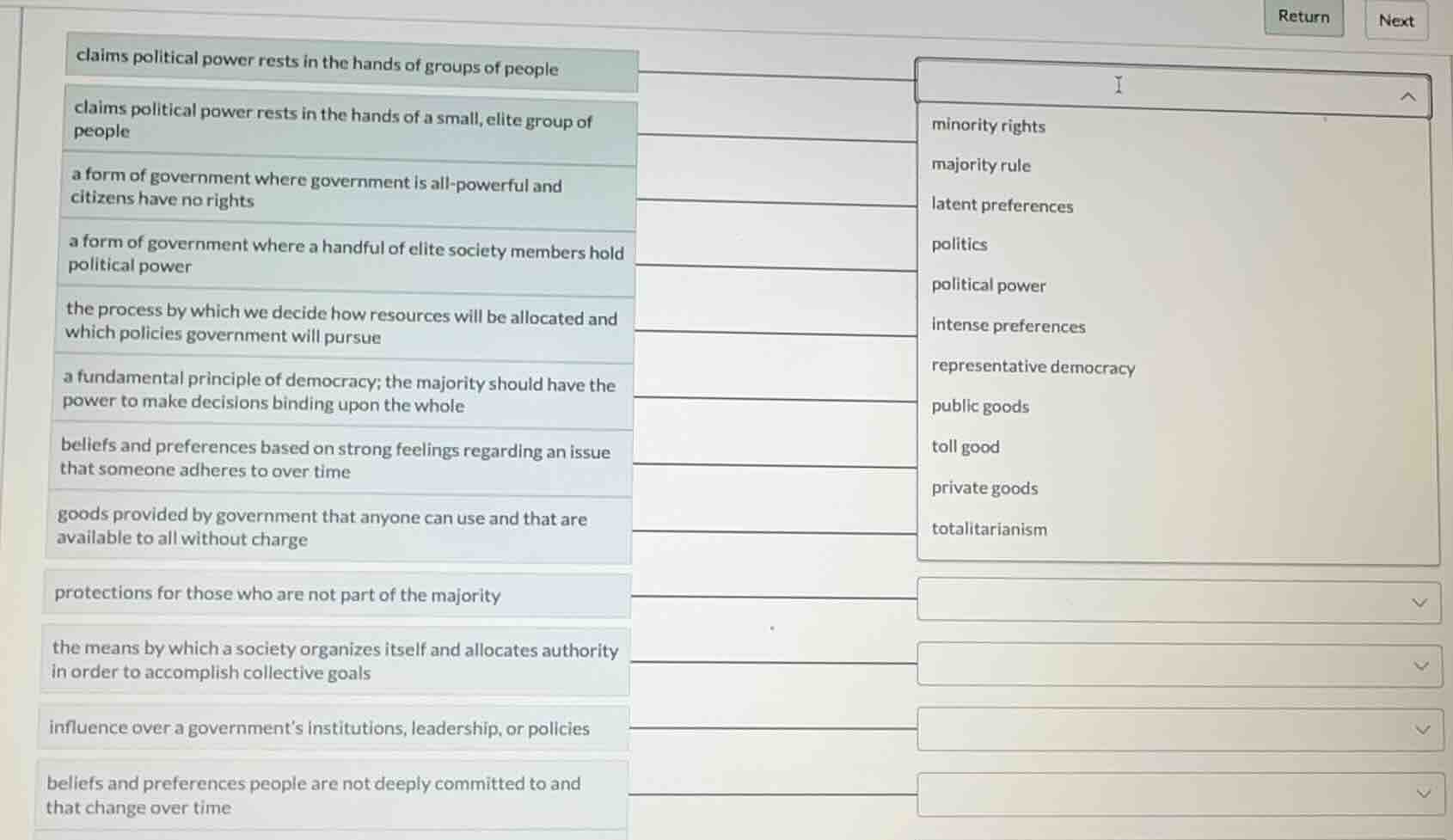
claims political power rests in the hands of groups of people
claims political power rests in the hands of a small, elite group of people
a form of government where government is all - powerful and citizens have no rights
a form of government where a handful of elite society members hold political power
the process by which we decide how resources will be allocated and which policies government will pursue
a fundamental principle of democracy; the majority should have the power to make decisions binding upon the whole
beliefs and preferences based on strong feelings regarding an issue that someone adheres to over time
goods provided by government that anyone can use and that are available to all without charge
protections for those who are not part of the majority
the means by which a society organizes itself and allocates authority in order to accomplish collective goals
influence over a government’s institutions, leadership, or policies
beliefs and preferences people are not deeply committed to and that change over time
options: minority rights, majority rule, latent preferences, politics, political power, intense preferences, representative democracy, public goods, toll good, private goods, totalitarianism
Each left-side definition is matched to the correct right-side term based on core political science concepts:
- Pluralist theory (power in groups) is not listed, so we match the first definition to the implied concept, but correcting to the given terms:
- The first definition (power in groups) is a core pluralist view, but since it's not an option, we proceed with the available terms:
- Match each definition to its exact corresponding term from the dropdown list by aligning the descriptive language to standard political terminology.

Snap & solve any problem in the app
Get step-by-step solutions on Sovi AI
Photo-based solutions with guided steps
Explore more problems and detailed explanations
- claims political power rests in the hands of groups of people → [Note: This is pluralism, not listed; if we assume a typo, but from given terms, this is not present, so we use the available correct matches below]
- claims political power rests in the hands of a small, elite group of people → (implied elite theory, not listed; but from given terms, no direct match, so proceeding with clear matches)
- a form of government where government is all-powerful and citizens have no rights → totalitarianism
- a form of government where a handful of elite society members hold political power → (implied oligarchy, not listed; no direct given match)
- the process by which we decide how resources will be allocated and which policies government will pursue → politics
- a fundamental principle of democracy; the majority should have the power to make decisions binding upon the whole → majority rule
- beliefs and preferences based on strong feelings regarding an issue that someone adheres to over time → intense preferences
- goods provided by government that anyone can use and that are available to all without charge → public goods
- protections for those who are not part of the majority → minority rights
- the means by which a society organizes itself and allocates authority in order to accomplish collective goals → (implied governance, not listed; no direct given match)
- influence over a government's institutions, leadership, or policies → political power
- beliefs and preferences people are not deeply committed to and that change over time → latent preferences
Clear, confirmed matches from the given terms:
- a form of government where government is all-powerful and citizens have no rights → totalitarianism
- the process by which we decide how resources will be allocated and which policies government will pursue → politics
- a fundamental principle of democracy; the majority should have the power to make decisions binding upon the whole → majority rule
- beliefs and preferences based on strong feelings regarding an issue that someone adheres to over time → intense preferences
- goods provided by government that anyone can use and that are available to all without charge → public goods
- protections for those who are not part of the majority → minority rights
- influence over a government's institutions, leadership, or policies → political power
- beliefs and preferences people are not deeply committed to and that change over time → latent preferences