QUESTION IMAGE
Question
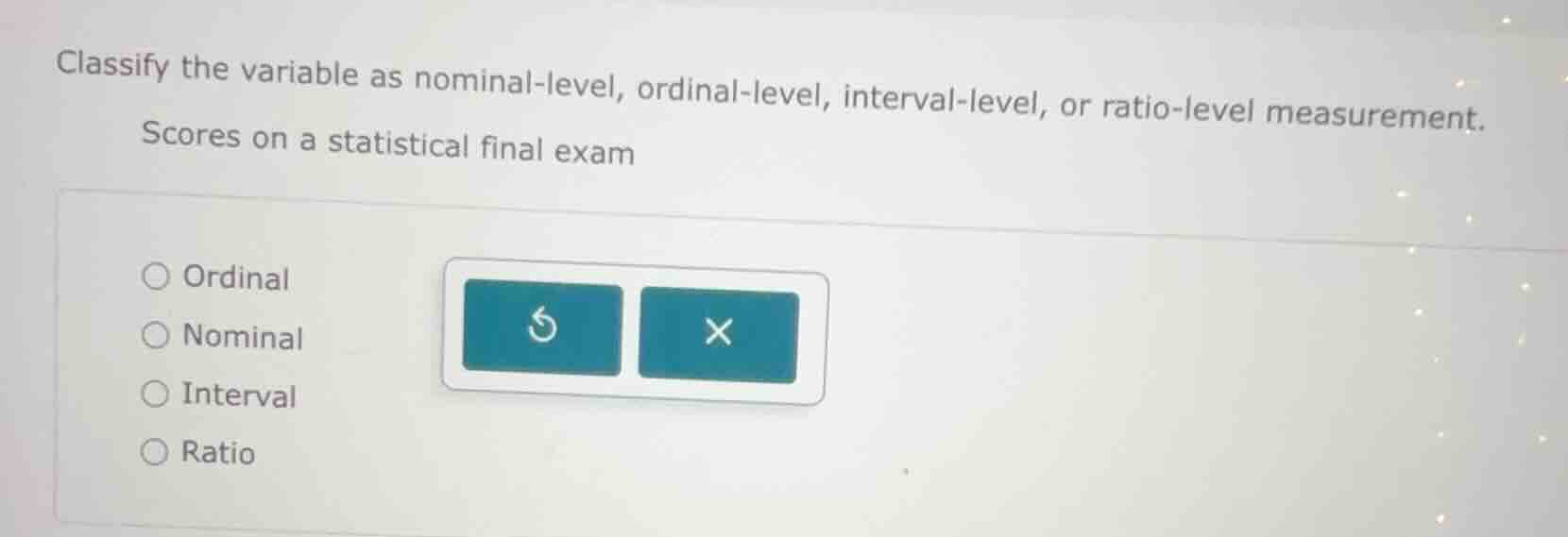
classify the variable as nominal - level, ordinal - level, interval - level, or ratio - level measurement. scores on a statistical final exam ordinal nominal interval ratio
To classify the variable "Scores on a statistical final exam":
- Nominal: Categories with no order (e.g., colors), not applicable here.
- Ordinal: Ordered categories, but differences aren't meaningful (e.g., letter grades A, B, C). Exam scores have meaningful differences (e.g., 80 vs 90).
- Interval: Data with ordered values, equal intervals, but no true zero (e.g., temperature in °C). Exam scores have a true zero (0 score means no correct answers) and equal intervals (1 point difference is consistent). Wait, actually, ratio - level data has a true zero and meaningful ratios (e.g., 20 is twice 10). Exam scores: 0 means no score, and a score of 80 is 4 times a score of 20 (if 20 is possible). But wait, sometimes exam scores are considered ratio? Wait, no, let's recall:
Wait, nominal: labels, no order. Ordinal: order, but differences not equal. Interval: order, equal differences, no true zero (e.g., IQ scores, temperature in °F or °C). Ratio: order, equal differences, true zero (e.g., height, weight, number of items).
Scores on an exam: 0 is a true zero (you got no points), and the difference between 50 and 60 is the same as 80 and 90. Also, a score of 100 is twice a score of 50 (if 50 is possible). So exam scores are ratio - level? Wait, but sometimes in education, exam scores are considered interval? Wait, no, let's check the definitions again.
Wait, the key is: does a value of 0 mean the absence of the quantity? For exam scores, 0 means you answered no questions correctly (absence of correct answers), so true zero. So ratio - level. Wait, but maybe the question here has a different take? Wait, no, let's re - evaluate.
Wait, maybe the question is considering that exam scores are ratio. Let's confirm the levels:
- Nominal: No order, just categories (e.g., gender, eye color).
- Ordinal: Ordered categories, but differences not equal (e.g., rank in a race: 1st, 2nd, 3rd; the difference between 1st and 2nd isn't the same as 2nd and 3rd in terms of time).
- Interval: Ordered, equal differences, no true zero (e.g., temperature in °C: 0 °C doesn't mean no temperature, and 20 °C isn't twice as hot as 10 °C in terms of molecular kinetic energy).
- Ratio: Ordered, equal differences, true zero (e.g., weight: 0 kg means no weight, and 20 kg is twice 10 kg).
Exam scores: 0 means no score (true zero), and the difference between 10 and 20 is the same as 30 and 40 (equal intervals). Also, a score of 40 is twice a score of 20 (if 20 is a possible score). So exam scores are ratio - level.
But wait, maybe the question's options are presented as above, and the correct answer is Ratio. Wait, but let's check again. Wait, maybe I made a mistake. Wait, some sources say that exam scores can be considered ratio. So the correct answer is Ratio.

Snap & solve any problem in the app
Get step-by-step solutions on Sovi AI
Photo-based solutions with guided steps
Explore more problems and detailed explanations
D. Ratio (assuming the options are labeled as A. Ordinal, B. Nominal, C. Interval, D. Ratio)