QUESTION IMAGE
Question
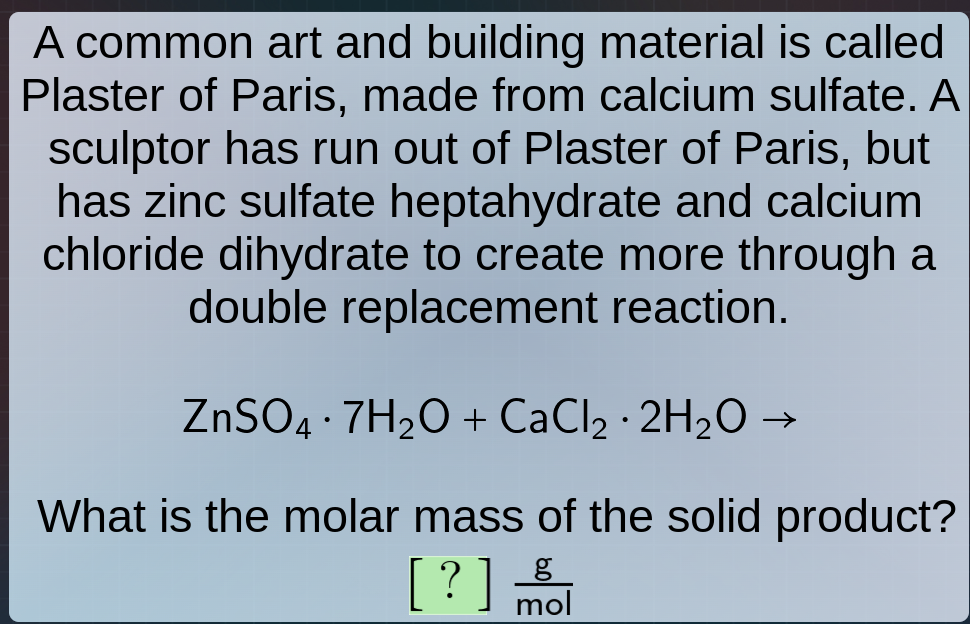
a common art and building material is called plaster of paris, made from calcium sulfate. a sculptor has run out of plaster of paris, but has zinc sulfate heptahydrate and calcium chloride dihydrate to create more through a double replacement reaction.
znso₄·7h₂o + cacl₂·2h₂o →
what is the molar mass of the solid product?
? \\(\frac{g}{mol}\\)
Step1: Identify the double replacement reaction products
In a double replacement reaction, the cations and anions switch partners. For the reaction \( \text{ZnSO}_4 \cdot 7\text{H}_2\text{O} + \text{CaCl}_2 \cdot 2\text{H}_2\text{O}
ightarrow \), the cations are \( \text{Zn}^{2+} \) and \( \text{Ca}^{2+} \), and the anions are \( \text{SO}_4^{2-} \) and \( \text{Cl}^- \). So the products will be \( \text{ZnCl}_2 \) and \( \text{CaSO}_4 \). Now we need to determine which product is solid. Calcium sulfate (\( \text{CaSO}_4 \)) is insoluble in water (a common rule for sulfates: most sulfates are soluble except for those of \( \text{Ca}^{2+} \), \( \text{Sr}^{2+} \), \( \text{Ba}^{2+} \), \( \text{Pb}^{2+} \), etc.), while zinc chloride (\( \text{ZnCl}_2 \)) is soluble. So the solid product is \( \text{CaSO}_4 \).
Step2: Calculate the molar mass of \( \text{CaSO}_4 \)
To calculate the molar mass, we sum the molar masses of each atom in the formula. The molar masses (from the periodic table) are: \( \text{Ca} = 40.08 \, \text{g/mol} \), \( \text{S} = 32.07 \, \text{g/mol} \), \( \text{O} = 16.00 \, \text{g/mol} \).
For \( \text{CaSO}_4 \), we have 1 Ca atom, 1 S atom, and 4 O atoms.
Molar mass of \( \text{CaSO}_4 = (1 \times 40.08) + (1 \times 32.07) + (4 \times 16.00) \)
First, calculate each term:
- \( 1 \times 40.08 = 40.08 \)
- \( 1 \times 32.07 = 32.07 \)
- \( 4 \times 16.00 = 64.00 \)
Then sum them up: \( 40.08 + 32.07 + 64.00 = 136.15 \, \text{g/mol} \)

Snap & solve any problem in the app
Get step-by-step solutions on Sovi AI
Photo-based solutions with guided steps
Explore more problems and detailed explanations
\( 136.15 \)