QUESTION IMAGE
Question
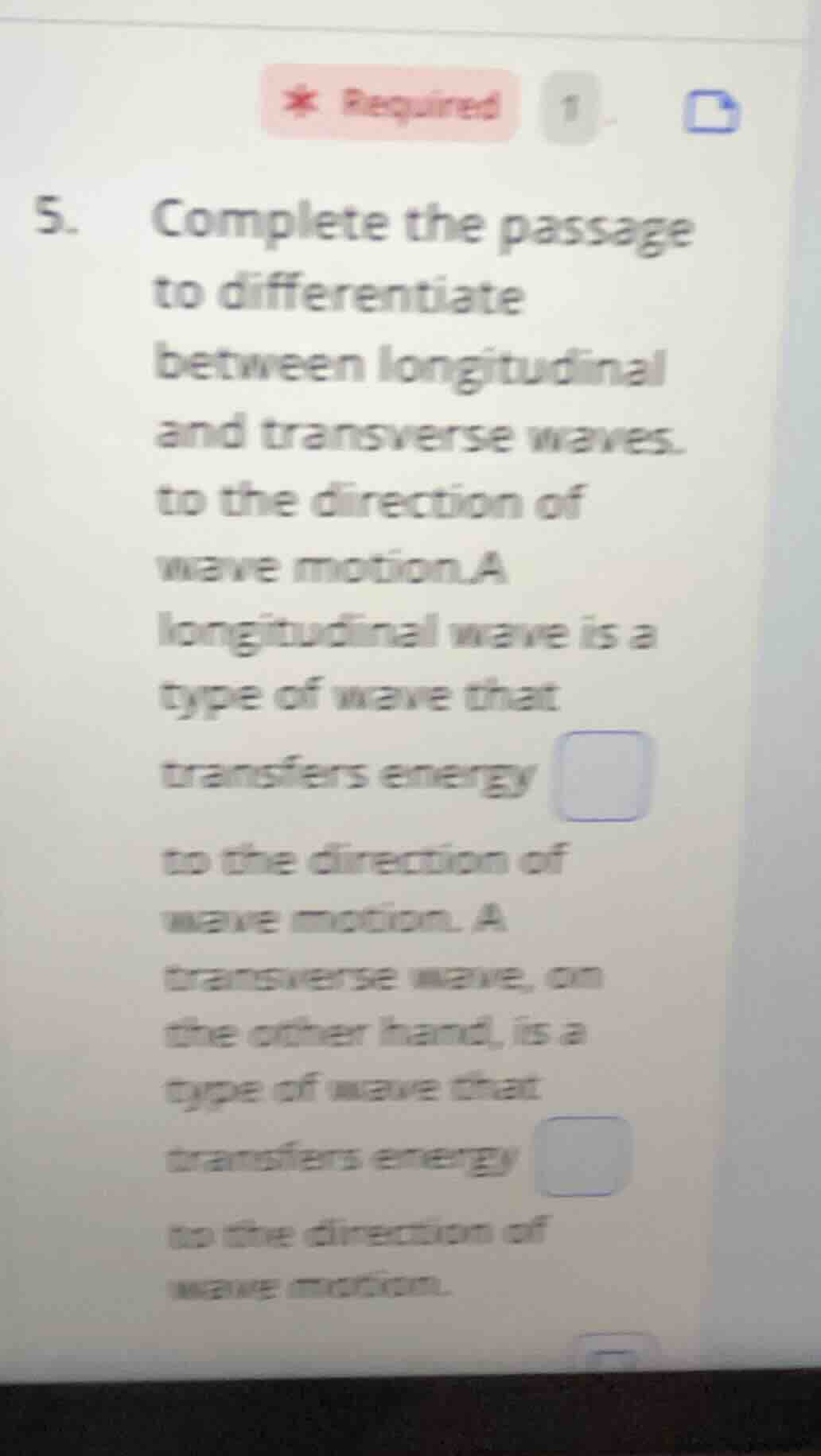
- complete the passage to differentiate between longitudinal and transverse waves. to the direction of wave motion.a longitudinal wave is a type of wave that transfers energy to the direction of wave motion. a transverse wave, on the other hand, is a type of wave that transfers energy to the direction of wave motion.
To differentiate longitudinal and transverse waves, we use the direction of particle oscillation relative to wave motion. In a longitudinal wave, particles oscillate parallel to the wave's direction (e.g., sound waves). In a transverse wave, particles oscillate perpendicular to the wave's direction (e.g., light or water waves).
For the first blank (longitudinal wave): The particles move back - and - forth along the same line as the wave travels, so the energy transfer is parallel to the wave motion direction. So we fill "parallel".
For the second blank (transverse wave): The particles move up - and - down or side - to - side, which is at a right angle to the wave's travel direction, so the energy transfer is perpendicular to the wave motion direction. So we fill "perpendicular".

Snap & solve any problem in the app
Get step-by-step solutions on Sovi AI
Photo-based solutions with guided steps
Explore more problems and detailed explanations
First blank: parallel
Second blank: perpendicular