QUESTION IMAGE
Question
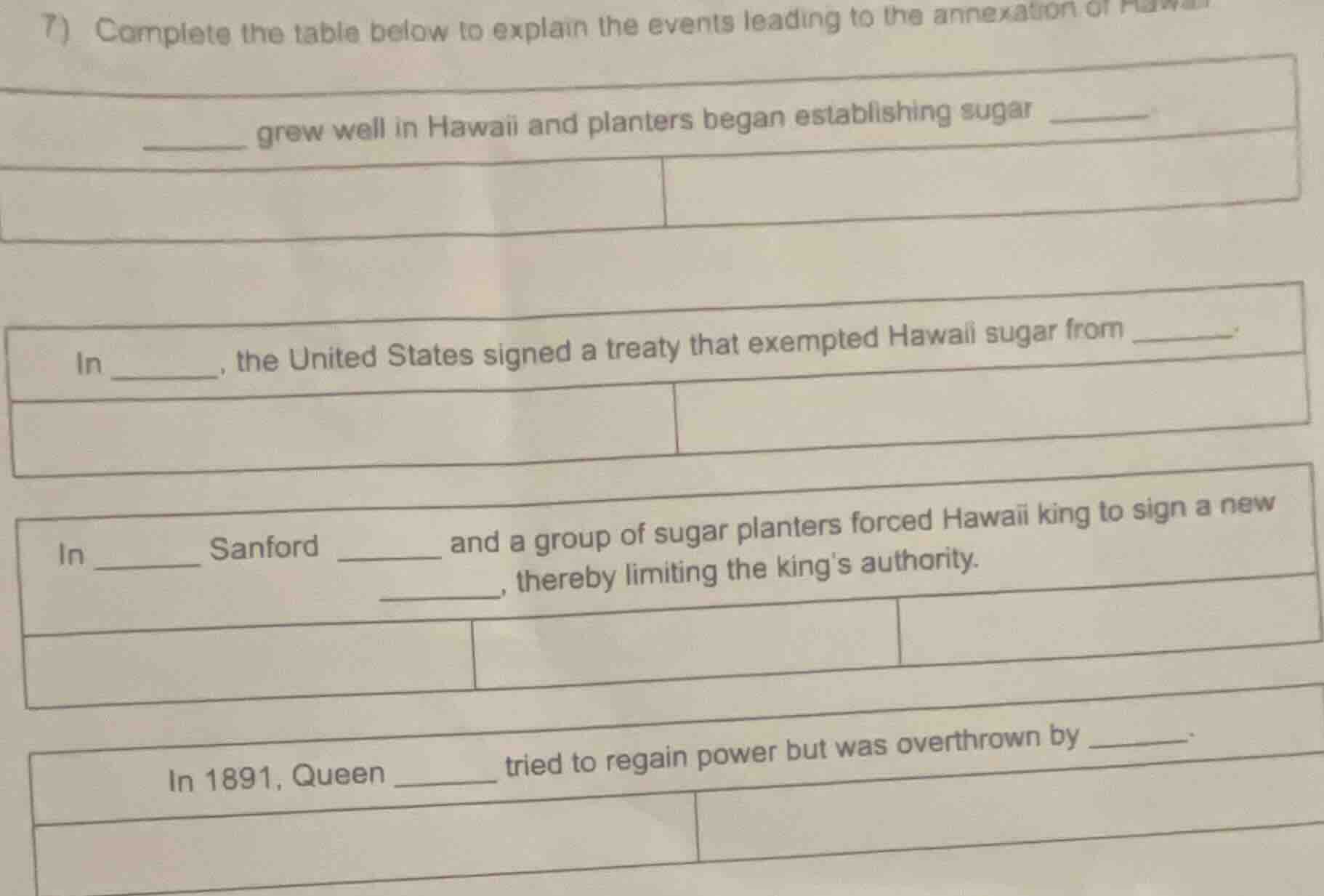
- complete the table below to explain the events leading to the annexation of hawaii
____ grew well in hawaii and planters began establishing sugar ____.
in ____, the united states signed a treaty that exempted hawaii sugar from ____.
in ____ sanford __ and a group of sugar planters forced hawaii king to sign a new ____, thereby limiting the king’s authority.
in 1891, queen ____ tried to regain power but was overthrown by ____.
To solve this, we recall the historical events leading to Hawaii's annexation:
First Row:
Sugar cane grew well in Hawaii, so planters established sugar plantations.
Second Row:
In 1875, the U.S. signed a treaty exempting Hawaii sugar from tariffs (import taxes).
Third Row:
In 1887, Sanford Dole and sugar planters forced the king to sign a new constitution (the Bayonet Constitution) to limit his authority.
Fourth Row:
In 1891, Queen Liliuokalani tried to regain power but was overthrown by American planters and U.S. Marines (in 1893, though the year here is 1891 for her ascension/attempt; the overthrow followed).
Filled Table (Key Blanks):
- $\boldsymbol{\text{Sugar cane}}$ grew well in Hawaii and planters began establishing sugar $\boldsymbol{\text{plantations}}$.
- In $\boldsymbol{1875}$, the United States signed a treaty that exempted Hawaii sugar from $\boldsymbol{\text{tariffs}}$.
- In $\boldsymbol{1887}$ Sanford $\boldsymbol{\text{Dole}}$ and a group of sugar planters forced Hawaii king to sign a new $\boldsymbol{\text{constitution}}$, thereby limiting the king’s authority.
- In 1891, Queen $\boldsymbol{\text{Liliuokalani}}$ tried to regain power but was overthrown by $\boldsymbol{\text{American planters (and U.S. forces)}}$.
(Note: For the last row, the overthrow occurred in 1893, but the question frames 1891 as her attempt to restore power, leading to the 1893 overthrow by American interests.)

Snap & solve any problem in the app
Get step-by-step solutions on Sovi AI
Photo-based solutions with guided steps
Explore more problems and detailed explanations
To solve this, we recall the historical events leading to Hawaii's annexation:
First Row:
Sugar cane grew well in Hawaii, so planters established sugar plantations.
Second Row:
In 1875, the U.S. signed a treaty exempting Hawaii sugar from tariffs (import taxes).
Third Row:
In 1887, Sanford Dole and sugar planters forced the king to sign a new constitution (the Bayonet Constitution) to limit his authority.
Fourth Row:
In 1891, Queen Liliuokalani tried to regain power but was overthrown by American planters and U.S. Marines (in 1893, though the year here is 1891 for her ascension/attempt; the overthrow followed).
Filled Table (Key Blanks):
- $\boldsymbol{\text{Sugar cane}}$ grew well in Hawaii and planters began establishing sugar $\boldsymbol{\text{plantations}}$.
- In $\boldsymbol{1875}$, the United States signed a treaty that exempted Hawaii sugar from $\boldsymbol{\text{tariffs}}$.
- In $\boldsymbol{1887}$ Sanford $\boldsymbol{\text{Dole}}$ and a group of sugar planters forced Hawaii king to sign a new $\boldsymbol{\text{constitution}}$, thereby limiting the king’s authority.
- In 1891, Queen $\boldsymbol{\text{Liliuokalani}}$ tried to regain power but was overthrown by $\boldsymbol{\text{American planters (and U.S. forces)}}$.
(Note: For the last row, the overthrow occurred in 1893, but the question frames 1891 as her attempt to restore power, leading to the 1893 overthrow by American interests.)