QUESTION IMAGE
Question
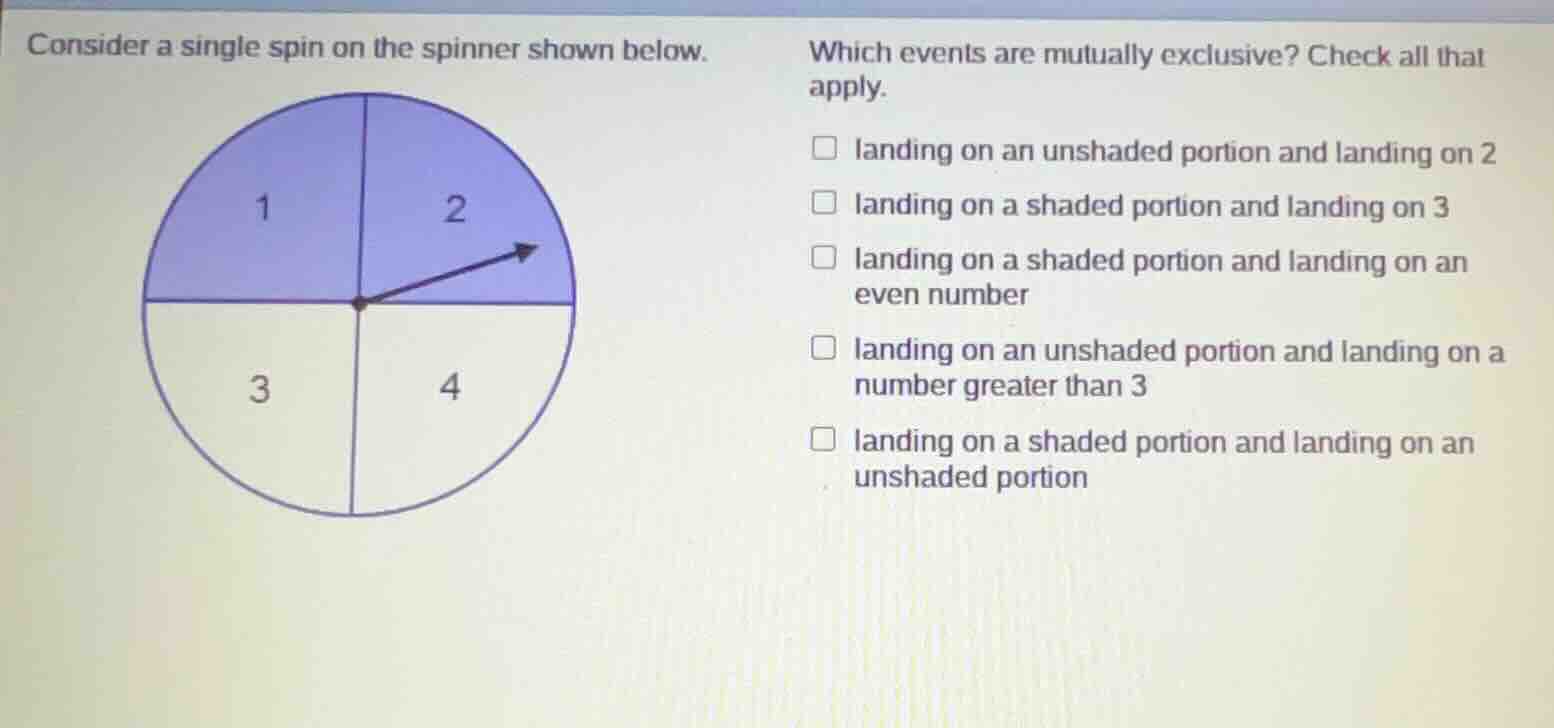
consider a single spin on the spinner shown below. which events are mutually exclusive? check all that apply. \square landing on an unshaded portion and landing on 2 \square landing on a shaded portion and landing on 3 \square landing on a shaded portion and landing on an even number \square landing on an unshaded portion and landing on a number greater than 3 \square landing on a shaded portion and landing on an unshaded portion
- Landing on an unshaded portion and landing on 2: The shaded portions are 1 and 2, unshaded are 3 and 4. So landing on 2 (shaded) and unshaded can't happen together? Wait, no—wait, 2 is shaded. So unshaded is 3,4. So landing on unshaded (3 or 4) and landing on 2: these are mutually exclusive (can't happen at the same time). Wait, but let's recheck. Wait, the first option: "landing on an unshaded portion" (3 or 4) and "landing on 2" (shaded). So they can't happen together. So this is mutually exclusive? Wait, maybe I made a mistake. Wait, let's analyze each option:
- Option 1: Landing on unshaded (3,4) and landing on 2 (shaded). These are disjoint (no overlap), so mutually exclusive.
- Option 2: Landing on shaded (1,2) and landing on 3 (unshaded). Shaded is 1,2; 3 is unshaded. So disjoint, mutually exclusive.
- Option 3: Landing on shaded (1,2) and landing on even number (2,4). The overlap is 2 (shaded and even), so not mutually exclusive.
- Option 4: Landing on unshaded (3,4) and landing on number >3 (4). Overlap is 4 (unshaded and >3), so not mutually exclusive.
- Option 5: Landing on shaded and unshaded—a spin can't be both shaded and unshaded, so mutually exclusive.
Wait, let's re-express the spinner: shaded regions are 1 (top-left), 2 (top-right); unshaded are 3 (bottom-left), 4 (bottom-right). So:
- Shaded: {1,2}; Unshaded: {3,4}
- Even numbers: {2,4}; Numbers >3: {4}
Now:
- Unshaded (3,4) and landing on 2: {3,4} ∩ {2} = ∅ → mutually exclusive.
- Shaded (1,2) and landing on 3: {1,2} ∩ {3} = ∅ → mutually exclusive.
- Shaded (1,2) and even (2,4): {1,2} ∩ {2,4} = {2} ≠ ∅ → not mutually exclusive.
- Unshaded (3,4) and >3 (4): {3,4} ∩ {4} = {4} ≠ ∅ → not mutually exclusive.
- Shaded and unshaded: {1,2} ∩ {3,4} = ∅ → mutually exclusive (a spin can't be both shaded and unshaded).
Wait, but the original options: let's check the first option again. Wait, "landing on an unshaded portion" (3 or 4) and "landing on 2" (shaded). So yes, mutually exclusive. Then option 2: shaded (1,2) and 3 (unshaded): mutually exclusive. Option 5: shaded and unshaded: mutually exclusive. Wait, but maybe the initial analysis was wrong. Wait, let's confirm the definition: mutually exclusive events are events that cannot occur at the same time (their intersection is empty).
So:
- Option 1: Unshaded (3,4) and 2: intersection is empty → mutually exclusive.
- Option 2: Shaded (1,2) and 3: intersection empty → mutually exclusive.
- Option 5: Shaded and unshaded: intersection empty → mutually exclusive.
Wait, but the problem says "check all that apply". Wait, maybe I misread the first option. Let's re-express:
- "Landing on an unshaded portion" (regions 3,4) and "landing on 2" (region 2, shaded). These are disjoint → mutually exclusive.
- "Landing on a shaded portion" (1,2) and "landing on 3" (region 3, unshaded) → disjoint → mutually exclusive.
- "Landing on a shaded portion" (1,2) and "landing on an even number" (2,4) → overlap at 2 → not mutually exclusive.
- "Landing on an unshaded portion" (3,4) and "landing on a number greater than 3" (4) → overlap at 4 → not mutually exclusive.
- "Landing on a shaded portion" and "landing on an unshaded portion" → a spin can't be both, so mutually exclusive.
Wait, but the options are:
- Landing on unshaded and landing on 2 → mutually exclusive.
- Landing on shaded and landing on 3 → mutually exclusive.
- Landing on shaded and unshaded → mutually exclusive.
But maybe the original spinner's shaded regions are 1 and 2 (top two), unshaded 3 and 4 (bottom two). Let's confirm:
- Shaded…

Snap & solve any problem in the app
Get step-by-step solutions on Sovi AI
Photo-based solutions with guided steps
Explore more problems and detailed explanations
- landing on an unshaded portion and landing on 2
- landing on a shaded portion and landing on 3
- landing on a shaded portion and landing on an unshaded portion