QUESTION IMAGE
Question
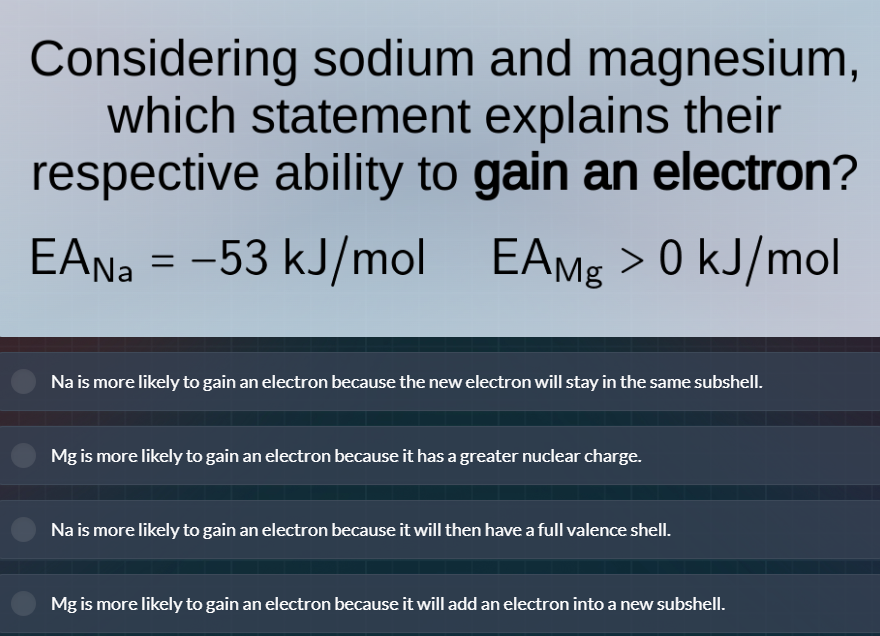
considering sodium and magnesium, which statement explains their respective ability to gain an electron?$\text{ea}_{\text{na}} = -53 \text{kj/mol}$ $\text{ea}_{\text{mg}} > 0 \text{kj/mol}$na is more likely to gain an electron because the new electron will stay in the same subshell.mg is more likely to gain an electron because it has a greater nuclear charge.na is more likely to gain an electron because it will then have a full valence shell.mg is more likely to gain an electron because it will add an electron into a new subshell.
Electron affinity (EA) measures the energy change when an atom gains an electron. A negative EA means energy is released (favorable for gaining an electron), while a positive EA means energy is absorbed (unfavorable). For sodium (Na), adding an electron fills its 3s valence subshell, forming a stable full valence shell, which is favorable ($EA_{Na}=-53$ kJ/mol). For magnesium (Mg), its 3s subshell is already full; adding an electron would require placing it in the higher-energy 3p subshell, making the process unfavorable ($EA_{Mg}>0$ kJ/mol). Analyzing the options:
- The first option is incorrect because Na's new electron fills its valence subshell, not just stays in the same subshell as the key driver.
- The second option is incorrect because Mg has a positive EA, so it does not favor gaining an electron.
- The fourth option is incorrect because adding an electron to a new higher-energy subshell makes Mg unlikely to gain an electron.

Snap & solve any problem in the app
Get step-by-step solutions on Sovi AI
Photo-based solutions with guided steps
Explore more problems and detailed explanations
Na is more likely to gain an electron because it will then have a full valence shell.