QUESTION IMAGE
Question
construct a cer for the following prompt.
plastic straws
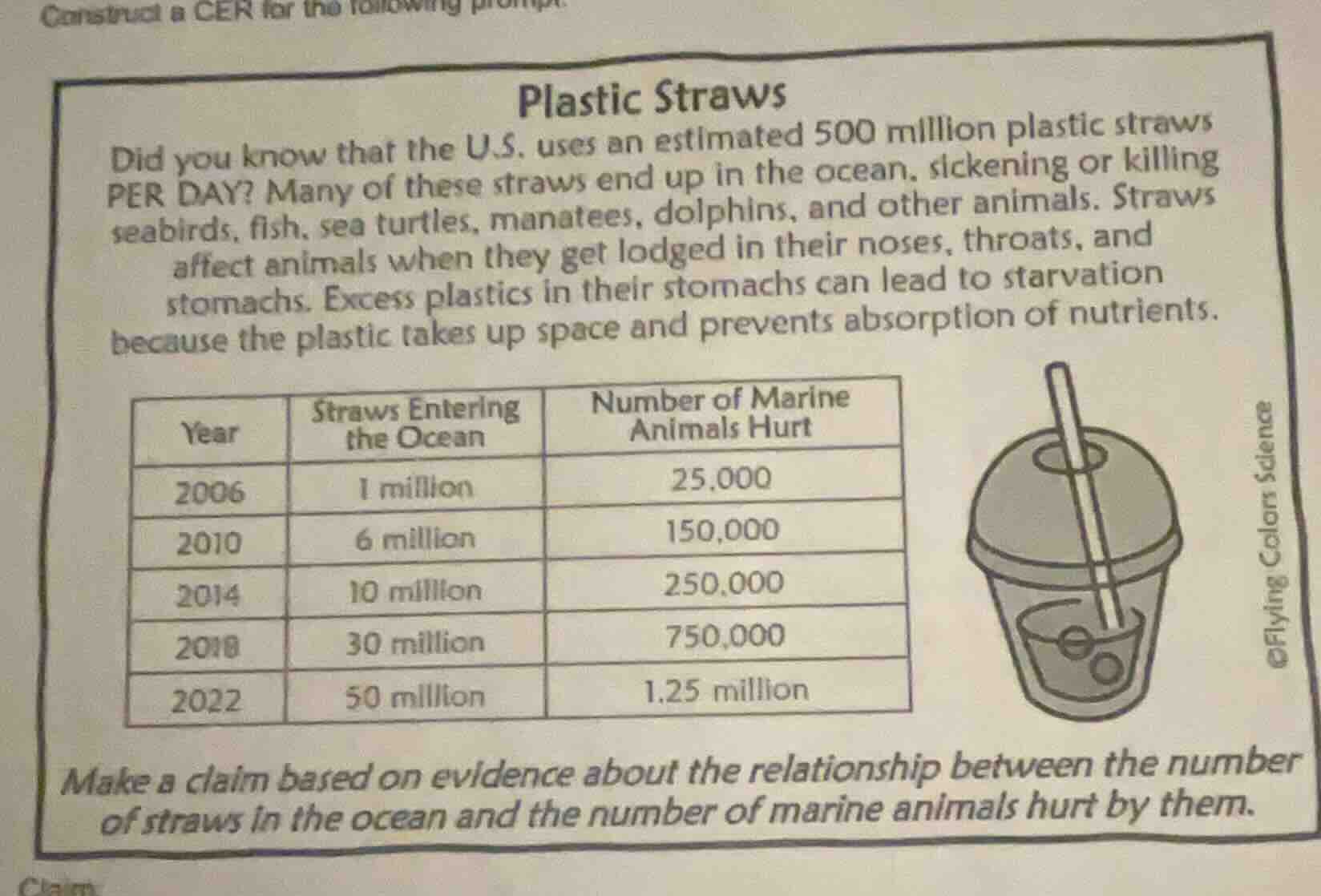
did you know that the u.s. uses an estimated 500 million plastic straws per day? many of these straws end up in the ocean, sickening or killing seabirds, fish, sea turtles, manatees, dolphins, and other animals. straws affect animals when they get lodged in their noses, throats, and stomachs. excess plastics in their stomachs can lead to starvation because the plastic takes up space and prevents absorption of nutrients.
| year | straws entering the ocean | number of marine animals hurt |
|---|---|---|
| 2010 | 6 million | 150,000 |
| 2014 | 10 million | 250,000 |
| 2018 | 30 million | 750,000 |
| 2022 | 50 million | 1.25 million |
make a claim based on evidence about the relationship between the number of straws in the ocean and the number of marine animals hurt by them.
claim
Claim:
As the number of plastic straws entering the ocean increases, the number of marine animals hurt also increases.
Evidence:
- In 2006, 1 million straws entered the ocean and 25,000 marine animals were hurt.
- In 2010, 6 million straws entered the ocean and 150,000 marine animals were hurt.
- In 2014, 10 million straws entered the ocean and 250,000 marine animals were hurt.
- In 2018, 30 million straws entered the ocean and 750,000 marine animals were hurt.
- In 2022, 50 million straws entered the ocean and 1.25 million marine animals were hurt.
Reasoning:
The data from the table shows a consistent trend: as the quantity of straws entering the ocean (the independent variable) rises over the years, the number of marine animals hurt (the dependent variable) also rises. This indicates a positive correlation between the number of plastic straws in the ocean and the number of marine animals harmed by them. The increase in straws provides more opportunities for marine animals to encounter and be harmed by the straws, either through physical obstruction (lodging in noses, throats, stomachs) or by causing starvation due to the plastic taking up space and preventing nutrient absorption, as described in the prompt.

Snap & solve any problem in the app
Get step-by-step solutions on Sovi AI
Photo-based solutions with guided steps
Explore more problems and detailed explanations
Claim:
As the number of plastic straws entering the ocean increases, the number of marine animals hurt also increases.
Evidence:
- In 2006, 1 million straws entered the ocean and 25,000 marine animals were hurt.
- In 2010, 6 million straws entered the ocean and 150,000 marine animals were hurt.
- In 2014, 10 million straws entered the ocean and 250,000 marine animals were hurt.
- In 2018, 30 million straws entered the ocean and 750,000 marine animals were hurt.
- In 2022, 50 million straws entered the ocean and 1.25 million marine animals were hurt.
Reasoning:
The data from the table shows a consistent trend: as the quantity of straws entering the ocean (the independent variable) rises over the years, the number of marine animals hurt (the dependent variable) also rises. This indicates a positive correlation between the number of plastic straws in the ocean and the number of marine animals harmed by them. The increase in straws provides more opportunities for marine animals to encounter and be harmed by the straws, either through physical obstruction (lodging in noses, throats, stomachs) or by causing starvation due to the plastic taking up space and preventing nutrient absorption, as described in the prompt.