QUESTION IMAGE
Question
construction crafts
electrician: this craft requires education and training. community colleges and vocational schools offer certification programs for electricians.
plumber: a plumber deals with the plumbing systems of a house in terms of installing, repairing, water installations, and wiring. community colleges or vocational schools offer credentials to become a licensed plumber.
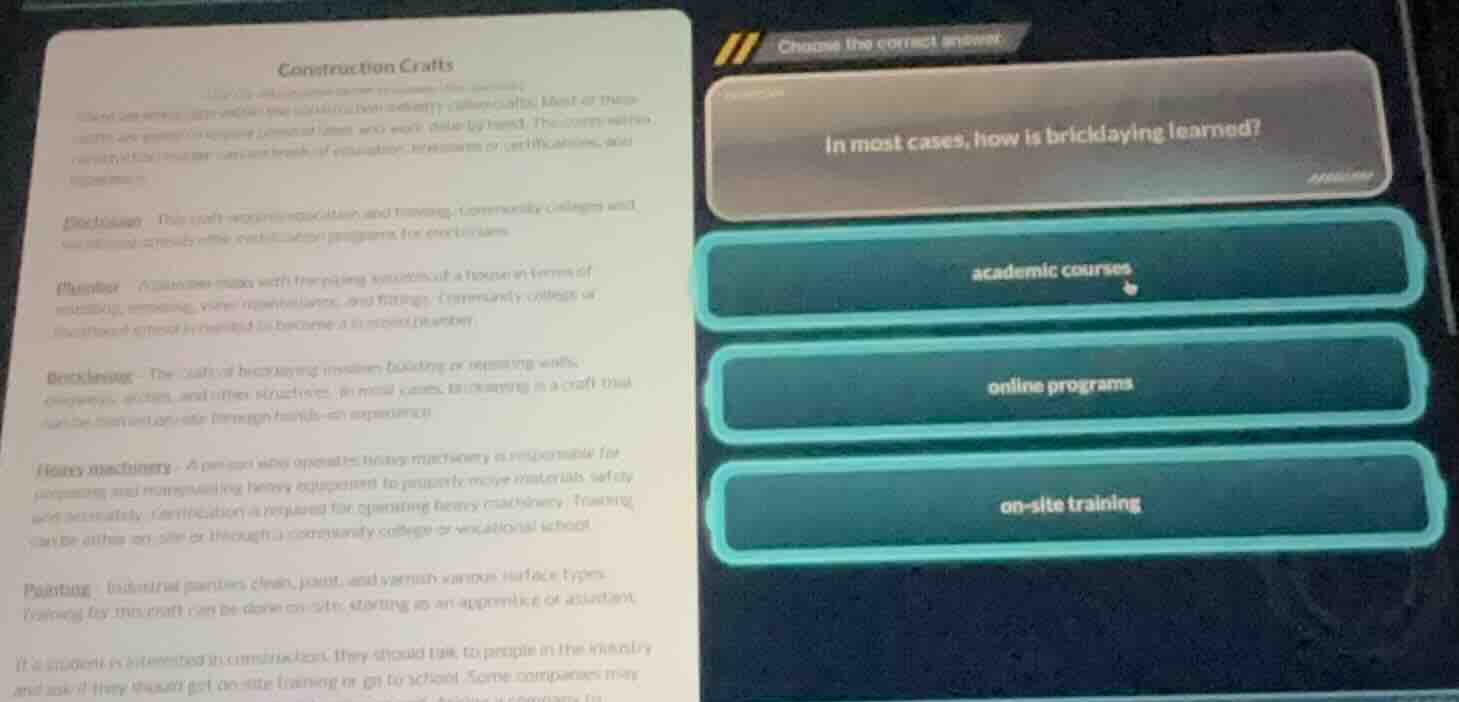
bricklaying: the craft of laying bricks, building or repairing walls, chimneys, arches, and other structures. in most cases, bricklaying is a craft that can be learned on - site through hands - on experience.
heavy machinery: a person who operates heavy machinery is responsible for operating and maintaining heavy equipment to properly move materials safely and accurately. certification is required for operating heavy machinery. training can be either on - site or through a community college or vocational school.
painting: industrial painters clean, paint, and varnish various surface types. painting by trade can be done on - site, starting as an apprentice or assistant.
if a student is interested in construction, they should talk to people in the industry and ask if they should get on - site training or go to school. some companies may
choose the correct answer
in most cases, how is bricklaying learned?
academic courses
online programs
on - site training
The text about bricklaying (under Construction Crafts) states that bricklaying is a craft that "can be learnt on - site through hands - on experience". Also, looking at the other crafts mentioned, like painting where training can be on - site as an apprentice, and the options given (academic courses, online programs, on - site training), the description of bricklaying's learning method aligns with on - site training. Academic courses and online programs are not as emphasized for bricklaying as on - site, hands - on training.

Snap & solve any problem in the app
Get step-by-step solutions on Sovi AI
Photo-based solutions with guided steps
Explore more problems and detailed explanations
C. on - site training (assuming the options are labeled A, B, C with A: academic courses, B: online programs, C: on - site training)