QUESTION IMAGE
Question
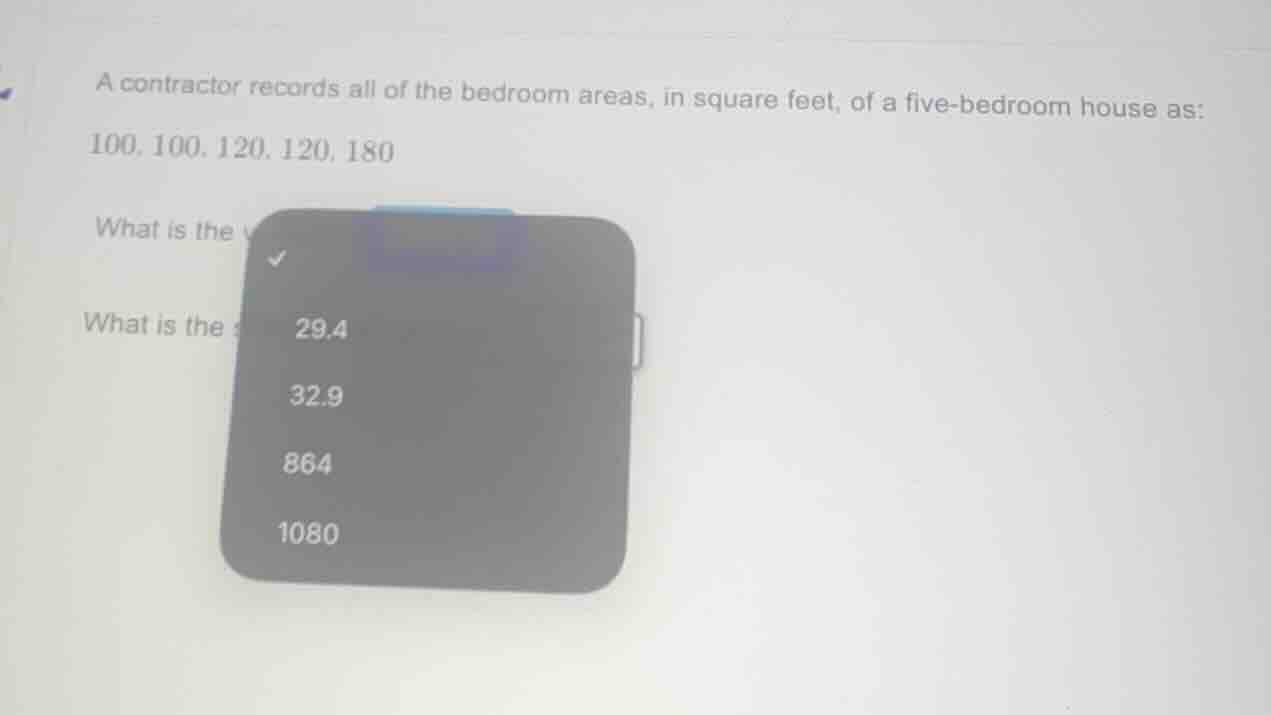
a contractor records all of the bedroom areas, in square feet, of a five - bedroom house as: 100, 100, 120, 120, 180
what is the
what is the
options: 29.4, 32.9, 864, 1080
Assuming the question is about the variance or standard deviation (since the options are 29.4, 32.9, 864, 1080 and we have data on bedroom areas), let's calculate the variance step - by - step.
Step 1: Calculate the mean ($\bar{x}$)
The data set is $x = [100, 100, 120, 120, 180]$. The number of data points $n = 5$.
The formula for the mean is $\bar{x}=\frac{\sum_{i = 1}^{n}x_{i}}{n}$.
$\sum_{i = 1}^{5}x_{i}=100 + 100+120 + 120+180=620$.
$\bar{x}=\frac{620}{5}=124$.
Step 2: Calculate the squared differences from the mean
For each data point $x_i$, calculate $(x_i-\bar{x})^2$:
- For $x_1 = 100$: $(100 - 124)^2=(- 24)^2 = 576$
- For $x_2 = 100$: $(100 - 124)^2=(-24)^2 = 576$
- For $x_3 = 120$: $(120 - 124)^2=(-4)^2 = 16$
- For $x_4 = 120$: $(120 - 124)^2=(-4)^2 = 16$
- For $x_5 = 180$: $(180 - 124)^2=(56)^2 = 3136$
Step 3: Calculate the sum of squared differences
$\sum_{i = 1}^{n}(x_i-\bar{x})^2=576 + 576+16 + 16+3136 = 4320$
Step 4: Calculate the variance ($s^2$)
The formula for the sample variance (if we consider this as a sample) is $s^2=\frac{\sum_{i = 1}^{n}(x_i - \bar{x})^2}{n - 1}$, and for the population variance is $\sigma^2=\frac{\sum_{i = 1}^{n}(x_i-\bar{x})^2}{n}$.
If we calculate the population variance: $\sigma^2=\frac{4320}{5}=864$.
If we calculate the sample variance: $s^2=\frac{4320}{4} = 1080$.
If we calculate the standard deviation, the population standard deviation $\sigma=\sqrt{864}\approx29.4$, and the sample standard deviation $s=\sqrt{1080}\approx32.9$.
If we assume the question is about the population variance, the answer is 864. If it is about the sample variance, the answer is 1080. If it is about the population standard deviation, the answer is 29.4, and if it is about the sample standard deviation, the answer is 32.9.
Since the problem statement is a bit unclear (the original question part is cut off), but based on the common analysis of such data (bedroom areas in a single house, so maybe population), if we consider variance:

Snap & solve any problem in the app
Get step-by-step solutions on Sovi AI
Photo-based solutions with guided steps
Explore more problems and detailed explanations
864