QUESTION IMAGE
Question
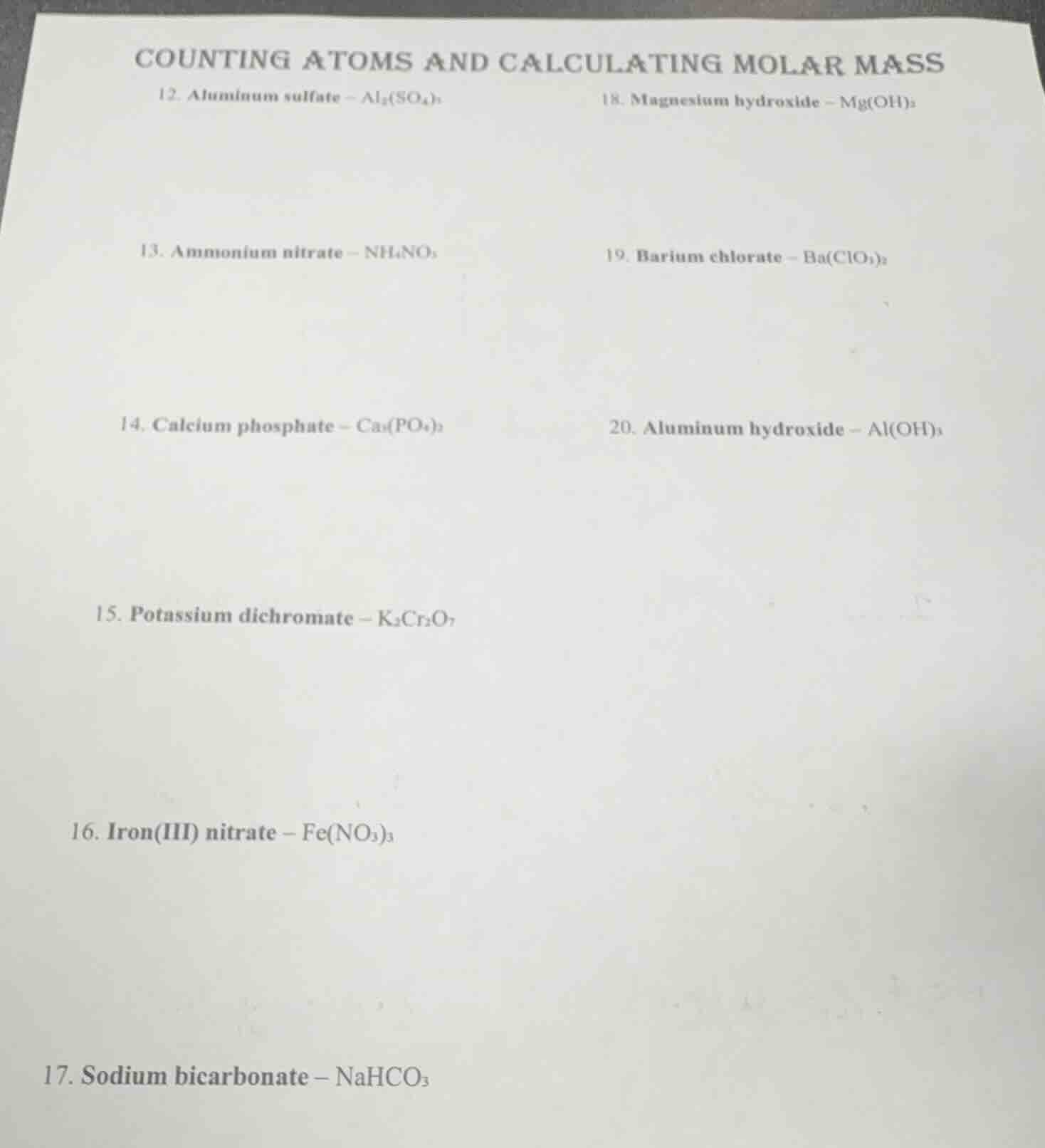
counting atoms and calculating molar mass
- aluminum sulfate - al₂(so₄)₃
- magnesium hydroxide - mg(oh)₂
- ammonium nitrate - nh₄no₃
- barium chlorate - ba(clo₃)₂
- calcium phosphate - ca₃(po₄)₂
- aluminum hydroxide - al(oh)₃
- potassium dichromate - k₂cr₂o₇
- iron(iii) nitrate - fe(no₃)₃
- sodium bicarbonate - nahco₃
Since the problem is about counting atoms and calculating molar mass, let's take an example, say problem 12: Aluminum sulfate - $\ce{Al2(SO4)3}$.
Step-by-Step Explanation for Counting Atoms in $\ce{Al2(SO4)3}$:
Step 1: Count Aluminum (Al) atoms
The subscript for Al is 2, so there are 2 Al atoms.
Step 2: Count Sulfur (S) atoms
In the sulfate group $\ce{SO4}$, the subscript for S is 1, and there are 3 sulfate groups (from the subscript 3 outside the parentheses). So number of S atoms = $1\times3 = 3$.
Step 3: Count Oxygen (O) atoms
In the sulfate group $\ce{SO4}$, the subscript for O is 4, and there are 3 sulfate groups. So number of O atoms = $4\times3 = 12$.
Step-by-Step Explanation for Calculating Molar Mass of $\ce{Al2(SO4)3}$:
Step 1: Find molar masses of each element
- Molar mass of Al: $26.98\ \text{g/mol}$
- Molar mass of S: $32.07\ \text{g/mol}$
- Molar mass of O: $16.00\ \text{g/mol}$
Step 2: Calculate mass contribution of each element
- For Al: $2\times26.98 = 53.96\ \text{g/mol}$
- For S: $3\times32.07 = 96.21\ \text{g/mol}$
- For O: $12\times16.00 = 192.00\ \text{g/mol}$
Step 3: Sum the contributions
Molar mass of $\ce{Al2(SO4)3}$ = $53.96 + 96.21 + 192.00 = 342.17\ \text{g/mol}$
If you want solutions for other compounds, follow a similar approach:
- For counting atoms: multiply the subscript of the atom inside the group by the subscript outside the parentheses (if there is a polyatomic ion in parentheses) and add the subscripts of individual atoms.
- For molar mass: multiply the molar mass of each element by its number of atoms (from counting) and sum them up.
For example, for problem 13: Ammonium nitrate - $\ce{NH4NO3}$
Counting Atoms:
- N: 2 (1 from $\ce{NH4}$ and 1 from $\ce{NO3}$)
- H: 4 (from $\ce{NH4}$)
- O: 3 (from $\ce{NO3}$)
Molar Mass Calculation:
- Molar mass of N: $14.01\ \text{g/mol}$, contribution: $2\times14.01 = 28.02\ \text{g/mol}$
- Molar mass of H: $1.008\ \text{g/mol}$, contribution: $4\times1.008 = 4.032\ \text{g/mol}$
- Molar mass of O: $16.00\ \text{g/mol}$, contribution: $3\times16.00 = 48.00\ \text{g/mol}$
- Molar mass of $\ce{NH4NO3}$ = $28.02 + 4.032 + 48.00 = 80.052\ \text{g/mol}$ (approx $80.05\ \text{g/mol}$)
You can apply the same method to all the given compounds.

Snap & solve any problem in the app
Get step-by-step solutions on Sovi AI
Photo-based solutions with guided steps
Explore more problems and detailed explanations
Since the problem is about counting atoms and calculating molar mass, let's take an example, say problem 12: Aluminum sulfate - $\ce{Al2(SO4)3}$.
Step-by-Step Explanation for Counting Atoms in $\ce{Al2(SO4)3}$:
Step 1: Count Aluminum (Al) atoms
The subscript for Al is 2, so there are 2 Al atoms.
Step 2: Count Sulfur (S) atoms
In the sulfate group $\ce{SO4}$, the subscript for S is 1, and there are 3 sulfate groups (from the subscript 3 outside the parentheses). So number of S atoms = $1\times3 = 3$.
Step 3: Count Oxygen (O) atoms
In the sulfate group $\ce{SO4}$, the subscript for O is 4, and there are 3 sulfate groups. So number of O atoms = $4\times3 = 12$.
Step-by-Step Explanation for Calculating Molar Mass of $\ce{Al2(SO4)3}$:
Step 1: Find molar masses of each element
- Molar mass of Al: $26.98\ \text{g/mol}$
- Molar mass of S: $32.07\ \text{g/mol}$
- Molar mass of O: $16.00\ \text{g/mol}$
Step 2: Calculate mass contribution of each element
- For Al: $2\times26.98 = 53.96\ \text{g/mol}$
- For S: $3\times32.07 = 96.21\ \text{g/mol}$
- For O: $12\times16.00 = 192.00\ \text{g/mol}$
Step 3: Sum the contributions
Molar mass of $\ce{Al2(SO4)3}$ = $53.96 + 96.21 + 192.00 = 342.17\ \text{g/mol}$
If you want solutions for other compounds, follow a similar approach:
- For counting atoms: multiply the subscript of the atom inside the group by the subscript outside the parentheses (if there is a polyatomic ion in parentheses) and add the subscripts of individual atoms.
- For molar mass: multiply the molar mass of each element by its number of atoms (from counting) and sum them up.
For example, for problem 13: Ammonium nitrate - $\ce{NH4NO3}$
Counting Atoms:
- N: 2 (1 from $\ce{NH4}$ and 1 from $\ce{NO3}$)
- H: 4 (from $\ce{NH4}$)
- O: 3 (from $\ce{NO3}$)
Molar Mass Calculation:
- Molar mass of N: $14.01\ \text{g/mol}$, contribution: $2\times14.01 = 28.02\ \text{g/mol}$
- Molar mass of H: $1.008\ \text{g/mol}$, contribution: $4\times1.008 = 4.032\ \text{g/mol}$
- Molar mass of O: $16.00\ \text{g/mol}$, contribution: $3\times16.00 = 48.00\ \text{g/mol}$
- Molar mass of $\ce{NH4NO3}$ = $28.02 + 4.032 + 48.00 = 80.052\ \text{g/mol}$ (approx $80.05\ \text{g/mol}$)
You can apply the same method to all the given compounds.