QUESTION IMAGE
Question
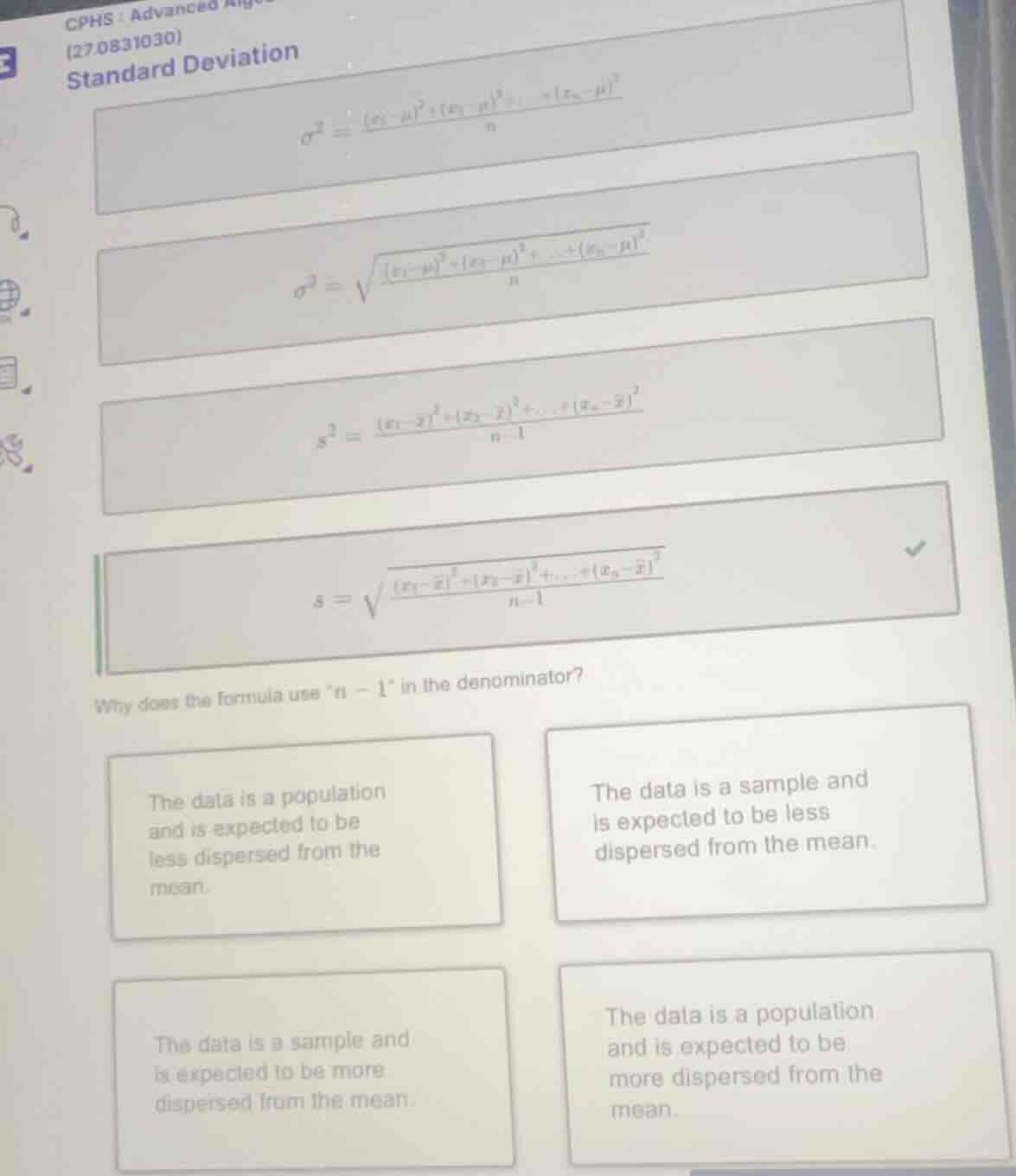
cphs : advanced (270831030)
standard deviation
$\sigma^2 = \frac{(x_1 - \mu)^2 + (x_2 - \mu)^2 + \dots + (x_n - \mu)^2}{n}$
$\sigma = \sqrt{\frac{(x_1 - \mu)^2 + (x_2 - \mu)^2 + \dots + (x_n - \mu)^2}{n}}$
$s^2 = \frac{(x_1 - \bar{x})^2 + (x_2 - \bar{x})^2 + \dots + (x_n - \bar{x})^2}{n - 1}$
$s = \sqrt{\frac{(x_1 - \bar{x})^2 + (x_2 - \bar{x})^2 + \dots + (x_n - \bar{x})^2}{n - 1}}$
why does the formula use \$n - 1$\ in the denominator?
the data is a population and is expected to be less dispersed from the mean.
the data is a sample and is expected to be less dispersed from the mean.
the data is a sample and is expected to be more dispersed from the mean.
the data is a population and is expected to be more dispersed from the mean.
The formula with \( n - 1 \) in the denominator is for the sample standard deviation (\( s \)) or sample variance (\( s^2 \)). When dealing with a sample (a subset of a population), using \( n - 1 \) (Bessel's correction) adjusts for the fact that sample data tends to underestimate the population's variability. So, the sample data is expected to be less dispersed from the sample mean (\( \bar{x} \)) than the population data from the population mean (\( \mu \)), and \( n - 1 \) corrects for this underestimation. The option "The data is a sample and is expected to be less dispersed from the mean" matches this concept.

Snap & solve any problem in the app
Get step-by-step solutions on Sovi AI
Photo-based solutions with guided steps
Explore more problems and detailed explanations
The data is a sample and is expected to be less dispersed from the mean.